
India's Changing Ethics
Jagdish Sheth, center, chats with conference participantsThe 20th century was driven by governments in advanced nations, but the 21st will be dominated by free market economies in emerging nations. Jagdish Sheth, executive director of the India, China and America Institute and a professor of marketing at Emory University, made this point in his address to the Markkula Center for Applied Ethics’ fourth biennial business ethics conference on March 9. The topic of the conference was Business Ethics in a Global World, with a focus on China and India.
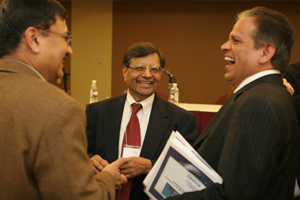
Jagdish Sheth, center, chats with conference participants
The collapse of Communism is one of four forces that are driving the shift from the 20th century global business model to the 21st, Sheth said. He argued that the best capitalistic countries are former Communist countries, such as China: Communism imposed discipline on citizens, created greater gender equality and invested heavily in technical education.
Another driving force is that affluent nations are aging, and their traditional industries will not generate as many jobs in the future. Even in the U.S., which is not aging as fast as other affluent countries, General Motors stands as an example of a company that is hiring only one new employee for every eight who retire.
In addition, economic pragmatism means those in power have discovered economics’ crucial role in elections. Sheth cited the fall of George Bush Sr., who went from being wildly popular to losing his re-election bid when the economy faltered.
Finally, Sheth cited the idea that “the world is flat”: the IT revolution has leveled the playing field between emerging and advanced economies.
And so Sheth forecast that the world is moving from the 1800s, which were the European century, and the 1900s, which were the American century, into the Asian century. He noted that Asian countries are trading with each other, and said both China and India are poised to become innovative economies, not just locations for low-end jobs. This shift will redefine business practices.
Sheth discussed several ways in which Indian business practices are unique – and may give rise to ethical behavior that may or may not be compatible with the prevailing Western viewpoint.
Indian business culture, he said, puts a premium on favors, friendship and clanship. Friendship is highly valued, whether based on multigenerational family friendships, school friendships or personal friendships. The Western concept of conflict of interest, he said, does not always mesh well with the Indian value of loyalty to one’s group.
Sheth noted that Western business has its own versions of these ideas: Procurement departments in U.S. companies are more likely to buy from the company’s customers, for example.
In terms of government rules and regulations, Sheth said that in India, the government acts as a gatekeeper rather than an enabler, with slow approval, a complex bureaucracy and corruption. Enforcement is also lax.
There is a strong belief in corporate social responsibility in India, Sheth said. He also noted how Indian management style differs from that in the West: Decisions are made by the person at the top, not in a participatory way. And there is what he called a caste system by education.
What are the implications of these differences – and of India’s rise – for business ethics? Sheth cited, among other ideas, a shift from a focus on shareholders to a focus on stakeholders. He predicted that ethics will be anchored to the idea of business as a profession, similar to the way the field of medicine is now. And he said there will be global standards of governance, but their application will be adapted to local conditions.
Margaret Steen is a freelance author
March 2007