
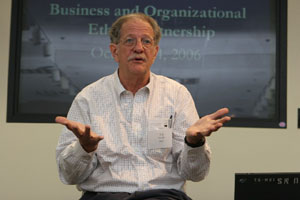
It’s no longer your daddy’s workplace—or your momma’s either—acknowledged Edward E. Lawler, III, in his talk “The Transformation of Work” at a recent meeting of the Business and Organizational Ethics Partnership. The director of the University of Southern California’s Center for Effective Organizations highlighted some of the findings from his book The New American Workplace, (Palgrave-Macmillan, 2006) co-authored with James O’Toole.
The book is a follow-up to O’Toole’s look at employment in the 1970s, which he chronicled in Work in America. That book focused on the actual tasks people did and how those impacted their health and wellbeing.
“The [earlier] book was very critical of a lot of the work that we had in the United States, in the sense that it was repetitive, boring, provided people with little opportunity for personal growth and development, and in some cases was simply unsafe. But the emphasis was not so much on the physical safety issue; it was more on the mental health of the country and the well-being of the people because of the conditions that they faced,” Lawler explained.
With funding from the Society for Human Resource Management, Lawler and O’Toole took another analytical look at the workplace, contrasting it with what O’Toole had found 30 years previously. “What was most dramatic to both of us was how many of the key issues today were unanticipated in the 1970s and just how different the workplace is today from one in the 1970s,” Lawler noted.
They organized the book around changes, consequences, and choices. Key changes over the past three decades included dramatic organizational and economic shifts. Businesses are more global and more competitive. Information technology unimagined in the ‘70s pervades businesses today. And the bulk of jobs in the United States has moved from manufacturing to service and other kinds of knowledge work. “[Now there’s] a very different set of issues around who owns companies, what they are about, what kind of work they create, what kind of work processes they have, what kind of technology they have,” he said.
Lawler and O’Toole then looked at those changes in terms of consequences for the worker and uncovered some surprises. “People are more satisfied with their jobs today than they were in the ‘70s—a little surprising, given all that you hear about work-life balance,” Lawler said, “but sensible, if you look at the nature of the work itself. People have more discretion today. They need more knowledge and skills to do [their work]. They get better feedback in many respects about the nature of their work and what’s going on. They have many more choices in terms of where they work, how they work, how long they work, what kind of career they can pursue. So maybe it’s not so surprising.”
Their analysis revealed two groups in particular whose satisfaction has increased significantly: women and CEOs. Women have significantly narrowed the gender gap in the last three decades in terms of salaries and access to high-level positions in corporations. Females are reaching parity in business schools and exceed male enrollment in some degree programs. As for CEOs, they have enjoyed a dramatic leap in compensation from the ‘70s. “Compensation has gone from wherever you want to start—30-1, 60-1—to 600-1, not to mention private jets and all kinds of other stuff that makes their life better. So they’re clearly winners,” he said.
Education is increasingly defining those winners. As the United States moves from a manufacturing economy to a knowledge and service economy, people who lack a high school degree (and in many cases a college degree), are “in trouble,” Lawler warned, and the trend in the past two to three years have become even more apparent. “It’s very clear from the ‘70s to today that the bottom 5-10 percent of the population typically does not have a high school degree and has lost purchasing power relative to the rest of the population, even relative to inflation.”
The transformation of the American workplace has resulted in more choices for the typical worker. “People today have enormously more choices than they had in the ‘70s—many different kinds of jobs, many more educational opportunities, etc.—but what’s very clear is that the risks have gone up enormously,” Lawler said. “Individuals have many more choices to make, but it’s not entirely clear that they’re well-equipped to make those choices. They have to make choices about career, continuing education, retirement funding, medical.”
Essentially, he said, today’s workers have to build their own brands as employees, diagnosing what are good organizations to work for, what kind of career tracks to pursue. “We make a fairly strong case that individuals have to increasingly think of themselves as self-employed, whether they’re working for IBM, or H-P or anybody,” he said.
Corporations, too, have choices. One of those involves management style. Lawler identified three styles: the traditional, bureaucratic manager; the low-cost operator; and the global competitor. “We make the argument that in a lot of industries, the Wal-Mart strategy—the low cost, low wages, poor benefits—may not be the best economic strategy, even though it has the allure of being able to provide low prices,” Lawler said.
Instead Lawler said he and O’Toole found organizations that were competing successfully with both the low-cost and traditional models using the global competitor approach. “They are clearly dependent on their human capital for their effectiveness,” he said. They reject the low-cost operator model, instead adopting a “mixed strategy toward their human capital. They probably have a core group of employees who are the technology leaders and senior executives, who have a relatively strong attachment to the organization.”
Surrounding them are contractors, who have no long-term attachment to the company. “Many of them are quite happy with that. They see that as a great option. They don’t have corporate politics,” he said.
“But in between the contractors and this core group are a whole bunch of people who have a new employment contract, if you will, which is: we expect you to be really loyal to us in a sort of serial monogamy relationship. As long as we want you, we want you to work hard, be loyal etc., but realize that it could end at any time. If your performance slips, if we decide to bow out of the business, if we decide to move your job to Indonesia, you’re gone. There’s no safety net, there’s nothing. You just better be ready. And we’ll make that decision based on the economics of the business and where we think the business is going to go, not based on concern for you. They don’t say it that way, but that’s the reality,” Lawler explained.
Finally, the new American workplace means many choices for the government as well. Should it step up a single-payer healthcare plan, removing it as a workplace issue? “Our current health service situation not only doesn’t serve most of the people, it doesn’t serve the competitive necessities of the American corporation,” Lawler said.
And the government should play a leading role in continuing education as well, he added. “We strongly argue that government needs to be more active in continuing education for people who are laid off or displaced by off-shoring of work, and also in situations just where technology may have somehow [changed their jobs],” he said. “We need to invest in education that will keep people current with technology. Obviously, giving money to universities is a great way to do that, creating programs at universities that both create technological breakthroughs that can keep the US economy growing and educate people in those economies.”
Overall, whether the changes in today’s workplace are positive or negative depends on one’s perspective, Lawler concluded. The data suggest that people report more pressure to work and be productive than ever before. Americans take fewer vacations and work longer hours than in any other developed country.
“You can look at that as a disaster: here's a stressed-out, work-obsessed nation. It's got all sorts of psychotic, neurotic people who are having terrible lives,” Lawler said. “Or you can look at it and say, ‘Wow! These people really enjoy work. It's exciting! It's interesting! It's rewarding! It's fulfilling! They have good friends there. They meet challenging problems. They're upgrading their knowledge and their skills all the time. What a wonderful world!’”
Anne Federwisch is a freelance journalist. Edward Lawler is Distinguished Professor of Business at the USC Marshall School of Business.