Dear Colleagues,
This time of year is always filled with activities and celebrations, even as the work of teaching and closing out the academic year continues.
Next week, on May 20, we host our annual DeNardo Lecture featuring guest speaker Carolyn Bertozzi, the 2022 Nobel Prize Laureate in Chemistry. Carolyn joins us from Stanford University and will be discussing her cutting-edge research in a talk entitled “Sweet Revenge on Cancer.” We are privileged to welcome such a highly accomplished researcher, academic, and scientist, and I hope you will make time to attend the lecture either in-person or via livestream.
I would like to extend my congratulations to Lee Panich, from Anthropology, who has been named as the Fay Boyle Professor, an endowed chair position. Lee will assume the title on Sept. 1, following the retirement of Enrique Pumar, who is the current endowed chair. Lee’s appointment recognizes his valuable scholarly expertise in indigenous culture and indigenous-colonial interactions in the Americas, and celebrates his excellent teaching and service to the College.
I would also like to acknowledge the members of our faculty who have earned rank and tenure promotions as announced earlier this week by President Sullivan. Promotions in any field are important, but they are particularly meaningful in academia, where the process of review is lengthy and exceptionally thorough.
Promotion to the Rank of Professor
- Paul Abbyad, Chemistry and Biochemistry
- Chris Bacon, Environmental Studies and Sciences
- Jimia Boutouba, Modern Languages and Literatures
- Greg Corning, Political Science
- Sharmila Lodhia, Gender and Sexuality Studies
- Amy Lueck, English
- Paul Mariani, S.J., History
- Takeshi Moro, Art and Art History
- Harry Odamtten, History
- Erick Ramirez, Philosophy
- Nicholas Tran, Mathematics and Computer Science
Awarded Tenure and Promotion to the Rank of Associate Professor
- Lang Chen, Psychology
- Laura Cocas, Biology
- Di Di, Sociology
- Jesica Fernández, Ethnic Studies
- Shiva Houshmand, Mathematics and Computer Science
- Molly King, Sociology
- Heather Turner, English
Promotion to the Rank of Teaching Professor
- Linda Burks, Mathematics and Computer Science
Here in mid-May, we lie between Mother’s Day and Father’s Day, so I offer a parent’s poem by Major Jackson, a poet who teaches at Vanderbilt.
Sincerely,
Daniel
The Nature of Memory
By Major Jackson
Once again I am trying to fall into the light,
twice-broken and knife-scarred, recalling my children
on Long Beach Island, loose sand in Anastasia’s dreads,
Langston holding a red plastic shovel
in one hand and the swordlike tail
of a horseshoe crab in another,
shorebirds winging above their heads.
If there is another world,
a poet struggles to describe ocean mist
dissipating over a young father,
distant and lonely, watching
his children’s laughter run into the sea
then explode at the edge of the world.
What is my life but a constant entering
into a dizzying churn of days
ping-ponging like numbered balls
in a glass air machine?
Then, as now, like all of us, I was brought here
through a clumsy series of human foibles
and thus am conditioned to read
the undersides of storms edging up a coast.
Someday they too will push down far enough
and learn to unfold the minutes and hours into
one long continuous wave. For now,
I hope they love themselves loud as that day,
light-drunk, kicking up sand.
Highlights
The Department of Physics has changed its name to the Department of Physics and Engineering Physics. This change better reflects the Department’s scholarship, teaching, and service contributions to Santa Clara University and clarifies that two important and distinct majors, physics and engineering physics (EP), are offered. Established at SCU nearly 50 years ago, the EP major emphasizes, to a greater extent than the traditional engineering major, the fundamental physics and modern scientific developments that are applicable to new technologies as well as to the more established ones. The course code will remain PHYS.
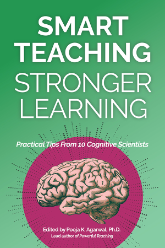
Michelle Rivers (Psychology) was one of ten cognitive scientists featured in a new book, Smart Teaching, Stronger Learning. The book is an approachable resource for teaching that distills key principles from the science of learning, with concise chapters and real-world examples for busy educators and leaders in K–12, higher education, and beyond.
Learn more about the techniques that Michelle discusses in the book in a recent "Cult of Pedagogy" podcast episode, "Retrieval in Action: Creative Strategies from Real Teachers."
 2025 Knowledge Exchange: Learning from each other's projects. 2025 Knowledge Exchange: Learning from each other's projects.
On April 9, Iris Stewart-Frey (Environmental Studies and Sciences, Environmental Justice and the Common Good Initiative), together with other leaders from the Water and Climate Justice Lab, organized a knowledge exchange across students and faculty environmental justice research in Environmental Science and Civil, Environmental, and Sustainable Engineering (CESE). Participating faculty included Ed Maurer (CESE), Allan Baez Morales (Frugal Innovation Hub), Aria Amirbahman (CESE), Rocio Segura (CESE), Qiuwen Li (Art and Art History), Will Rush (ESS), David DeCosse (Markkula Center for Applied Ethics), and Maia Dedrick (Anthropology). Undergraduate student presenters were Dana Johnson '25 (Civil Engineering), Karina Martin '25 (Civil Engineering), Arturo Torres Torres Landa '26 (Computer Science, Mathematics), Elyse Kenyon '25 (Environmental Science), William Alexander '26 (Environmental Science), Bri Guingona '25 (Environmental Studies), Ellie Henrich '25 (Environmental Science), and Jessica Garofalo '25 (Environmental Science).
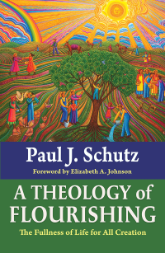
Paul J. Schutz (Religious Studies) published A Theology of Flourishing: The Fullness of Life for All Creation (Orbis Books). From the publisher: "Proposing a groundbreaking theological approach to what it means to truly thrive, the book reframes Christian thought around the concept of abundant life for all of creation. Drawing from scripture, tradition, and contemporary theology, the book argues that flourishing is God’s fundamental intention for the universe. Suitable for students and scholars alike, this timely work confronts modern crises of injustice, inequality, and ecological destruction while constructing a fresh, hope-filled vision of Christian life for the well-being of all."
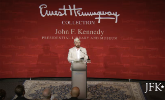
Miah Jeffra (English) has been awarded an artist residency from the UCross Foundation. The mission of Ucross Foundation is to foster the creative spirit of deeply committed artists and groups by providing uninterrupted time, studio space, living accommodations, and the experience of the majestic Wyoming High Plains on its historic 20,000-acre ranch. Previous recipients include Colson Whitehead, Annie Proulx, Ha Jin, and Joy Harjo.
Image: Miah Jeffra reading at the JFK Presidential Library.
At the annual conference of the American Association of Teachers of Italian (AATI) held April 25-27 at Princeton University, Marie Bertola (Modern Languages and Literatures) and Evelyn Ferraro (Modern Languages and Literatures) presented at the panel "Advocacy in Italian Studies: Relevance of Italian Studies in Optimizing Students’ Professional Development and Career Prospects." Their presentation highlighted a variety of innovative curricular initiatives that have been shaping career pathways through the Italian Studies program since 2016. A key focus was the newly developed Italian internship course, which connects language proficiency with real-world career skills. The course provides students with the opportunity to apply their Italian in professional settings, combining their language abilities with insights from Italian Studies and intercultural communication. By linking language and cultural study to career preparation, the course aims to make Italian more relevant in today’s global market, helping students use their language skills in practical, career-focused ways. The presentation also covered the challenges of incorporating career development into language programs.
Hsin-hung (Sean) Yeh (Modern Languages and Literatures) was invited by the Department of East Asian Languages and Cultures at UC Berkeley to deliver a talk titled “Navigating Challenges and Innovations in the L2 Taiwanese Online Classroom.” Presented on March 14 at the EALC Library in Dwinelle Hall, the talk explored the unique pedagogical challenges of teaching L2 Taiwanese in a digital setting and highlighted innovative strategies designed to enhance accessibility, inclusivity, and student engagement.
Sean demonstrated how inclusive teaching practices and digital tools are integrated to build interactive and supportive online learning environments that accommodate students from diverse cultural and linguistic backgrounds. He also emphasized the importance of learning objectives and backward design in crafting structured, scaffolded, and meaningful learning activities. By sharing practical applications and lesson design approaches, Sean offered valuable insights for making the teaching of less commonly taught languages more effective and inclusive in today’s digital classrooms.
Christine Wieseler (Philosophy) gave a presentation and co-facilitated a workshop on teaching at the American Philosophical Association-Pacific Division meeting in San Francisco on April 18.
The presentation, “Medical Gaslighting and the Limitations of ‘Mutual Distrust’ between Patients and Physicians,” challenged Barnes’ suggestion that the term “medical gaslighting” has unclear explanatory value and may contribute to harm without any benefit that would outweigh this risk. Christine contended that Barnes’ analysis under-appreciates the harm of experiencing medical gaslighting as well as the benefits of having a way to articulate that harm. Barnes advocates "mutual distrust" between physicians and patients. In contrast, this presentation argued that we need a greater emphasis on trustworthy physicians and institutions, not less.
The workshop (co-facilitated with Alison Reiheld from Southern Illinois University, Edwardsville), "Dealing with Bias in Case Studies and Thought Experiments: An Underexamined Issue in Teaching Applied Ethics," guided participants through analysis of case studies and thought experiments in order to identify biases. The workshop focused on how case choice and construction impact students' moral reasoning and how to create better case studies.
Nathan Lackey (Philosophy) authored a paper entitled “We Are Missing Multiple Model Integration in the Psychology of Implicit Bias” in Topoi: An International Review of Philosophy.
In this paper, Nathan argues that scientific models of implicit bias generally fall into one of two categories: individualistic or situationist. The former abstract away (or omit) environmental features from the system of interest and locate the phenomenon in the mind of the individual. However, new models of prejudicial attitudes have foregrounded just those features abstracted away in preceding models. These conceptualizations of attitudes foreground situations. The scientists that posit them claim that measures of implicit bias are better understood as measures of places as opposed to people, for example.
These categories of models have very different implications for intervention strategies aimed at reducing the impact of implicit biases. In this paper, he draws on philosophical insights from the philosophy of science to advocate for an integration of these models. The desiderata he provides asks researchers to clarify how citizens and policymakers ought to proceed given the plurality of diverse models. Should interventions at the individual level or structural level be prioritized? This issue has important consequences for achieving egalitarian goals in contemporary society.
 The Plague Archives artist Maya Gurantz with students in Sonja Mackenzie's Public Health Senior Capstone class and Craig Stephens (Biology, Public Health) and Matthew Newsom Kerr's Difficult Dialogues: Infectious Disease and Human Society class. The Plague Archives artist Maya Gurantz with students in Sonja Mackenzie's Public Health Senior Capstone class and Craig Stephens (Biology, Public Health) and Matthew Newsom Kerr's Difficult Dialogues: Infectious Disease and Human Society class.
The Public Health and History Departments, in collaboration with the de Saisset Museum and the Center for Arts and Humanities, welcomed artist Maya Gurantz to campus for a two-day engagement with The Plague Archives, Gurantz's exhibit currently on display at the de Saisset. Sonja Mackenzie (Public Health), Matthew Newsom Kerr (History) and Maya Gurantz brought the contemporary relevance of Public Health and History into dialogue through visual inquiry on recent histories of HIV/AIDS activism and historical contexts of vaccination and disease on a panel, "Reimagining Public Health Futures and Histories." Students and faculty had a dynamic set of discussions in classroom visits, including Public Health Senior Capstone students, who worked with Maya to consider the impact of history and visual representation as they collect a contemporary archive of stories of people experiencing homelessness in Silicon Valley. The Plague Archives is curated by Ciara Ennis (Art and Art History), director of the de Saisset Museum, and is on display through June 14. Come and visit The Plague Archives satellite exhibit with Public Health Public Service Announcements in the Public Health office, Alumni Science 259.
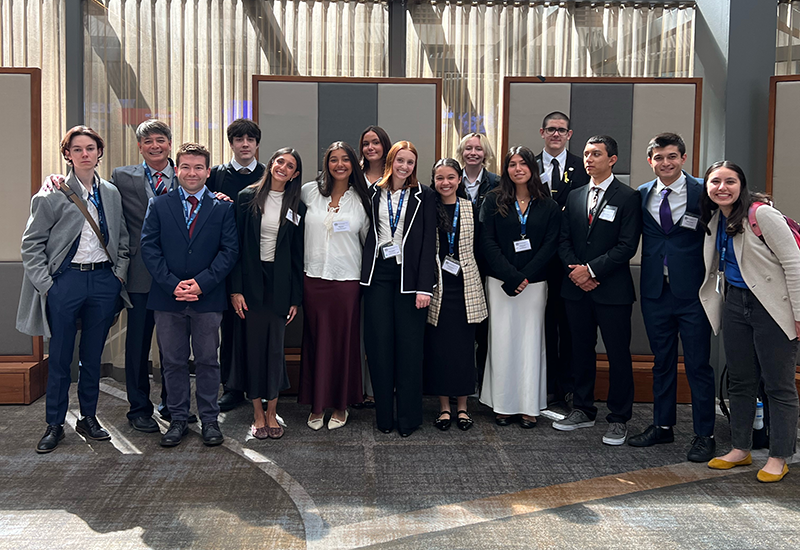 2025 MUNFW Conference attendees. (l-r) Christian Barnard ’26 (Political Science, Theatre Arts), Kenneth Faulve-Montojo (Political Science), Liam Putnam ’26 (Political Science), Evan Clegg ’28 (Political Science), Laura da Costa Locatelli, Bella Rene ’27 (Public Health Science), Leah Jannetti, Jade Haddad ’26 (Political Science, Philosophy), Rachel Alonzo '28 (Political Science), Timothy Sinnott ’26 (Individual Studies), Sofia Parodi ’28 (Economics, Political Science), Itay Volk, Xavier Vegas ’28 (Political Science, History), Mateo Coulson ’28 (Political Science), Nikki Azar ’28 (Political Science). Not pictured Ariana Yamasaki and Huxley Murray ’25 (Political Science). 2025 MUNFW Conference attendees. (l-r) Christian Barnard ’26 (Political Science, Theatre Arts), Kenneth Faulve-Montojo (Political Science), Liam Putnam ’26 (Political Science), Evan Clegg ’28 (Political Science), Laura da Costa Locatelli, Bella Rene ’27 (Public Health Science), Leah Jannetti, Jade Haddad ’26 (Political Science, Philosophy), Rachel Alonzo '28 (Political Science), Timothy Sinnott ’26 (Individual Studies), Sofia Parodi ’28 (Economics, Political Science), Itay Volk, Xavier Vegas ’28 (Political Science, History), Mateo Coulson ’28 (Political Science), Nikki Azar ’28 (Political Science). Not pictured Ariana Yamasaki and Huxley Murray ’25 (Political Science).
This year’s Model United Nations Far West (MUNFW) Conference was held April 11-15. The SCU delegation represented Cameroon, France, Morocco, and Peru. This year’s delegates made their presence felt at the conference. Ariana Yamasaki ’25 (Political Science, Philosophy) co-chaired the Committee on the Status of Women, which went on to receive the Michael McBride Outstanding Resolution Certificate. Laura da Costa Locatelli ’27 (Political Science, Psychology) earned the Planczka Achievement Certificate for the Art and Practice of Diplomacy. In addition, Itay Volk ’28 (Computer Science and Engineering) was selected to co-chair next year’s United Nations High Commission for Refugees and as Student Representative to MUNFW executive board for the 2025-26 session. Finally, Leah Jannetti ’25 (Political Science), representing France on the United Nations Security Council, had a significant hand in shaping a key resolution toward UN Security Council reform. Like previous years, the 2025 SCU MUN was generously funded and sponsored by the Political Science Department, the College of Arts and Sciences, and the Registered Student Organization.
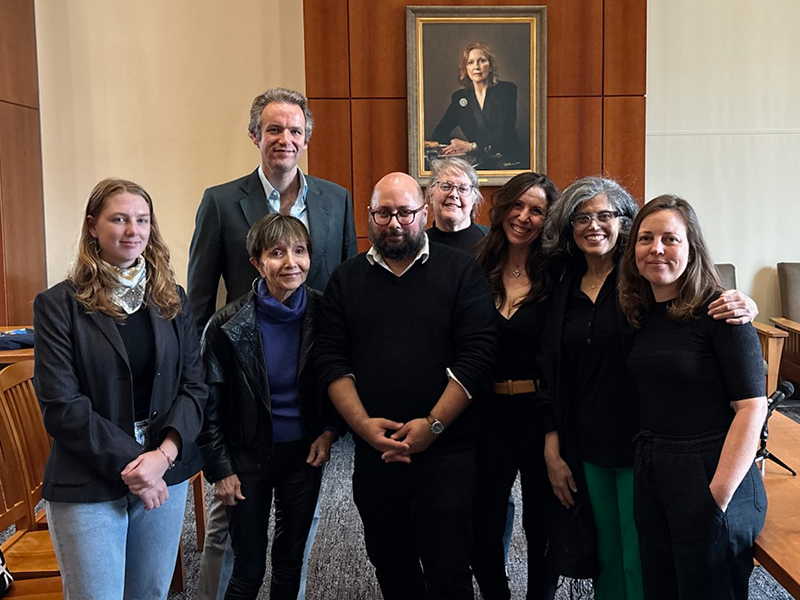 Louise Le Cam (left) and David Do Paço (center) from the French Embassy with the French and Francophone Studies faculty (Catherine Montfort, Jeffrey Burkholder, Jimia Boutouba, Lamia Benyoussef, and Keziah Poole) and their Academic Department Manager, Kari Craighead. Louise Le Cam (left) and David Do Paço (center) from the French Embassy with the French and Francophone Studies faculty (Catherine Montfort, Jeffrey Burkholder, Jimia Boutouba, Lamia Benyoussef, and Keziah Poole) and their Academic Department Manager, Kari Craighead.
On April 24, the French and Francophone Studies program welcomed David Do Paço, a French diplomat currently serving as the Attaché for Academic Cooperation in San Francisco with the cultural services of the French Embassy (Villa Albertine). An accomplished scholar with expertise in historical anthropology, urban studies, diaspora studies, diplomatic history, food history, and the history of gender and sexuality, Dr. Do Paço led a series of discussions—with students in the classroom, with faculty and administrators, and in a plenary session—on the history and political stakes of Muslims in Europe throughout the modern period. These conversations explored, among other topics, the largely unrecognized role Muslims have played in shaping modern European history. The talk and ensuing Q&A were wide-ranging and addressed many of the key dynamics that continue to shape our societies today. The event was well attended, bringing together students, staff, faculty, and the broader SCU community. It was generously sponsored by the Department of Modern Languages and Literatures, the Department of Classics, the Department of History, the Department of Political Science, and the Office for Diversity and Inclusion.
Tom Plante (Psychology) was awarded the Pope John Paul II Research and Academic Excellence Award from the Catholic Psychotherapy Association at their annual national convention in Philadelphia, Pennsylvania on May 1.
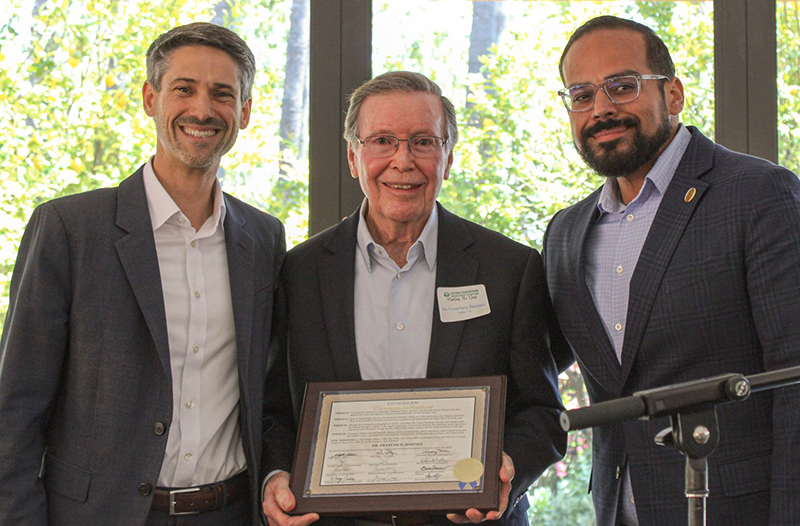 Matt Mahan, Mayor of the City of San José, Francisco Jiménez, and Peter Ortiz, Councilman of the City of San José. Matt Mahan, Mayor of the City of San José, Francisco Jiménez, and Peter Ortiz, Councilman of the City of San José.
Francisco Jiménez (Modern Languages and Literatures, Emeritus) was honored with the 2025 Jorge Escobar Achievement in Education Award by the Latino Education Advancement Foundation (LEAF) “for his compassionate leadership and lifelong impact on students, education, and the community.” In addition, Francisco received a Congressional Resolution from Congresswoman Zoe Lofgren, honoring a legacy "reflected in the lives he has touched, the stories he has told, and the institution that bears his name.” He was also presented with a Commendation from Mayor Matt Mahan and the San José City Council “for his lifelong contributions to literature, education, and the empowerment of immigrant communities across the nation.” These recognitions were presented during the Planting the Seed Annual Luncheon held at the Mexican Heritage Plaza in San José on May 2.
On May 8, he gave a special presentation to students and teachers from Faith Christian Academy, who traveled from Coalinga to meet him after reading his books The Circuit, Breaking Through, and Reaching Out in preparation for the visit.
Earlier in the spring, on April 26, Jiménez gave an author talk at the Santa Clara Central Park Library to celebrate adult learners, their tutors, and program donors. His presentation emphasized the importance of literacy and was followed by a Q&A session and book signing.
College of Arts and Sciences Calendar
|
|
Class of 2025 - Studio Art Senior Show
All Day | Edward M. Dowd Art and Art History Building
Through June 13
Graduating seniors in the Studio Art Program exhibit their capstone projects. Opening Reception: May 16, 5 p.m., Dowd Lobby. |
|
|
Faculty Writing Retreat
9 a.m. - 4 p.m. | Varsi 222
Faculty Development provides a quiet, focused space for your writing. Bring your projects and anything else you might need for the day. Feel free to drop in and out as your schedule allows. Light lunch and snacks are provided. |
|
|
19th Annual Art History Symposium
3:30 - 5 p.m. | Edward M. Dowd Art and Art History Building
The annual Art History Student Research Symposium provides students with an opportunity to present their research in a formal setting and format modeled after a professional conference. The Symposium is held in the Art and Art History gallery and draws a large audience from across the Santa Clara University community. Topics reflect student interests in a range of media from areas across the world, from the ancient period to the present. |
|
|
overhead, a skylark called
8 p.m. | Across campus
Also May 17 at 8 p.m. and May 18 at 2 p.m.
What do you call home? Travel across campus and through worlds as you explore this question in a new devised dance-theater piece created by Sinatra Chair Brian Thorstenson (Theatre and Dance) in partnership with Visiting Artists-in-Residence, Detour Productions. Visit SCU Presents for tickets. |
|
|
Is the world going to hell in a handbasket? What you can do to manage the stress and anxiety of current times
11:45 a.m. - 12:45 p.m. | Williman Room
Given current economic disparities, the loneliness epidemic, social media deception, global disasters, political corruption, and more, Tom Plante (Psychology) will discuss what you can do to better manage the stress and anxiety of current times in this stress management workshop. |
|
|
Faculty Office Hours
Various times | Varsi 218 (Weekly through June 2025)
You can get personalized support and feedback about your teaching materials, course design, and more by connecting with one of our Faculty Associates at their new weekly Office Hours. No need to RSVP, just show up with your questions!
Mondays
1-2 p.m. Instructional Technology
2:30-3:30 p.m. C.J. Gabbe (Environmental Studies and Sciences): syllabus design, assignment design, and community-based learning.
Wednesdays
Noon-1 p.m. Patti Simone (Psychology/Neuroscience): advising, FAR, inclusive teaching, promotions.
|
|
|
World Poetry Reading
4:30 - 6 p.m. | Kenna Hall, Room 102
The Arabic, Islamic, and Middle Eastern Studies (AIMES) program and the Department of Modern Languages and Literatures invite you to come and read a poem in a language of your choice. |
|
|
The Student Conversation: My Insider/Outsider Experience in Science
1:10 - 2:10 p.m. | Lucas Hall 126
In its 123-year history, the Nobel Prize in Chemistry has been awarded 116 times. Surprisingly, only eight female chemists have been recognized. Against this traditional backdrop, the groundbreaking achievement of Carolyn Bertozzi, 2025 Gerald and Sally DeNardo Lecturer and esteemed Professor at Stanford University, cannot be overstated. |
|
|
Meet and Greet Poster Session: Gerald and Sally DeNardo Lectureship
2:30 - 4 p.m. | SCDI North Lobby
Natural and social science students and faculty share their research findings with the broader SCU community in this informal multidisciplinary poster session and meet and greet with DeNardo Speaker, Carolyn Bertozzi, Ph.D., Nobel Prize Laureate in Chemistry 2022. |
|
|
Gerald and Sally DeNardo Lectureship: Sweet Revenge on Cancer
7:30 p.m. | Music Recital Hall
Carolyn Bertozzi, Ph.D., Anne T. and Robert M. Bass Professor of Chemistry at Stanford University, Nobel Prize Laureate in Chemistry in 2022, will discuss developing a new kind of cancer immune therapy that functions as a “lawnmower,” cutting the disease sugars off of cancer cells so that the immune system can recognize them as diseased and kill them. |
|
|
CAFE: Engaging Students in the Classroom-Strategies for Reducing Screen Time and Increasing Eye Contact
11:45 a.m. - 12:45 p.m.| Varsi 222
Discover effective strategies to enhance student engagement while minimizing screen use in the classroom. Learn how to create a more interactive learning environment, increase eye contact, and foster deeper connections with your students. |
|
|
Music@Noon: The MANA Quartet
Noon - 1 p.m. | Music Recital Hall
Called a “groundbreaking ensemble” by the Los Angeles Chronicle, the San Francisco Bay Area-based MANA Quartet has repeatedly won high praise from today’s leading composers and audiences. |
|
|
Zen Meditations
5 p.m. | Multifaith Sanctuary, St. Joseph Hall
Let go of your day and prepare for the evening by stretching, de-stressing, calming the body, and soothing the mind. We start each session with a de-stress guided meditation and transition to silent sitting and walking meditation. All are welcome! Led by Sarita Tamayo-Moraga (Religious Studies). |
|
|
Chamber Music Concert
7:30 p.m. | Music Recital Hall
Join the SCU string, wind, and percussion students for an unforgettable evening of live chamber music. Visit SCU Presents for tickets. |
Got IT Questions or Issues?
Stop by the virtual IT drop-in sessions with Charles Deleon! These sessions are designed to provide faculty and staff in the College of Arts and Sciences a friendly and casual setting for addressing general IT questions and concerns. Feel free to drop in and out at any time during the scheduled session, whether you have a quick question, need assistance with something and don't know where to start, or simply want to learn more about our IT resources.
Biweekly. Next session: Friday, May 23, 11:30 a.m. - 12:30 p.m.
Zoom link
|
|
A Theology of Flourishing: The Fullness of Life for All Creation
4 - 5:30 PM | Williman Room, Benson Memorial Center
Join the Bannan Forum for a book launch featuring Paul Schutz (Religious Studies) as he proposes a groundbreaking theological approach to what it means to truly thrive. Reframing from Christian thought around abundant life for all creation, Paul will address modern crises and offer a hope-filled vision rooted in scripture, tradition, and contemporary theology. |
|
|
CAFE: The Unique Experiences of Gen Z in the College Classroom
12:15 - 1:15 p.m. | Varsi 222
What makes for an effective classroom environment for Gen Z? What are their frustrations with faculty and what do they love to see in the classroom? Our very own faculty and student researchers in the Sociology Department will share their research findings on Gen Z college students from across the state. |
|