| Trouble viewing this email? Read it online. |

| April 2, 2026 | Submit a College Note |
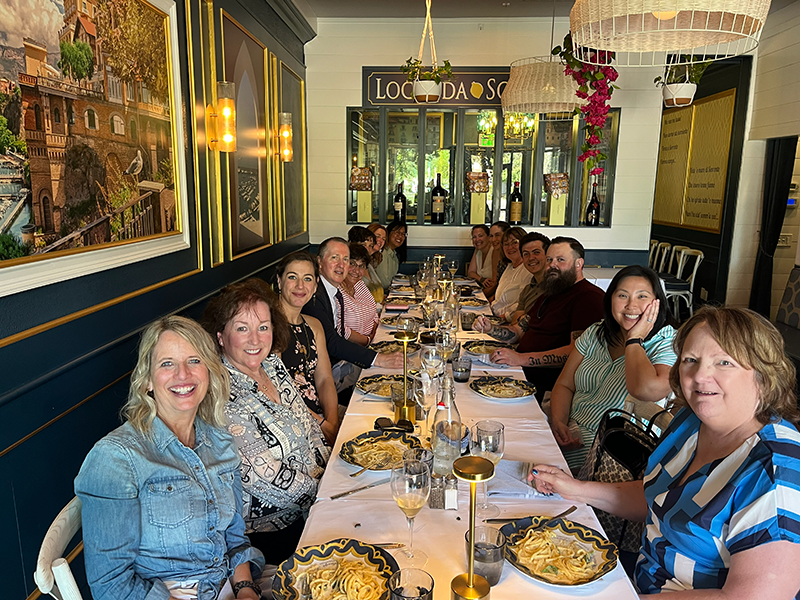
The College of Arts and Sciences Dean's Office gathered to honor Marie Brancati as she retires on April 15. L-R: Britt Cain, Noreen Golden, Ali Reimer, Dean Daniel Press, Marie Brancati, Maggie Hunter, Danielle Perryman, Sandy Boyer, Sarah Hays, Kat Saxton, Kathleen Villarruel Schneider, Calvin Miller, Charles Deleon, Denise Ho, Sue Khalipa.
Spring quarter is here and I find myself teaching again, the first class I’ve taught in a few years. What a joy it is to be back in the classroom – and I am especially grateful to be co-teaching with Kat Saxton, a gifted instructor! 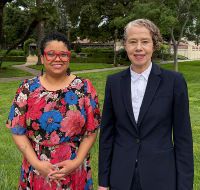
This week marks the start of a leadership change for the Center for the Arts and Humanities. Danielle Morgan (English) has taken over as the director for the Center, and is being joined by Ciara Ennis (de Saisset) as the associate director. I look forward to all these two have planned over the next couple of years. I’d like to give my thanks to Amy Randall (History), who served as associate director and then director of the Center for these past four years. We are gearing up for a busy Week 2 on campus. In addition to a number of events by our departments, our annual DeNardo Lectureship in the Health Sciences will host a leader in the Neuroscience field, Kafui Dzirasa, M.D., Ph.D., for a public lecture on April 8th and a student lecture and recognition dinner on April 9th. Also on the 8th is the University's annual Day of Giving—keep your eyes out for some campus-wide events including a blood drive and Trivia with the Provost that day! Then, on April 10th, Princeton University Sociologist, Ruha Benjamin, will give a talk, hosted by the Black Justice Studies Collaborative and the Silicon Valley Studies Initiative. Capping off that week is Preview Day on Saturday, April 11th. This event seals the deal for a number of our prospective students each year, so thank you to everyone who will be coming to campus on a Saturday to represent the College and/or your department. What a week! Here is a 1971 poem by the incomparable Adrienne Rich, who was much beloved in Santa Cruz. Sincerely, Daniel Planetarium By Adrienne Rich
A woman in the shape of a monster a woman ‘in the snow in her 98 years to discover she whom the moon ruled Galaxies of women, there An eye, ‘virile, precise and absolutely certain’ encountering the NOVA every impulse of light exploding from the core Tycho whispering at last What we see, we see the light that shrivels a mountain Heartbeat of the pulsar The radio impulse I am bombarded yet I stand I have been standing all my life in the Highlights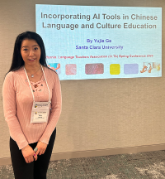
Yujie Ge (Modern Languages and Literatures) presented at the California Language Teachers Association spring conference on February 28. She delivered a presentation focusing on how she used AI tools to create video clips for various teaching and learning needs, such as listening comprehension for class activities and listening assessments on tests. This innovation not only provides feasible solutions to the challenges Chinese educators may face, due to the lack of level-appropriate and content-suitable listening resources, but also enriches students’ learning experiences in Chinese language and culture. The AI tools she introduced include video creation tools from ChatGPT and Google Gemini. She compared the two tools and discussed the pros and cons during the video creation process. One finding is that AI video creation tools are still developing, and users often encounter inaccuracies in the generated products, particularly in intonation, pronunciation, and subtitles in the target language.
Tom Plante (Psychology) published the recent journal article, "Examining Catholic practices and traditions through a contemporary psychotherapeutic lens," in Integratus: The Journal of the Catholic Psychotherapy Association. Abstract: While the Roman Catholic Church offers numerous spiritual practices, rituals, and traditions in support of its mission as it cares for the souls of the faithful, few of these elements of Catholic life have been subjected to quality empirical research to examine their potential psychotherapeutic benefits. The purpose of this article is to reflect on the potential psychological, behavioral, and relationship benefits of several common elements of the Catholic faith and practice through the lens of what we know about psychology and human behavior from many decades of research and clinical practice. Tom also published an introductory editorial, "Transitions and next steps for Integratus in 2026 and beyond," as the new co-editor of Integratus: The Journal of the Catholic Psychotherapy Association.
Brita A. Bookser (Child Studies) published a co-authored article with Timothy J. Williamson (Loyola Marymount University, Psychology) titled, "Teaching for Justice with Picture Books in Higher Education" in the Fall 2025 volume of the Journal of Children's Literature. Bookser and Williamson present two case studies from their teaching, then describe examples of picture books aligned with transdisciplinary higher education course themes. The authors contend that, "When animated by a critical framework in any discipline in higher education, children's literature invites new pedagogical practices that help students connect personal experiences and current events with complex social issues." This publication describes how picture books help undergraduate students explore identity, develop critical consciousness, and respond to sociopolitical injustice — learning opportunities and outcomes that are valuable across disciplines.
On March 19, Benjamin Gillespie (Theatre and Dance) successfully launched his recently published book Late Stage: Theatrical Perspectives on Age and Aging at the Martin E. Segal Theatre Center in New York City. The evening included scholarly conversation, a performance by the legendary theatre troupe Split Britches, and a remembrance for the late scholar Elinor Fuchs. Esteemed panelists included Bonnie Marranca, Hillary Miller, Scott Magelssen, Dorothy Chansky, and Valerie Barnes Lipscomb. The event was followed by a reception and book signing co-sponsored by the North American Network in Aging Studies (NANAS). A recording of the event livestream is available on HowlRound.

Natasha Glendening (Public Health) presented at the American Association of Geographers (AAG) Annual Meeting in San Francisco on March 18. She participated in a session titled "Symposium on GeoAI for Sustainable Cities and Health Research: GeoAI Innovations and Public Health." Her research, "Predicting human settlements in the Gambella Region of Ethiopia: A remote sensing and machine learning approach," involved training a predictive model to identify settlements in an isolated area of Ethiopia. Natasha's work leverages open-access data to help measure unmet need for healthcare in the region. She hopes that this work can also provide a replicable framework for estimating population presence in data-scarce and logistically challenging environments.
Christopher Bacon (Environmental Studies and Sciences) and Stephen R. Gliessman co-published a timely editorial in the journal Agroecology and Sustainable Food Systems that assessed the food system-related outcomes of the largest global climate conference in 2025. In their assessment of the COP 30 climate negotiations, they analyzed "backsliding and bright spots" of this critical implementation summit with a focus on possibilities for food system transformation. The authors found that the final COP30 agreement involved backsliding by omitting any mention of industrial agriculture’s fossil fuel dependence, commodity-driven deforestation, and the food system's contribution to a third of global climate emissions. However, they also highlight seeds of possibility in several side agreements and the power of a robust resistance. These seeds of change included: (1) Faith-based collaboration, as more than 60 faith-based institutions announced their divestment from fossil fuels. (2) The Belém Declaration as leaders from 43 countries pledged to foreground social justice, hunger, and poverty alleviation in climate action, and (3) The estimated 70,000 people who participated in a climate justice march and the People’s Summit, which paralleled the official conference and put forth an alternative agenda that recognizes the human right to food and leverages agroecology to guide grassroots and governmental cooperation to accelerate transitions towards sustainable food systems and more peaceful relations.

On February 12, "This is the Way" recorded an episode with a live audience at Santa Clara University, hosted by Justin Tiwald (SCU Austin J. Fagothey Visiting Professor and University of Hong Kong) and Richard Kim (Loyola University Chicago), with guest Meilin Chinn (SCU Philosophy). The conversation explored the role of music in Chinese philosophy, touching on questions such as: What can we know through music? How does music relate to human emotion? Can music make us better people? And should music serve political ends? Image: Episode 32 of “This Is the Way”: Music Has in It neither Grief nor Joy
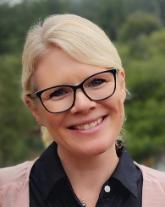
Birgit Koopmann-Holm (Psychology) was invited to deliver a colloquium at UC Berkeley in February. Her talk, titled “From Self-Focus to Solidarity: Understanding Variations in Self-Transcendent Emotions,” presented an overview of her research on individual and cultural differences in the expression of sympathy, conceptualizations of compassion, sensitivity to others’ suffering, and experiences of awe. She highlighted how these differences are closely linked to the extent to which people want to avoid distress and negative emotions more broadly.
John Hawley (English, emeritus) published “Postcolonial Ecocriticism and the Recovery of Hope: Okri, Dangarembga, and the Spiritual,” in History Research, March 2026. John also presented a paper at the recent South Asian Literature Association’s meeting in Charlotte, North Carolina, titled “Literature, Empathy, and Class Warfare: Aravind Adiga’s Last Man in Tower and Amnesty." At that meeting, he was presented with the organization’s Distinguished Service in South Asian Studies Award.
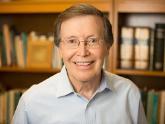
Francisco Jiménez (Modern Languages and Literatures emeritus) served as the keynote speaker at Sacred Heart Nativity School’s Fr. Mateo Sheedy Luncheon on February 25, a gathering held to celebrate and honor Father Sheedy’s enduring legacy, a vision that continues to transform the lives of hundreds of students at Sacred Heart Nativity School. In his address, Francisco paid tribute to Father Mateo Sheedy’s strong commitment to providing a faith-based, high-quality education for students from underserved communities. He emphasized the broader significance of this mission, noting that when education is guided by empathy, compassion, and a commitment to justice, it has the power to change lives.
Accessibility Compliance
Accessibility Resources
Faculty Development
Got IT Questions or Issues?Stop by the virtual IT drop-in sessions with Charles Deleon! These sessions are designed to provide faculty and staff in the College of Arts and Sciences a friendly and casual setting for addressing general IT questions and concerns. Feel free to drop in and out at any time during the scheduled session, whether you have a quick question, need assistance with something and don't know where to start, or simply want to learn more about our IT resources. Biweekly. Next sessions: Friday, Apr. 10, and Apr. 24, 11:30 a.m.–12:30 p.m. Zoom link
Get connected!      |
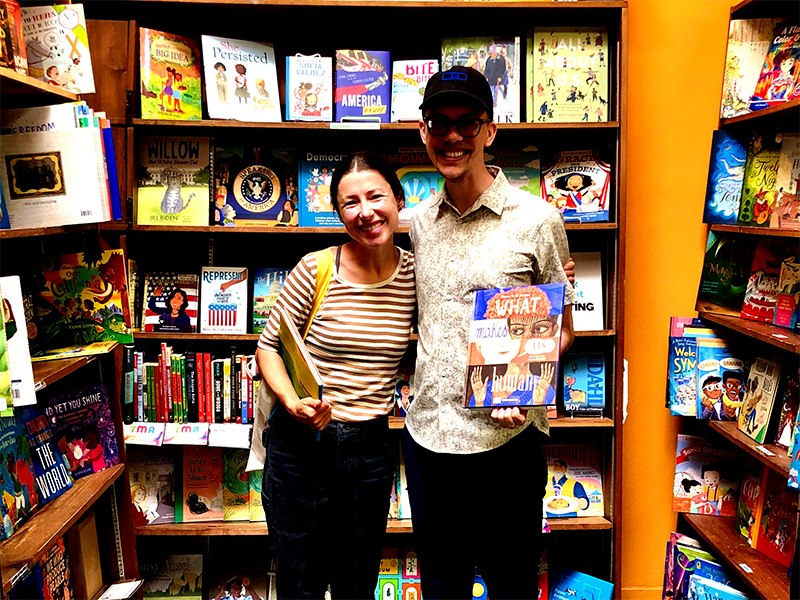 Brita A. Bookser and Timothy J. Williamson investigate picture books in 2024 at Hicklebee's Bookstore in San José.
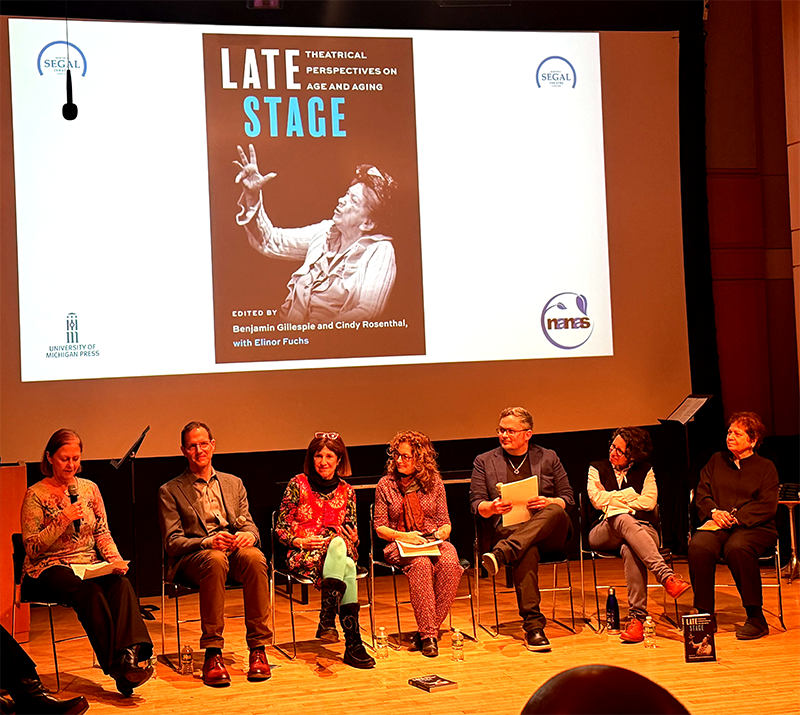 Panelists at the book launch for Late Stage: Theatrical Perspectives on Age and Aging at the Martin E. Segal Theatre Center in New York City.
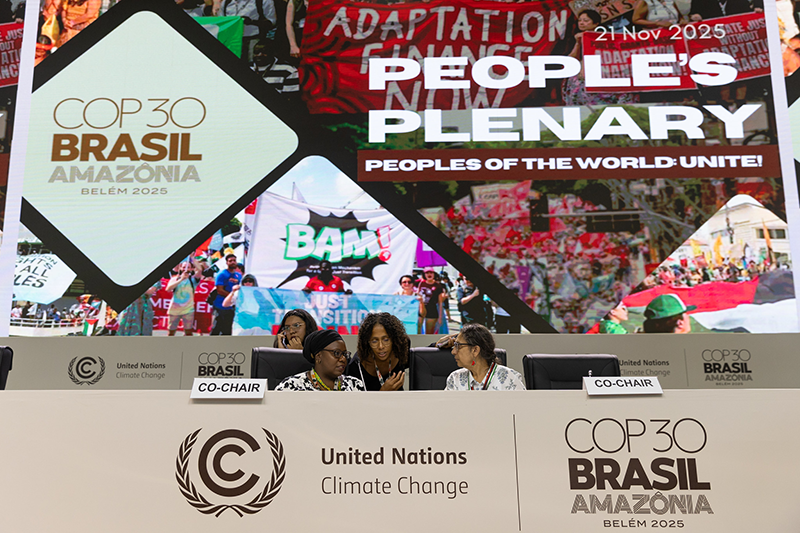 Members of civil society during the People’s Plenary (Photo: UN Climate Change - Kiara Worth)
| College of Arts and Sciences |
Submit a College NoteQuestions? Contact Sandy Boyer |