| Trouble viewing this email? Read it online. |

| August 8, 2025 | Submit a Note |
I hope that you have successfully been pursuing that elusive academic mix of summer productivity, disconnectedness punctuated by scholarly and artistic stimulation and rejuvenation…! In the new academic year, we’ll be introducing two new minors in the College—one in the Department of Modern Languages and Literatures (MODLL) and the other in the Department of Environmental Studies and Sciences (ESS). MODLL has added a minor in Chinese and Sinophone studies, which aims to provide students with a comprehensive and interdisciplinary understanding of the Sinophone world. ESS has created a minor in geospatial analysis, which promotes the use of spatial data so students can build technical and analytical skills for addressing problems with particular attention to place. The addition of these minors will strengthen the curriculum in both areas and we are excited for the enhanced opportunities they’ll provide for our students. On the professional development side, I’d like to call your attention to the fellowship program at the Harvard Radcliffe Institute. Applications for this year-long fellowship are due Sept. 11 (humanities, social sciences, and creative arts) or Sept. 30 (science, engineering, and mathematics). The program not only helps create time to focus on scholarly projects, it also affords participants access to Harvard resources such as libraries, archives, research assistants, and professional development opportunities. I encourage you to apply if you have a project in the works or on the horizon that meets the criteria for the fellowship. Here is a poem by Philip Levine, who taught a long time at Fresno State, and was the U.S. Poet Laureate in 2010. Sincerely, Daniel For Fran By Philip Levine
I see the true vein in her neck Out through the winding of the bone. To those whose need of us endures My living wife, Francis Levine, Highlights
Abstract: Jesuit and Catholic higher education has much to offer our students and the world but with fewer and fewer Jesuits and Catholic clerics or laypersons in the classrooms or anywhere else at our universities, this 500 century old Jesuit tradition and 2,000 year old Catholic is seriously threatened. Strategic hiring for mission and identity, being proactive with evangelization, and retaining our approach to academic life, learning, and formation are critically needed, especially now. Otherwise, our Jesuit and Catholic institutions run the risk of being overwhelmed with secularization that will ultimately lose the richness that Jesuit and Catholic inspired education and perspectives offer our students and ultimately the world when the world most desperately needs it.
John Farnsworth (Environmental Studies and Sciences, Emeritus) had an article, “Boots on the Ground,” published by the Writers for Democratic Action. It reflects on the military parade celebrating the U.S. Army's 250th anniversary.
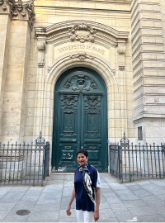
The international conference, “Faces/Phases of Humanoids: Ethics of Digital Surveillance, Sustainable World Models and Privacy Rights,” a follow-up of the United Nations ‘AI for Global Good Summit’ 2023, was recently held at the Université Paris-Panthéon-Assas, Paris. Speakers presented on the complex challenges that emerge at the convergence of AI technology and human rights to Ambassador Jean Manes and her team at the U.S. Mission to UNESCO. Aparajita Nanda (English) presented a paper on the ethical dilemma around humanoids in the works of Octavia Butler where the Foucauldian panoptic discourse is reimagined as a paradoxical force that both divides and integrates, forming a unique amalgamation of power and control. Image: Aparajita Nanda outside Universites De Paris.
Abstract: Philosophy professors may inadvertently contribute to antifat bias and fatphobia in the classroom. “What about health?” is the most common question students raise in conversations about antifat bias and fatphobia. Christine discusses the relationship between weight and health, the “obesity epidemic” as moral panic, and ways that antifat bias and fatphobia occur in everyday life. She shares her experiences, difficulties, and suggestions for teaching philosophy courses that guide students to begin thinking critically about antifat bias and fatphobia. Critical approaches to fatness raise philosophically rich moral, epistemic, and ontological questions and require careful reflection on our own positionality. Specific topics are addressed, including developing a personal stake in dismantling antifat bias and fatphobia, inclusive design and denaturalizing the built world, antifat bias in medicine, intersectionality and epistemic oppression, eating disorders and fatphobia through a feminist philosophical lens, how microaggressions sustain fat oppression, and fat temporality and crisis phenomenology.

Rich Barber (Physics), a passionate advocate for science and undergraduate research, passed away last year, but his legacy continues. His final project, a collaboration with Janice Edgerly-Rooks (Biology) and three undergraduate co-authors, culminated in a new scientific article published on July 12 in Environmental Entomology. The article, "Exploring dynamics of nature’s raincoat: comparing how nano-scale silk fibers produced by dryland and tropical species of webspinning insects interact with water," investigates how silks from tropical and dryland insect species (order Embioptera) respond to rainfall. This research builds on earlier work exploring silk's protective, raincoat-like properties. Emily Arias ’24 (Biology) and Andrew Schatz ’26 (Environmental Science) worked with Professor Barber, using SCU’s Center of Nanostructures' 3D Zeta and scanning electron microscopes to quantify silk-water interactions. Aidan Kaneski ’25 (Biology) joined Professor Edgerly-Rooks in April 2025 to further analyze hydrophobic-hydrophilic properties. The team discovered that water droplets on spun silk caused a fiber-to-film transformation in all four species studied. Arboreal embiopterans produced denser silk coverings and films than ground-dwelling species, potentially offering strong protection against heavy tropical rainfall. The silks tended to be hydrophilic, which may explain their transformation upon water exposure as the droplets interact with the silk proteins. Image: Janice Edgerly-Rooks and Rich Barber. Photo by Grace Stokes (Chemistry and Biochemistry).
Get connected!      |



| College of Arts and Sciences |
|
Questions? Contact Sandy Boyer |