| Trouble viewing this email? Read it online. |

| January 23, 2026 | Submit a College Note |
January is a busy time for everyone in the College, but especially the faculty and staff who are responsible for academic year plans, faculty personnel reviews, and hiring the next cohort of faculty. The Dean’s suite has been a vibrant place as of late, with many candidates coming through to meet with the Associate Deans and me. I always find this to be an exciting time as I get to know these candidates, some of whom will join us here on campus and make their marks on your departments, our students, and their disciplines. This year, we are hiring 13 tenure track faculty and 8 teaching professors from 14 departments, including Anthropology, Art and Art History, Chemistry and Biochemistry, Child Studies, Communication, English, Environmental Studies and Sciences, Mathematics and Computer Science, Modern Languages and Literatures, Music, Philosophy, Physics and Engineering Physics, Psychology, and Sociology. I’ve met with around 30 candidates to date, and am happy to report we’ve already made three tenure track hires. This week's poem is from Ada Limón, the 24th poet laureate of the United States, and from her new collection Startlement. This particular poem was written for NASA’s spacecraft the Europa Clipper, which launched on October 14, 2024. The mission of the Clipper is to travel close to Jupiter's second moon, Europa – a moon that has a lot of water under a massive ice sheet. As Ms. Limón writes, "[T]he poem is engraved in my own handwriting on the vault plate of the spacecraft and was also made into a picture book by the wonderful illustrator Peter Sís.” Warm regards, Daniel In Praise of Mystery: a Poem for Europa By Ada Limón Arching under the night sky inky pin quick wishes on stars. From earth, Still, there are mysteries below our sky: We are creatures of constant awe, And it is not darkness that unites us, each rivulet, each pulse, each vein. We, too, are made of wonders, of great
Highlights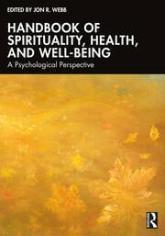
Tom Plante (Psychology) published a co-authored book chapter entitled "The psychological health of clergy: Religious and spiritual considerations" in J. Webb (Ed.) Handbook of Spirituality, Health, and Well-Being: A Psychological Perspective (2026). New York: Routledge. Abstract: Clergy are leaders within organized religions that engage in service-oriented roles and activities. Spirituality and religion are inherent to the clergy vocation and their health. Social scientists have categorized clergy as a “high-risk” group in terms of their health and well-being given the high demands of their vocation and precarious role within their communities. The Ritualistic,Theistic, Existential (RiTE) model of spirituality offers an emergent conceptualization to understand clergy health. Future research examining the RiTE model with diverse clergy populations is warranted. The purpose of this chapter is to highlight some of the unique health concerns of clergy and to describe evidence-based interventions that address their spirituality, health, and well-being.
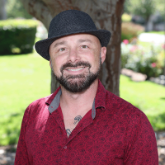
Miah Jeffra's (English) essay, "Load-Bearing," is shortlisted for the Leopold Bloom Prize for Innovative Narration, and will be published in the latest issue of L'esprit Literary Review. Miah will also be featured on three panels at this year's San Francisco Writers Conference: "On Writing Controversial Subject Matter (Conscientiously)," "Memoir Forms Reimagined," and "Queer/Trans Fellowship Culture in Resistance to Empire."
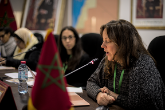
Keziah Poole (Modern Languages & Literatures) presented at the conference entitled Moroccan Cinema: Challenges and Promises at Sidi Mohamed Ben Abdellah University in Fez on December 18, 2025. Her paper, "Visibility and Translegibility in Moroccan Women's Cinematic Narratives," examined the cultural and political dynamics that shape the international passage of films made about and by Moroccan women, focusing on three contemporary filmmakers. Image: Keziah Poole presenting at the Moroccan Cinema conference in Fez.
Mateo J. Carrillo (History) presented a paper at the American Historical Association’s annual meeting in Chicago on January 11, 2026. The paper was based on the fourth chapter of his current book project. The session was titled “Infrastructure and the Environment in Modern Latin America.” Fellow panelists included María de los Ángeles Picone (Boston College), Óscar Aponte (Villanova University), and Kyle Harvey (Western Carolina University).
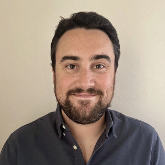
Tyler van Wulven's (Philosophy) article, "The Road to Hell: Unhappy Consciousness and Authoritarianism," was published in The Journal of the Hegel Society of America. The paper draws on German philosopher G.W.F. Hegel's philosophical analyses of mastery, servitude, and withdrawal in order to better understand the conditions that have given rise to authoritarian attitudes in the United States. In addition, the article attempts to redescribe those in the throes of authoritarian ideologies as suffering and seeking to overcome that suffering, and it draws further inspiration from recent work in sociology ("Deaths of Despair"), anthropology (the proliferation of what David Graeber called "B.S. Jobs"), and political theory (Michael Sandel on "The Tyranny of Merit").
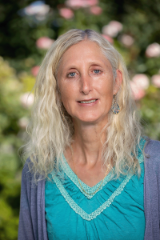
Iris Stewart-Frey (Environmental Studies and Sciences, Environmental Justice and the Common Good Initiative) presented on a panel for San Francisco’s public library AI week, examining the intersection of AI hyperscale data centers and the environment, highlighting how the growth of AI is increasingly shaping research, education, the labor market, communications, and human relations. The discussion emphasized that while these tools offer powerful new opportunities, they also raise urgent questions about energy and water use, data transparency, ethics, policies, social change and environmental justice. Environmental leaders, scholars, and community voices came together to assess both the promises and risks of this rapidly evolving landscape. The panel also featured and was moderated by Khari Johnson, a tech reporter at CalMatters who covers technology in the public interest and who has reported on the social impacts of artificial intelligence for over a decade. Also joining the conversation was Tamara Kneese, director of the Climate, Justice, and Technology program at Data & Society, whose research explores the social and environmental impacts of digital technologies. Kneese is the author of Death Glitch and has held roles at the Green Software Foundation, Intel, and the University of San Francisco.
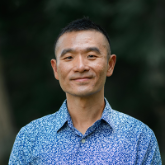
At the 2025 International Annual Conference of Teaching Chinese as a Second Language (ATCSL), held December 12-14, 2025, at Chung Yuan Christian University in Taoyuan, Taiwan, Hsin-hung (Sean) Yeh (Modern Languages and Literatures) presented on curriculum design for Mandarin and Taiwanese instruction through the lenses of learner motivation and pedagogical negotiation. Drawing on mixed-method data from diverse learner populations in the United States, the presentation explored how multilingual identities, heritage language backgrounds, and issues of linguistic legitimacy shape students' classroom experiences. The talk proposed identity-oriented and inclusive instructional strategies, including differentiated instruction, pedagogical negotiation, and diversified teaching materials. By foregrounding learner perspectives, this presentation highlighted practical approaches for building more inclusive, flexible, and sustainable language classrooms. The study contributes to ongoing conversations in Mandarin Chinese and Taiwanese language education regarding equity, learner agency, and innovative pedagogical practices in multilingual and multicultural contexts.
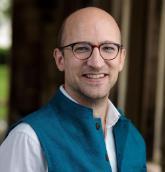
Christine Wieseler (Philosophy) presented research at the American Philosophical Association Eastern Division meeting in Baltimore, which was held from January 7-10, 2026. She provided a commentary on Serene Khader's book, Faux Feminism: Why We Fall for White Feminism and How We Can Stop during an author-meets-critics session. Here is a small excerpt: Khader’s newest monograph is accessible, thorough in terms of topics and citations, insightful, and, at times, even funny. I mention this last descriptor because it is no small feat to evoke laughter while writing about oppression and ways that individuals and groups have gone astray from a feminism for all. In her words, “[t]his book is about how to recognize feminist visions that harm and exclude, and how to stop ourselves from falling into them” (2025, 8). Christine also presented research on medical gaslighting and critical phenomenology as part of a session entitled "Phenomenology and Disability." Among other things, this session focused on questions about how best to characterize the growing area of phenomenology written by and/or centered around disabled people's lived experiences.

Michelle Rivers (Psychology) recently published an article in Applied Cognitive Psychology entitled, “Does Covert Prequestioning Enhance Learning? Implications for the Roles of Attention and Retrieval in the Prequestioning Effect.” This research examined whether students benefit from trying to answer questions before learning new material and whether it matters if those answers are typed out (overt prequestioning) or simply thought about silently (covert prequestioning). Across two experiments, undergraduate students read short informational texts (e.g., about Saturn or Yellowstone National Park). Before reading, some students answered prequestions by typing responses, others answered the same questions silently in their heads, and a comparison condition just read the text. Later, all students took multiple-choice tests on the material. The results showed a clear pattern: both overt and covert prequestioning improved learning compared to reading alone, and there was no meaningful difference between typing answers and thinking about them silently. Importantly, students in the covert condition spent less time on the prequestions but learned just as much, suggesting that silently answering questions can be a more time-efficient strategy. Key takeaway for educators: Asking students questions before they read or listen can significantly improve learning, even if students answer those questions only in their heads.
Alberto Ribas-Casasayas (Modern Languages and Literatiures) presented his co-edited volume Otras iluminaciones: Narrativa, cultura y psicodélicos before an at capacity auditorium at Casa Amèrica in his hometown of Barcelona. Founded in 1911, Casa Amèrica is a cultural center that offers literary, musical, and film exhibitions, seminars, and debate and study sessions focusing on Latin American nations and communities.
REAL Program Information SessionsThe REAL Program is providing information sessions on the following dates: January 26, 1 - 1:45 p.m. (DISC, SCDI 2306) Final Drop In Session Application deadline: March 1
Faculty Development
Got IT Questions or Issues?Stop by the virtual IT drop-in sessions with Charles Deleon! These sessions are designed to provide faculty and staff in the College of Arts and Sciences a friendly and casual setting for addressing general IT questions and concerns. Feel free to drop in and out at any time during the scheduled session, whether you have a quick question, need assistance with something and don't know where to start, or simply want to learn more about our IT resources. Biweekly. Next sessions: Friday, Jan. 30, and Feb. 13, 11:30 a.m.–12:30 p.m. Zoom link
Get connected!      |
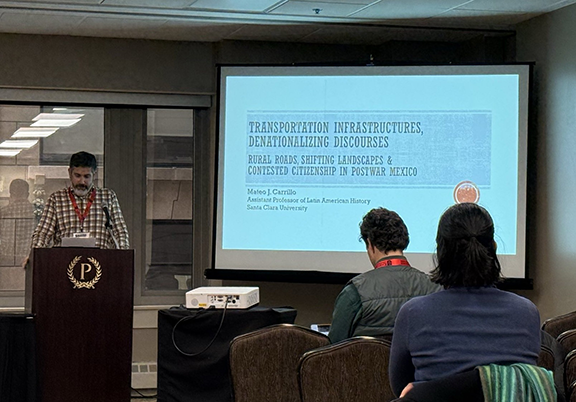 Mateo J. Carrillo presenting at the Palmer House in Chicago.
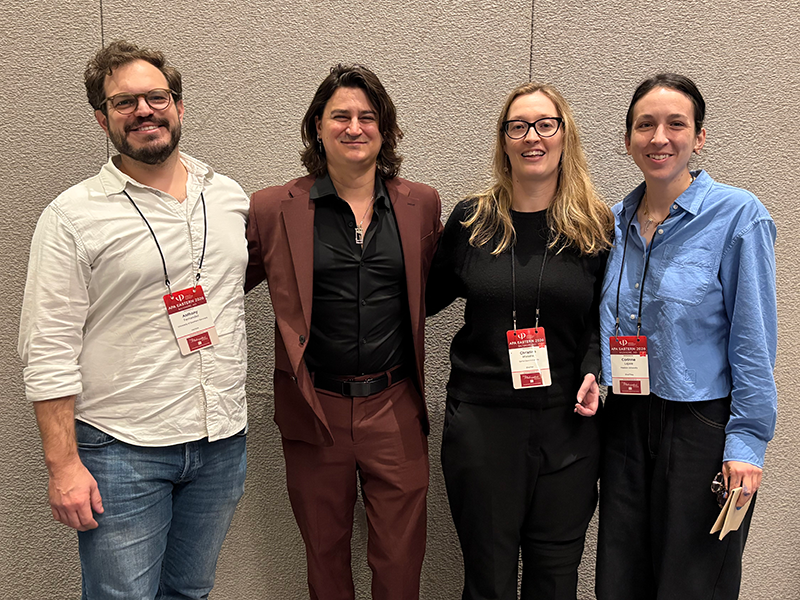 Left to right: Anthony Fernandez, Joel Michael Reynolds, Christine Wieseler, and Corinne Lajoie.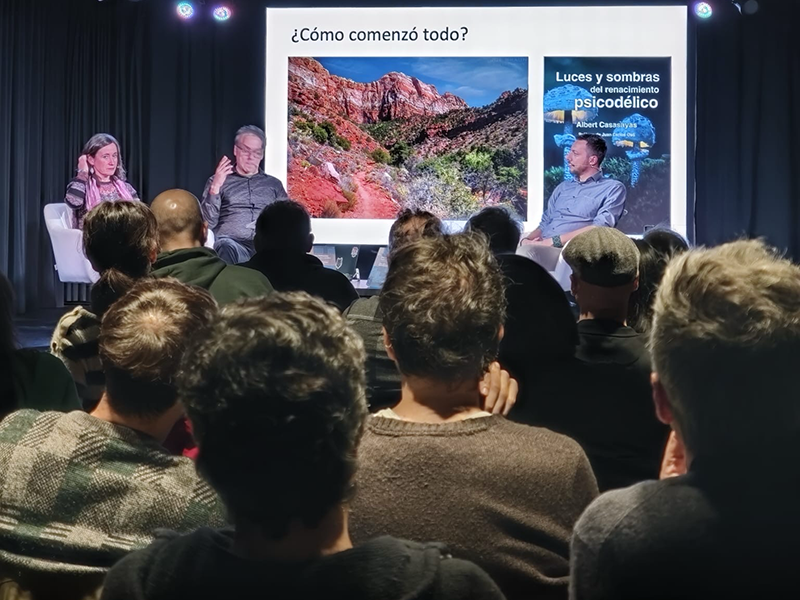
| College of Arts and Sciences |
Submit a College NoteQuestions? Contact Sandy Boyer |