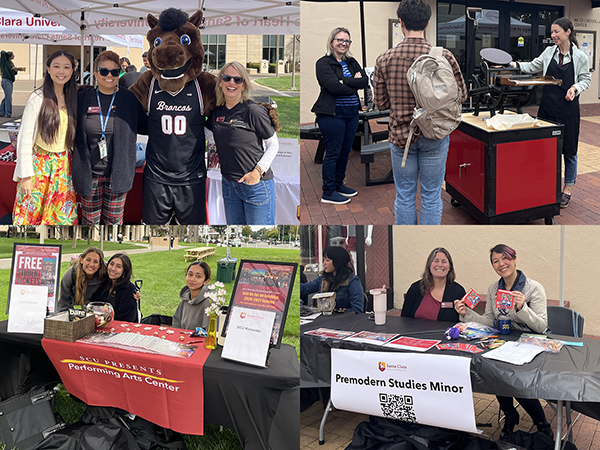
On October 23, the Center for the Arts and Humanities hosted their 3rd annual Pop Up event to celebrate National Arts and Humanities month. The event included tabling from departments and organizations in the arts and humanities (as well as campus at large), an interactive art and sound installation, an antique letterpress, and hands-on activities. It was a great day celebrating arts and humanities at SCU!
Dear Colleagues,
This week, I’d like to recognize Jamie Van Wormer, the former Senior Director of Development for the College. Monday was Jamie’s last day at SCU. She was instrumental in securing funding for the Global Languages and Cultures Center as well as funding for increased archaeology field opportunities for our students. In just over one year, Jamie re-engaged with past donors to the College and found new ones to support our faculty and students. She will be greatly missed (and Marquette University, her new home, owes us one…!). Planning for Jamie’s replacement in University Relations is underway, though I don’t have any concrete updates at this time.
We have a lot going on in the College these next two weeks, including our Fall mainstage theatre performance, as well as a few music ensemble performances (details for which can be found in the calendar section below). As we enter the end-of-quarter marathon of performances by our Theatre and Dance and Music departments, I want to acknowledge the work we have been doing to address pain points in their buildings by implementing improvements and adjustments, however small, to ensure these spaces meet student, faculty and staff needs and function as efficiently as possible. Recent projects include upgrades to address high noise levels in the music rehearsal room; adjustments to fire-safe doors to ensure safety while also being able to create a more welcoming and comfortable environment in the Music Department office; flooring replacement behind our theatre stages; repair of mainstage electric lines; and a Mayer Theatre roof replacement; with more projects in planning stages. Big thanks go to Carolyn Guggemos, Steven Fetter, Alison Lucas and our colleagues in University Operations for managing all of these projects, and to our department faculty for working with us to make these improvements happen.
This week's poem is by the prize winning poet, Cornelius Eady, who holds the Hodges Chair of Excellence at the University of Tennessee. This poem appeared in the May 2026 issue of Poetry.
Sincerely,
Daniel Proof
By Cornelius Eady Written for the inauguration of Zohran Mamdani, Jan 1, 2026, NYC.
You have to imagine it:
Who said you were too dark/too
Large? Too queer/too loud?
Who said you were too poor/
Too strange? Too fat?
You have to imagine it:
Who said you must keep quiet?
Who heard your story, then
Rolled their eyes?
Who tried to change your name
To invisible?
You’ve got to imagine:
Who heard your name
And refused to pronounce it?
Who checked their watch
And said “not now”?
James Baldwin wrote:
“The place in which I’ll fit
Will not exist
Until I make it.”
New York, city of invention,
Roiling town, refresher
And re-newer,
New York, city of the real,
Where the canyons
Whisper in a hundred
Tongues,
New York,
Where your lucky self
Waits for your
Arrival,
Where there is always soil
For your root.
This is our time.
The taste of us/the spice of us
The hollers and the rhythms and
The beats of us.
In the echo of our
Ancestors,
Who made certain we know
Who we are.
City of Insistence,
City of Resistance,
You have to imagine:
An Army that wins without
Firing a bullet,
A joy that wears down
The rock of no.
Up from insults,
Up from blocked doors,
Up from trick bags,
Up from fear/up from shame,
Up from the way it was done before.
You have to imagine:
That space they said wasn’t yours.
That time they said you’d never own.
The invisible city lit, on its way.
This moment is our proof.
Highlights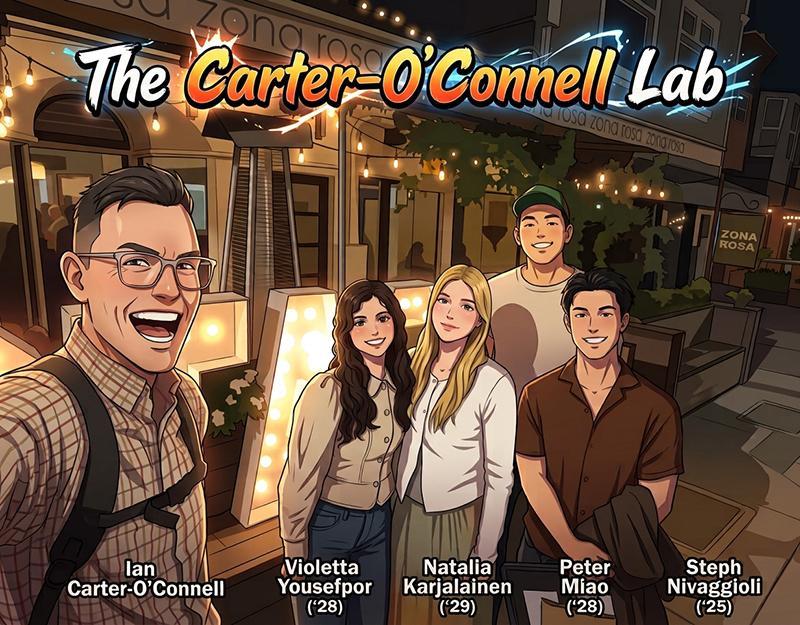 Celebrating the recent paper with the lab. From left to right: Ian Carter-O'Connell, Violetta Yousefpor, Natalia Karjalainen, Peter Miao, Steph Nivaggioli. Photo redesign with an assist from Gemini.
Ian Carter-O’Connell (Chemistry and Biochemistry) published a new study in Molecular & Cellular Proteomics titled "Optimized detection of acidic ADP-ribosylation by PARP14 in vitro using multi-modal mass spectrometry reveals putative autoregulatory patches."
The research addresses a key hurdle in chemical biology: mapping ADP-ribosylation, a cellular signal involved in antiviral immunity and cancer progression. Because the bonds on acidic amino acids are fragile, standard mass spectrometry often fails to detect them. The team optimized a low-cost hydroxylamine-labeling workflow that doubled detection efficiency while reducing false positives. Applying this to the enzyme PARP14, they identified nine modification sites—six previously unknown—and discovered a novel "autoregulatory patch" that controls enzyme activity.
A team of nine SCU undergraduates served as co-authors: Steph Nivaggioli ’25 (Biochemistry), Hannah H. Nguyen ’24 (Biology), Kiana K. Harker ’24 (Biology), Christian M. Mohr ’25 (Biology), Jake Wood ’26 (Bioengineering), Mikayla Dupen ’25 (Neuroscience, Biochemistry), Zeeshan Javed ’22 (Biology), Natalia Karjalainen ’29 (Bioengineering), and Violetta Yousefpor ’28 (Bioengineering), alongside collaborator Ashok Reddy (Oregon Health & Science University). Current lab members Natalia Karjalainen and Violetta Yousefpor will continue the project in cellular models. This work was supported by an ongoing NIH Academic Research Enhancement Award (R15).
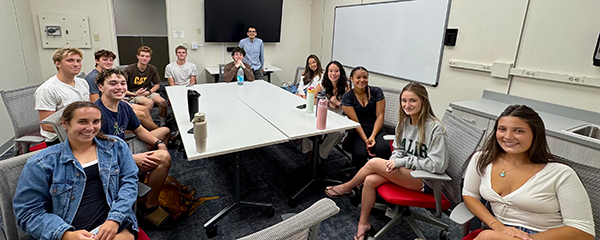 Participants of the Spanish Table in the new Global Languages and Cultures Center.
The Spanish Table met for its first Fall meeting in the new Global Languages and Cultures Center, housed in the Department of Modern Languages and Literatures. Facilitated by Abel Cruz and Víctor Quiroz, the Spanish Table aims to promote the Spanish language and Latine culture at SCU through Spanish informal conversations at all proficiency levels. Students have limited time to practice language in the classroom, so the Spanish Table is a great opportunity for students to engage in interactive dialogues and inter-cultural activities in the target language. The Spanish Table is also open to faculty and staff who would like to practice their Spanish language skills. We meet weekly in Daly Science 305. If you would like to join these informal conversations, contact either Abel Cruz or Víctor Quíroz. ¡Esperamos verte pronto!
Jesica S. Fernandez (Ethnic Studies) attended the Ignatian AI Conference at Fordham University to present her emerging research at the intersections of ethical critical reflexivity, sociopolitical wellbeing and AI interactions. Her presentation, entitled "Ignatian Spirituality as Ethical Critical Reflexivity: Toward a Mindful Engagement with AI," explored the question: How can Ignatian spirituality values, such as ethical critical reflexivity, be fostered in generative AI interactions? To address this question, practices and strategies associated with ethical critical reflexivity, defined as introspective mindful embodied awareness, described with the intention to help audience members reflect and develop present-awareness or a conscientious understanding of themselves in relation to technology, thus AI. As we consume, interact, and experience AI generated content, we must learn to foster ethical critical reflexivity to prevent AI from compromising qualities that contribute to wellness, such as human relationships, agency in decision-making, self-esteem, sense of purpose or spirituality. Ethical and critically reflexive discernment, which are characteristic of Ignatian spirituality, are needed to engage with generative AI. Mindful engagement with AI could help surface people's best human qualities, such as compassion, humility, care, and creativity—and Jesica is currently exploring this new area of inquiry.
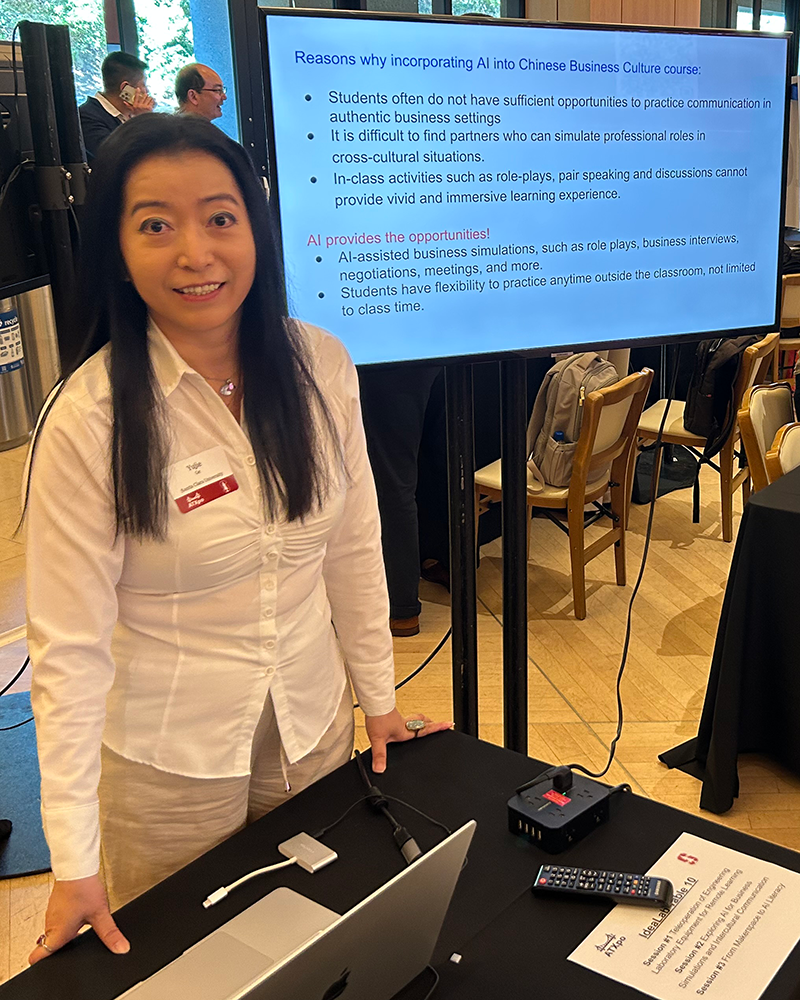
Yujie Ge (Modern Languages and Literatures) participated in 2026 ATXpo IdeaLab at Stanford University in October. She presented her research on exploring the use of AI in business simulations and intercultural communication in her teaching of Chinese Business Culture. It has been challenging for students to find language partners with whom they can practice communication skills in authentic business contexts. AI provides opportunities to help students achieve their learning goals. AI-assisted business simulations include role plays, job interviews, business negotiations, and meetings. She also shared AI-generated videos reflecting various business scenarios. In addition, she introduced how AI can be used to guide students in writing professional business emails in the target language. She emphasized that AI should serve as a supportive learning tool rather than a replacement for students' original work. She also encouraged students to critically evaluate AI-generated content for cultural accuracy, potential stereotypes, and limitations.
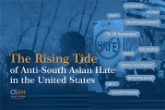
Rohit Chopra (Communication) co-authored a report, "The Rising Tide of Anti-South Asian Hate in the United States," for the Center for the Study of Organized Hate, Washington, D.C.. The report, released in September 2026, examines the sharp rise in racist, xenophobic, and violent narratives targeting South Asians that have dramatically increased across mainstream and fringe social media platforms since late 2024. More than half a million anti-South Asian posts appeared on X between January 2025 and June 2026, rising 240% from January 2024 to June 2026. Anti-South Asian hate also remained deeply entrenched on fringe platforms, with almost 400,000 posts targeting South Asians on 4chan, 8chan, and Gab in 2025. The report embeds the analysis of online hate in the larger political economy of anti-South Asian hate in the US, current wave of anti-minority and anti-immigrant policy, rhetoric, and sentiment in the country, and the shift in the policies of social media platforms, such as the weakening of protections against hate speech and abandonment of fact-checking initiatives.
The report has drawn statements of response from the Congressional Asian Pacific American Caucus (CAPAC) and the office of Congressman Raja Krishnamoorthi (D-IL). It has also been covered by NPR, Al Jazeera, South China Morning Post, Times of India, Business Standard, and Wire India, among a host of global publications and media outlets.
Image: Report cover of "The Rising Tide of Anti-South Asian Hate in the United States"
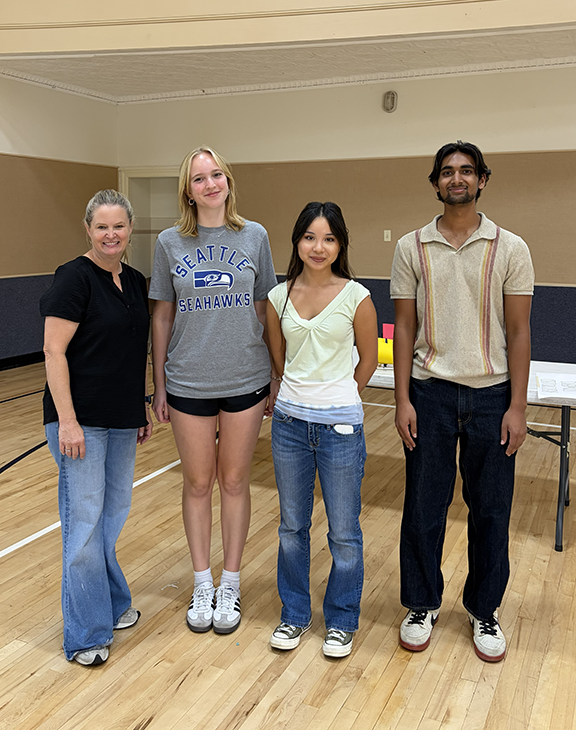 Ignatian Design in Engineering and Science (IDEAS) team at St. Clare School (L-R): Barbara O'Brien, Barrett Efta, Kassie Ngo, Kathan Palagiri.
On October 7, Barbara O’Brien (Psychology), alongside three undergraduate research assistants, launched Co-Designing with Communities, an innovative STEM outreach initiative connecting university, high school, and elementary school students through near-peer mentorship.
In the program’s inaugural pilot, psychology undergraduates Barrett Efta ’27 (Psychology) and Kathan Palagiri ’27 (Psychology) provided evidence-based mentorship training to 29 St. Francis High School students, equipping them with skills in informal learning and STEM activity facilitation. The high school students then put their training into action by leading a hands-on STEM Day for students in Grades 3–5 at St. Clare School.
Rather than presenting abstract problems, the high school mentors facilitated interactive STEM challenges framed around empathetic, story-driven narratives written by Kassie Ngo ’29 (Psychology), helping young learners develop creative solutions for those in need. By serving as STEM mentors, high school students have the opportunity to give back to their community, strengthen their leadership and communication skills, and inspire younger learners to explore STEM through creativity, collaboration, and problem-solving. Laura Doyle (School of Engineering) also contributed to the initiative by providing guidance and expertise on the STEM challenges.
Designed with community needs in mind, the event was offered at no cost to St. Clare School and required no additional preparation from elementary school educators, bringing engaging, hands-on STEM experiences directly to elementary students while minimizing barriers for schools and educators.
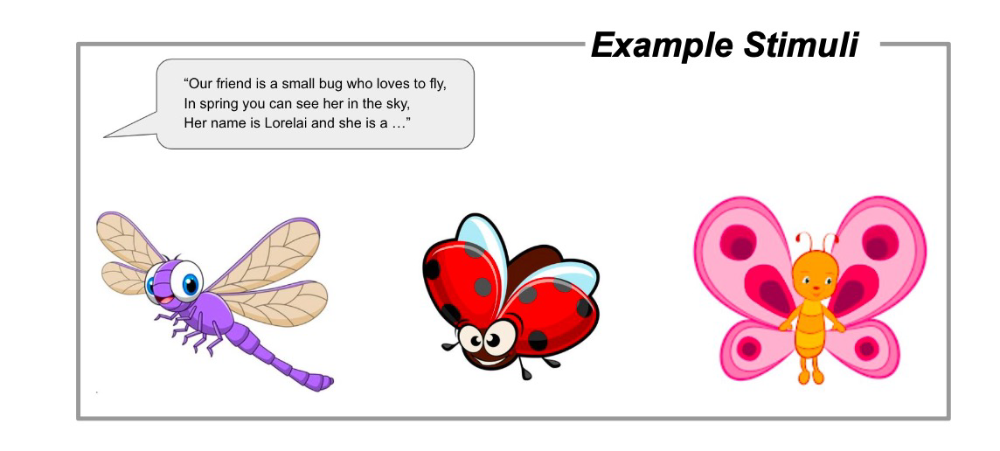
Image: Example images used in the study... which bug do you think is Laurelai?
Kirsten Read (Psychology) and three student (now alumnae) coauthors, Grace Roach '23 (Psychology), Dhanya Paul '22 (Neuroscience), and Caroline Cotler '23 (Psychology) just had a new paper published in the journal Language Learning and Development based on a multi-year project with preschool-aged children investigating how they use their own predictions about the words that will complete rhymes to help them remember and learn new animal names. The paper, "Surprise or Confirmation?: Predictability Helps Young Children Remember" describes the unique naturalistic, child-centered, eye movement tracking methods used in our lab's work, and the findings that support presenting new information in fun, structured, and predictable ways for young learners.
Eugene Schlesinger (Religious Studies) published an article "Unity: To What End and at What Cost?" in the Journal of Ecumenical Studies. It began as a presentation last November at the North American Academy of Ecumenists, which was supported by a Dean's Grant. The article explores the ways in which appeals to "unity" are often weaponized against women and sexual minorities in order to maintain the status quo, and calls for a conception of ecumenism that allows for more robustly agonistic mechanisms and processes. The journal also did a brief interview with him, which is featured on their blog.
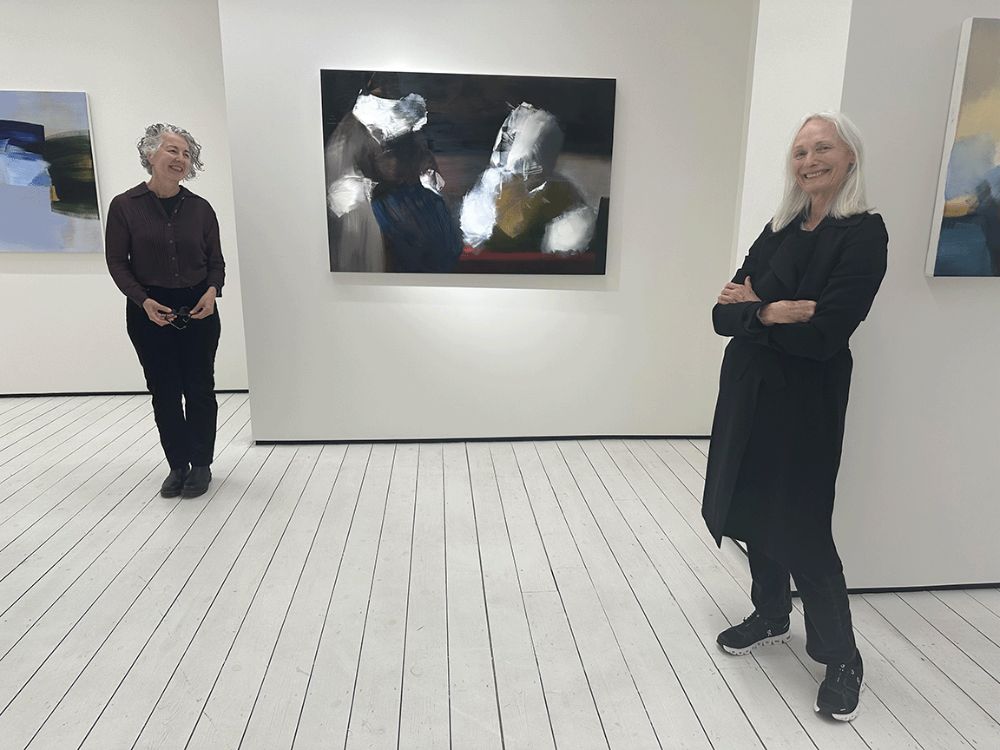 Robin Tremblay-McGaw (left) and Elise Ansel, Cadogan Gallery, October 2026 standing in front of "Woman in Green."
Robin Tremblay-McGaw's (English) ekphrastic poems in conversation with painter Elise Ansel's exhibition "Wall Window Table Light" at the Cadogan Gallery, London, have been published in the exhibition catalog. Robin read the poems at the gallery on October 13. Ansel's work is in conversation with painting from the past. In this show, the work responds to Vermeer's paintings which feature women reading and writing letters. Ansel's preoccupation with light and her feminist reinterpretations of Vermeer are echoed in Robin's poems.
Rondo Presto
—in conversation with Elise Ansel’s “Woman in Green,” 2026
white furies. up in. furioso. bone ash. there are costs. spectra won’t stay put.
bodies wont’ stay put. the women’s lines rhyme. storm thrall. something scherzos—
a window. reconciles. movement of pitch. fealty or not. a figure. those undisclosed solitudes.
departures
View the catalog. Listen to recordings of the poems.
In September, Brita A. Bookser (Child Studies), Russ Skiba (Indiana University), and Harold Jordan (ACLU-Pennsylvania) published the research briefing paper, "What Does and Doesn't Work: Myths and Facts about School Discipline Disproportionality." The paper reviews over two decades of empirical research indicating that exclusionary school discipline (e.g., suspension, expulsion) is implemented inconsistently and does not promote safe or effective learning environments, differential rates of punishment are not fully explained by student characteristics, and alternatives to exclusionary discipline do not create chaos. Exclusionary discipline is associated with numerous adverse outcomes for students, including poor academic performance, school dropout, and legal system involvement. The Federal School Discipline and Climate Coalition—a national civil rights coalition—published the research briefing paper in correspondence with a press advisory statement, which addressed misrepresentations of research and unsubstantiated claims in August 2026 U.S. Department of Education guidance on school discipline.
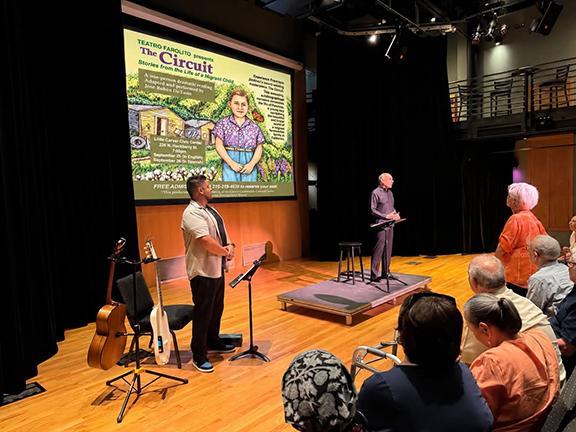
On September 25 and 26, Francisco Jiménez (Modern Languages and Literatures, Emeritus), had his autobiographical book The Circuit: Stories from the Life of a Migrant Child adapted for the stage by José Rubén De León, a prominent actor, playwright, and musician based in San Antonio, Texas. De León presented two solo performances at the Little Carver Theatre in San Antonio, one in English and the other in Spanish. The performances brought to life Jiménez’s childhood experiences growing up as the son of migrant farmworkers. Original music composed and performed on guitar and flute by Galo Gutiérrez connected the stories.
Francisco was also invited to contribute to the Silicon Valley Latino's “What Home Means to Me” series. In his essay, he reflects on the experiences that have shaped his understanding of home and belonging.
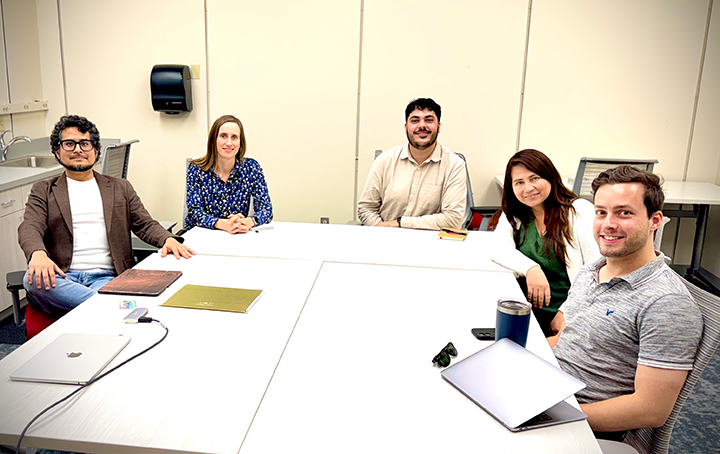 Indigenous Latin America Study Group
Panolti! Imaynalla! Mari mari! Maiteí! La ütz awäch? The Indigenous Latin America Study Group held its first meeting of the 2026–2027 academic year. This meeting took place in the new Global Languages and Cultures Center (GLCC), housed within the Department of Modern Languages and Literatures. The Study Group provides a forum for discussion and inquiry into Indigenous cultures and their influence across Latin America. We also welcome connections with faculty members interested in Indigenous histories, cultures, and discourses more broadly. If you are interested in joining the group or learning more about its activities, please contact Victor Quiroz (Modern Languages and Literatures). We would be delighted to welcome you!
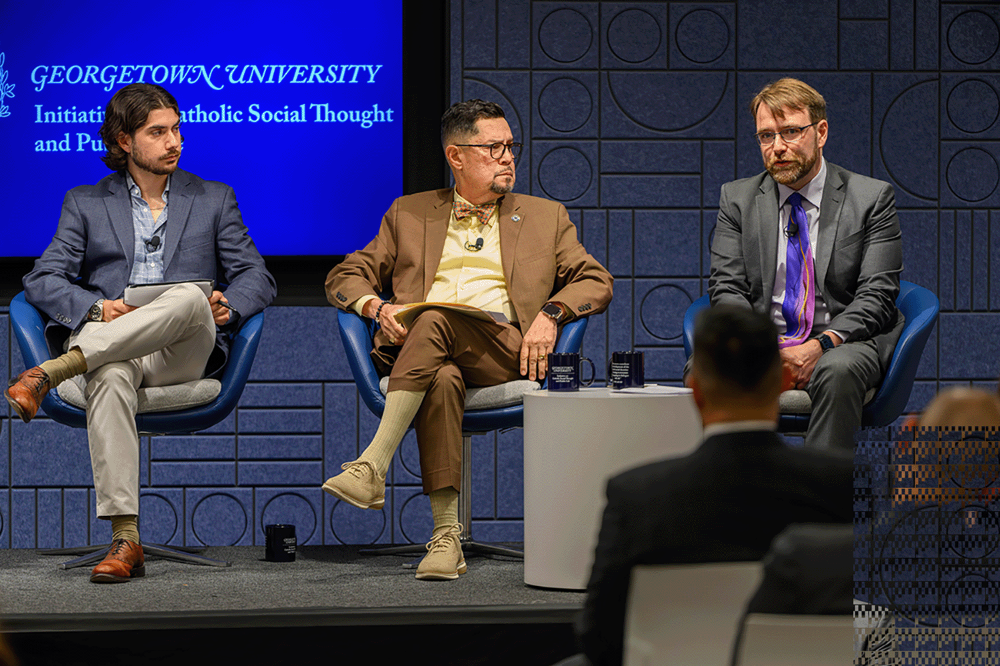 (Right - Left): Nicholas Hayes-Mota in conversation with Prof. Luis Fraga (Notre Dame) and Christian Soenen (Georgetown) at a public dialogue on "Latino Political Power in Flux: Aspiration, Identity, and the Common Good," hosted by Georgetown University's Initiative on Catholic Social Thought and Public Life.
In January 2026, Nicholas Hayes-Mota (Religious Studies) was appointed a Spring 2026 Fellow at Georgetown University's Initiative on Catholic Social Thought and Public Life. Since then, Nicholas has remained actively involved with the Initiative. On September 17, he traveled to Georgetown's campus to serve as a featured panelist in a public dialogue, hosted by the Initiative, on "Latino Political Power in Flux: Aspiration, Identity, and the Common Good," which was viewed by over 1,000 people online. The following day, he participated in a national "Latino Catholic Leaders" convening, co-hosted by the initiative and Prof. Hosffman Ospino of Boston College, which brought together young Latino Catholic professionals in journalism, politics, academia, organizing, and church leadership.
Ana María Pineda (Religious Studies) gave the lecture at the annual St. Mary of Magdala Celebration at Boston College. The event “includes a liturgical celebration as well as a lecture by a distinguished scholar on various topics highlighting the legacy of women in the Church.” Pineda’s lecture, "Women of the Dawn: Mary Magdalene and Tonantzin/Our Lady of Guadalupe,” drew parallels between both women, exploring the power of witness—testimonio—and the imperative of announcing the good news for all, especially the poor and marginalized.
|
|
Parallel Visions
Thru Nov. 20 | Edward M. Dowd Art and Art History Building
Curated by Kelly Detweiler. SCU Artists: Ryan Carrington, Kathy Aoki, Takeshi Moro, Ryan Reynolds and Pancho Jimenez. Japanese Artists: Kineta Kunimatsu, Rie Kawakami, Mitsugu Aikawa, Hiroshi Takeda, and Hiroyasu Kosukagawa. |
|
|
Confronting the Homelessness Crisis Through Art
Thru Nov. 20 | Library
Made possible by an Arts for Social Justice Grant from SCU’s College of Arts and Sciences and additional funding from Destination: Home SV, the Unhoused Initiative at Santa Clara University is proud to present “Confronting the Homelessness Crisis through Art” - a fall quarter art exhibition highlighting artistic works of people with lived experience of homelessness. Through the project, we hope to shine a light on the homelessness crisis in Silicon Valley through creative mediums and their creators. Visual art, poetry, music and presentations, will center the perspectives of people who have experienced homelessness during this four-week exhibition.
Artists’ Talk & Reception featuring Art Hazelwood
November 9, 4:30 p.m.
California Mission Room, Benson Memorial Center |
|
|
First Fridays Shut Up & Write
9 – 11 a.m. | Varsi Hall 222
Need a space to focus on that article, book chapter, or grant proposal? Faculty Development offers structured time, a quiet environment, and a supportive atmosphere to make serious progress on your writing. |
|
|
The Importance of Being Earnest
Nov 6–15 (Thu - Sat 8 p.m., Sun 2 p.m.) | Louis B. Mayer Theatre
Directed by Kimberly Mohne Hill (Theatre and Dance), Oscar Wilde’s most famous and enduring play uses farce, satire, words and wit to delight us with the ridiculousness of the Victorian upper class. Reserve your tickets through SCU Presents Performing Arts Center. |
|
|
LGBTQ+ Affinity Night of The Importance of Being Earnest
7 – 7:45 p.m. | Fess Parker Studio Theatre Lobby
An evening to celebrate community and Oscar Wilde’s enduring queer wit. Gather for an informal reception in the Fess lobby from 7-7:45 p.m. followed by the performance in the Mayer Theatre. RSVP appreciated but not required. Reserve your tickets through SCU Presents Performing Arts Center. [Ticket 40% off discount code: Pride40]. |
|
|
Will Reading and Writing be Transformed in the Age of AI?
7 – 8:30 p.m. | Locatelli Center
Dr. Maryanne Wolf will be in conversation with Kirsten Read (Psychology) on the future of literacy and human thought as generative artificial intelligence and automated text summaries increasingly permeate our daily lives. This is the sixth installment of the Provost’s Compelling Conversations series. |
|
|
Force-Feeding in Carceral Times
11:45 a.m. – 12:50 p.m. | Learning Commons Viewing and Taping A
Michelle Velasquez-Potts (Gender and Sexuality Studies) will discuss her book Suspended Animation’s central argument: the state regulates life and death through the feeding tube, suppressing political resistance and corporeal sovereignty. She will summarize the contexts from which both force-feeding and hunger striking emerge within carceral sites such as prisons and detention camps, providing a historical overview of the practices and explaining why hunger strikes and force-feeding have surged worldwide since the late twentieth century. |
|
|
Music@Noon — Threads-of Sound
Noon | Music Recital Hall
Enter a world of vivid colors, unexpected textures, and expressive voices in an afternoon of chamber music by Jennifer Higdon, George Crumb, and more. Featuring pianist Teresa McCullough (Music), mezzo-soprano Melinda Martinez Becker '04, M.A. '06, cellist Megan Chartier, and pianist Margaret Halbig. |
|
|
Faculty and Artist Lunch Time Conversation with Guest Artist Pilar Agüero-Esparza
Noon – 12:45 p.m. | de Saisset Museum
Join guest artist Pilar Agüero-Esparza in a walk through of the exhibition The Four (Revisited). Co-presented by SCU’s de Saisset Museum and Center for the Arts & Humanities. |
|
|
Pedagogical Resourcing: Assignment & Assessment Design (in the Age of AI)
Noon – 1:30 p.m. | Varsi Hall 222
Need help developing course materials in the age of AI and/or building out your pedagogical toolkit? Join Faculty Development for lunch and a drop-in consult! |
|
|
Veterans Day Ceremony
3 – 4 p.m. | St. Ignatius Lawn
SCU commemorates Veterans Day with a formal color guard ceremony just steps from the Mission Church and remarks from Santa Clara University alumnus and former Secretary of Defense Leon Panetta ’60, J.D. ’63. |
|
|
Celebration of World Philosophy Day at SCU
9:30 – 3:30 p.m. | California Mission Room, Benson Memorial Center
Join the Department of Philosophy for their 2nd celebration of World Philosophy Day! They will have engaging panels and talks by philosophy faculty, alumni, and students; fun prizes (like philosopher finger puppets), and food. Everyone is welcome! |
|
|
Q&A with Jazz Bell with a focus on Zinemaking
10:30 a.m. | On Zoom
Join KB Brookins (English) in their New Forms for Creative Writing class for a Q & A with Jazz Bell - with a focus on Zinemaking. Email kbrookins@scu.edu for the Zoom link. |
|
|
Fall Orchestra & Wind Ensemble
7:30 p.m. | Mission Santa Clara
SCU’s Orchestra & Wind Ensemble join together in a performance of classic and contemporary pieces, filling Mission Santa Clara with exhilarating sounds. Reserve your tickets through SCU Presents Performing Arts Center. |
|
|
Digital Archives, Liminality & Voice: Rethinking Public Scholarship through Digital Art, Performance and Pedagogy
1 – 2 p.m. | St. Clare Room, Learning Commons, Third Floor
Please join the Digital Humanities Initiative for this exciting and timely panel, including two DHI Small Grant awarded projects in 2026. This panel includes a discussion on pedagogy, and could be useful for students as they work on alternative formats for research and writing. |
|
|
Quantum Spin Liquids and Competing States in Kagome Antiferromagnets
5 – 6 p.m. | Bergin Hall 214
Dr. Wei He from Stanford University/SLAC speak on this interesting topic.
What happens when magnetic moments cannot agree on how to align? Spin-1/2 kagome antiferromagnets, built from corner-sharing triangles, offer a fascinating example of how geometric frustration and strong quantum fluctuations can prevent conventional magnetic ordering even at absolute zero, giving rise to quantum spin liquids (QSLs). However, identifying these elusive states in real materials and understanding their microscopic nature remain extremely challenging. |
|
|
Research Support at Santa Clara
Noon – 1 p.m. | Varsi Hall 222
This panel aims to help faculty learn about the various support structures, funding databases, grant-writing support, and resources available across campus—including the Office of Research, Sponsored Projects, Institutional Giving, and unit-level support. |
|
|
Humean Perspectives on Propensity Evidence at Trial
11:45 a.m. – 12:50 p.m. | Learning Commons Viewing and Taping A
The Brown Bag Series in the Humanities welcomes Leah Faibisoff (Law). Contemporary American evidence law prohibits the use of a person’s character or character traits at trial to prove they acted in accordance with that character on a specific occasion. The rule prevents inductive arguments that someone must have acted a certain way based on their past actions. It prevents fact finders, especially juries, from arriving at conclusions like “once a criminal, always a criminal.” This talk will explore whether the use of propensity evidence at trial can be justified within what has been called a “rational” system of evidence and legal proof whereby courts decide litigated questions by weighing evidence in the scale of reason. |
|
|
Music@Noon — Beethoven: The Art of Variation
Noon | Music Recital Hall
Explore Beethoven’s art of musical transformation with the Shoreline Piano Trio: Menghua Lin, piano • Sue-mi Shin, violin • Katie Youn, cello. This program highlights how Beethoven transforms simple musical ideas into something endlessly imaginative. The recital features the elegant Handel Variations (1796), the lively Violin Sonata No. 8 (1802), and the witty yet profound “Kakadu” Variations (1824). |
|
|
Seeking Honor at the Spanish Royal Court: Inca Lords and the Politics of Blood Purity in Early Modern Spain
2:15 – 3:20 p.m. | Kenna Hall 104
Join the Department of History for a talk by their newest Assistant Professor, Héctor Linares. Light refreshments/snacks will be served. Open to all interested students, faculty, and staff. |
|
|
Fall Jazz Band & Combos Festival
7:30 p.m. | Music Recital Hall
Night 1 - November 18, 2026
Night 2 - November 19, 2026
Passion & precision blend in a celebration of live jazz. Join SCU's talented Jazz Band as they breathe new life into time-honored hits from jazz greats, create innovative improvisations, and explore brand new compositions. Whether you're a jazz lover or a newcomer, join us for captivating concerts that are sure to have you bopping to the beat. Reserve your tickets through SCU Presents Performing Arts Center. |
|
|
Third Thursdays Shut Up & Write
9 – 11 a.m. | Varsi Hall 222
Need a space to focus on that article, book chapter, or grant proposal? Faculty Development offers structured time, a quiet environment, and a supportive atmosphere to make serious progress on your writing. |
|
|
Q&A with Saúl Hernandez
10:30 a.m. | On Zoom
Join KB Brookins (English) in their New Forms for Creative Writing class for a Q&A with Saúl Hernandez. Email kbrookins@scu.edu for the Zoom link. |
|
|

 Meta Muse and OpenAI Dots are AI agents with customizable avatars.