|
Note from the Chair
Dear Alumni and Friends,
In a time when environmental funding faces significant cuts and vital policy protections are being rolled back, we need nuanced, innovative, committed, and capable problem solvers more than ever. I am happy to share that the faculty, staff, and students in Santa Clara University’s Department of Environmental Studies and Sciences (ESS) are stepping up to meet the moment.
As you see in this newsletter, ESS students are conducting original community-engaged research. They are learning new skills and tackling urgent issues, such as climate change, ecological restoration, water pollution, air quality, marine conservation, and access to healthy food for—and with—communities that are most in need. In their capstone courses, every graduating senior conducts research with a community partner and creates a professional research poster (see stories below), and many students gain hands-on experience through our "deep dive" courses, food justice initiatives, and valuable field trips.
Our faculty members continue to secure external grants and publish their studies in top-tier journals. Students are often active participants in this research and co-authors on articles and posters presented at scientific meetings, community forums, and on-campus events. This combines with students’ hard work to support their success, as evidenced by Sam Lei, whose academic achievements and research with ESS faculty members, which helps identify e. coli contamination as part of a monthly water testing program for Central Valley residents dependent on domestic wells, was recently recognized with two highly competitive national awards, and our many alumni achievements in graduate school, community service, and career works.
Looking ahead to the 2025-26 academic year, we are delighted to welcome Nico Hernandez as a new assistant professor with a focus on energy transitions and science and technology studies. He will teach our introduction to environment and society, and design a new course about race and the environment, this year. We are also excited to announce the launch of our new Geospatial Analysis Minor.
During these challenging times, we recognize that building an expansive and inclusive community and deepening our dialogue will continue our shared pursuit of truth and processes of reconciliation, enabling us to better care for one another and our common home. In early July, I gained a deeper understanding of our expansion community by responding to an invitation to moderate a panel on environmental justice at the 2025 Assembly of the International Association of Jesuit Colleges and Universities in Bogotá, Colombia, representing more than 200 institutions worldwide.
We are grateful for your ongoing support, which includes career panels, capstone partnerships, informational interviews, donations, and more. Your involvement makes a real difference! We encourage you to stay connected by hosting interns, mentoring students, finding us on LinkedIn, and sharing your own stories for our website.
With kind regards,
Christopher Bacon
Chair and Professor, Department of Environmental Studies and Sciences
|
| Top Story |
 |
|
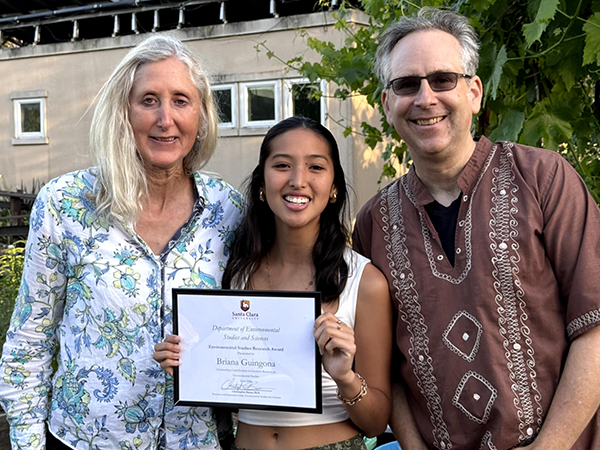
ESS Senior Awards & Celebration - Congratulations 2025 Seniors
Join us in congratulating the Environmental Studies & Sciences 2025 Seniors! We’re incredibly proud of all your accomplishments and the hard, dedicated work it took to get you to this point. We look forward to your post-SCU journey!
At the ESS 2025 Senior Send Off, the ESS Dept recognized five seniors with awards:
|
 |
Samantha Lei Wins Two National Fellowships
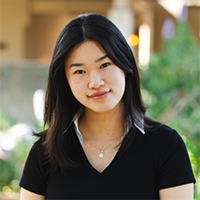
Congratulations to rising senior Sam Lei (Environmental Science 2026), who has won the Goldwater and Udall national fellowships based on her academic achievements, her research work with Professor Iris Stewart-Frey in the Water and Climate Justice Lab since her freshman year, and her vocational aspirations. Sam (shown here presenting at the American Geophysical Union annual conference) has led a monthly well testing program in the Central Valley for residents in areas dependent on domestic wells. With mentorship from Assistant Professor William Rush, she also helps lead the water quality lab and data analysis for both nitrates and metals, as well as communication with the communities about potential red flags. The Udall Scholarship Program identifies future leaders in environmental, tribal public policy, and health care fields. The Goldwater Scholarship Program supports outstanding undergraduates interested in pursuing research careers in the sciences, engineering, and mathematics.
Read More about Sam's Fellowship
Read More about Sam in Santa Clara Magazine
|
| |
|
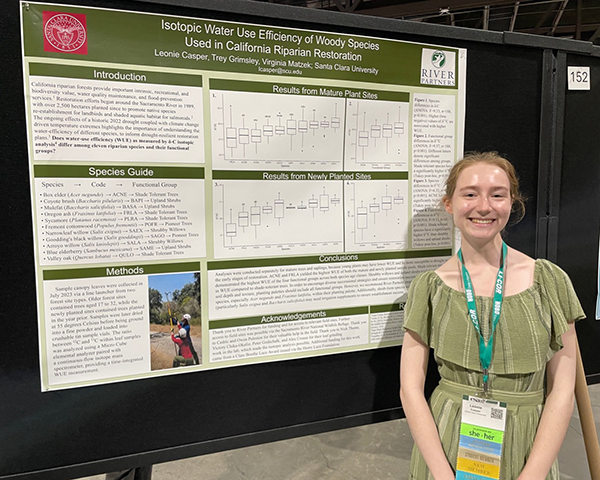 |
Student Research Update: Leonie Casper ’25
Leonie presented a poster on isotopic work at the Ecological Society of America Conference in Long Beach.
Read More
|
| In Our Courses |
 |
|
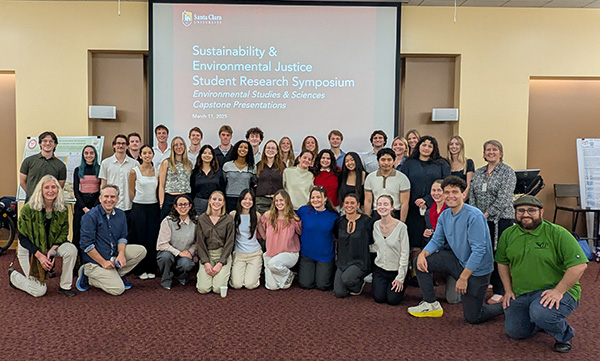
Professor Bacon’s Capstone student teams tackle food justice and strengthen garden-based education
Students conducted a values-based marketing feasibility study for a new catering co-op in East San Jose, designed school gardens, and built a countrywide food system data dashboard.
Read More
|
|
Professor Stewart-Frey’s Capstone student projects tackle water and climate challenges in environmental justice communities
Teams developed a river health assessment, studied riparian declines with ag development, and investigated levee risk assessments under climate warming.
Read More
|
|
Professor Dialesandro’s Capstone student projects address environmental injustice, water contamination, and air pollution
Student teams utilized geospatial and remote sensing analysis to help communities plan for a new park, mitigate extreme heat exposure, and identify sources of water pollution.
Read More
|
| |
|
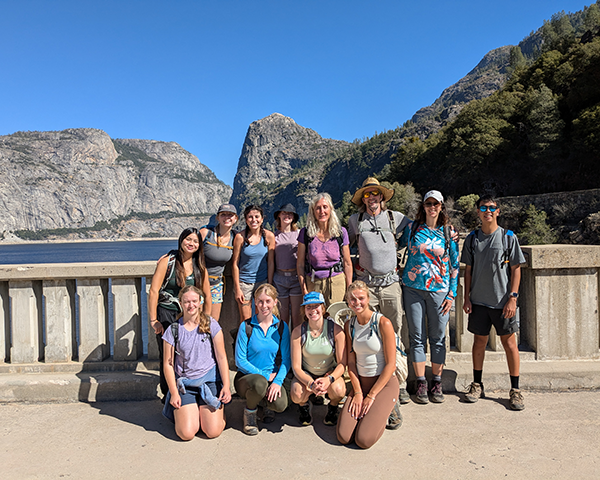 |
Deep Dive Course into the California Waterscape
Teams developed a river health assessment, studied riparian declines with ag development, and investigated levee risk assessments under climate warming.
Read More
|
| Latest Faculty & Student Research |
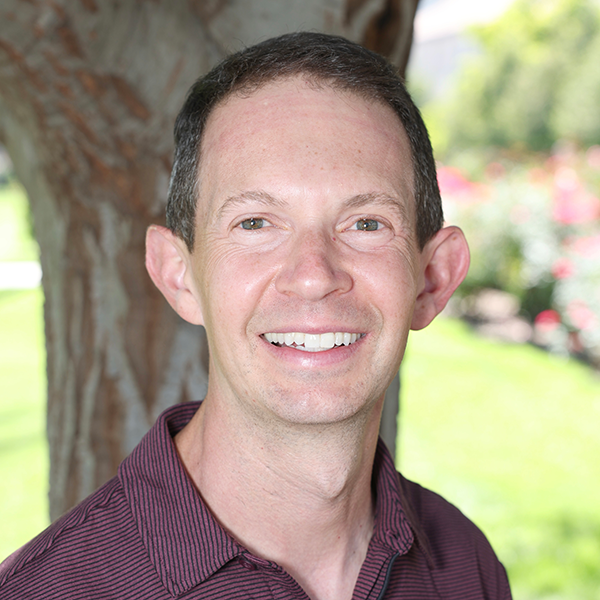 |
Gabbe publishes on urban heat planning with recent ESS graduates
Three ESS graduates collaborate with Gabbe to advance heat resilience research in California.
Read More
|
| |
|
 |
New Report Card Highlights Status & Trends for 30 Marine Species
Marvier led analysis of monitoring data. Photo credit: Southern sea otter (Enhydra lutris nereis) in Morro Bay, California, photo by Mike Baird, licensed under the Creative Commons Attribution-Share Alike 2.0 Generic license.
Read More
|
| |
|
 |
Convening for the Climate: The AGU 2024 Experience
Faculty and students traveled to Washington, D.C., to attend AGU and present research.
Read More
|
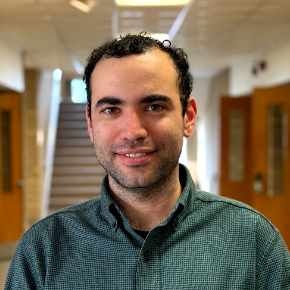 |
Welcome, Nicolas “Nico” Hernandez
Nico Hernandez joins ESS faculty as an Assistant Professor specializing in: Energy transition efforts in Puerto Rico, energy democracy, environmental rhetoric, science and technology studies. Please join us in welcoming Nico!
|
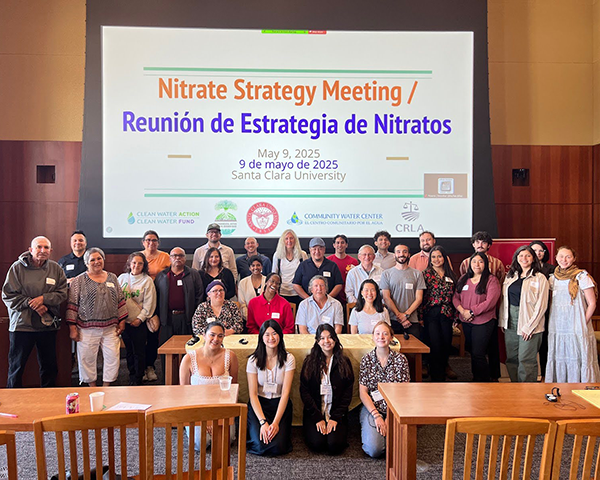 |
Nitrate Drinking Water Contamination Strategy Meeting
Iris Stewart-Frey and the Water and Climate Justice Lab collaborated with the Community Water Center, the California Rural Legal Assistance, the Environmental Law Foundation, Clean Water Action, the Leadership Council for Justice and Accountability, Monterey Waterkeepers, the California Coastkeeper Alliance and the Natural Resources Defense Council to organize a one-day bilingual conference at SCU. Representatives from environmental organizations, community committees, and academia heard community testimony, shared information, and developed strategic goals for nitrate regulatory programs (such as CV-SALTS, Ag 4.0, and the Dairy Order) and clean water advocacy. Iris Stewart-Frey and Jake Dialesandro presented new findings on how nitrate in groundwater varies in space and time, especially near Concentrated Animal Feeding Operations (CAFOs). Student lab members Elyse Kenyon, Stephanie Davis, and Samantha Lei contributed to the presentation. Victory Chika Okafor, Sophia Toribo, and Briana Guingona supported the logistics.
|
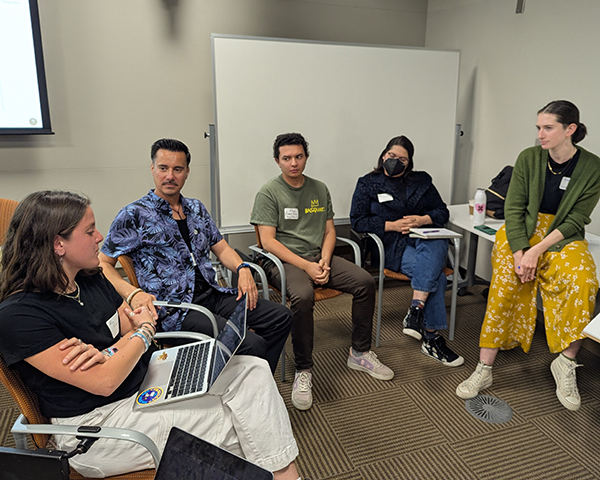 |
Bay Area Food Systems Resilience Learning Exchange
Chris Bacon partnered with Veggielution, UC Cooperative Extension, Valley Verde, and the South Bay Food Justice Collaborative to organize a half-day workshop and exchange among 21 organizations. Participants included twelve community organizations, faculty and students from five higher education institutions, three independent businesses, and one government agency. Program managers, County of Santa Clara Grant Food Resilience Grant recipients, leaders, policymakers, advocates, and researchers involved in systems change work in the South Bay area shared results of initiatives guided by the Santa Clara County Food Systems Work Plan and related efforts to advance food security, food sovereignty, and resilience.
|
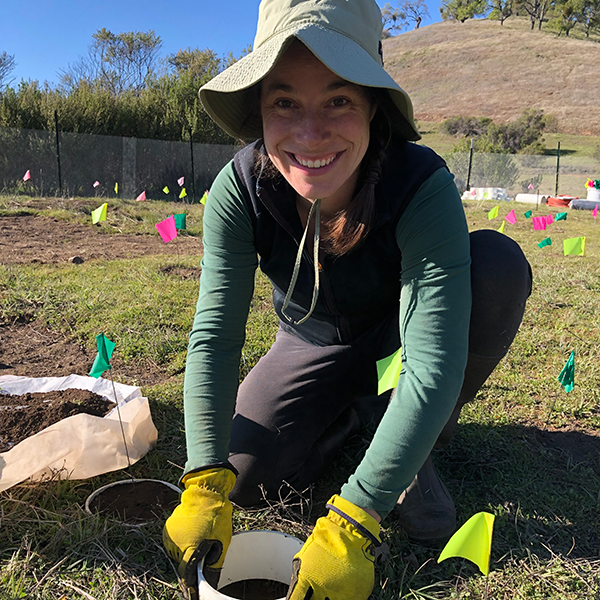 |
Miranda Melen ’09
Miranda recently earned her doctorate in ecology and evolutionary biology!
Read More
|
|