| Trouble viewing this email? Read it online. |

| November 21, 2025 | Submit a College Note |
For the past several weeks, we have been celebrating Gratitude Month at SCU. Post-it note stations have been set up in SCDI, Dowd, Vari, and Daly 300 for members of our community to leave messages of thanks. SCU’s Gratitude Calendar has offered small acts of kindness to perform each day in appreciation of those around us. The timing of Gratitude Month is no coincidence. Thanksgiving is just around the corner. For many of us, it is a time to gather with friends and family to share a meal and give thanks for the blessings, both big and small, in our lives. As I reflect on why I am grateful to be at SCU and in the College, I have a mix of feelings, as I’m sure you do. I delight in our unique and interesting community while I fret about the state of the world and our well-being as a university. If I ask myself why I am grateful to be here, I realize that my current answer has a lot to do with reassurance. If the times feel dangerous, then can our values and culture provide us some safety or refuge? I feel that we build community in part to support each other when times are challenging; however, a community must be built, cultivated, and nurtured by its members. Here in the College, we have created a culture that values our connectedness and celebrates our differences. As researchers, scholars, and staff, we are here for a common purpose—to educate the next generation of leaders. But, as colleagues and friends, we choose to participate in this community because of the ways in which it enriches and supports us. Next week, as you gather with loved ones to celebrate Thanksgiving, may your blessings be bountiful and your sense of community full. This week's poem is by Suji Kwock Kim, the Korean-American-British poet and playwright. Sincerely, Daniel Slant By Suji Kwock Kim If the angle of an eye is all, the slant of hope, the slant of dreaming, according to each life,
what is the light of this city,
light of Lady Liberty, possessor of the most famous armpit in the world,
light of the lovers on Chinese soap operas, throwing BBQ’d ducks at each
other
with that live-it-up-while-you’re-young, Woo Me kind of
love,
light of the old men sitting on crates outside geegaw shops
selling dried seahorses & plastic
Temples of Heaven,
light of the Ying ‘n’ Yang Junk Palace,
light of the Golden Phoenix Hair Salon, light of Wig-o-ramas,
light of the suntanners in Central Park turning over like rotisserie chickens
sizzling on a spit,
light of the Pluck U & Gone with the Wings fried-chicken shops,
the parking-meter-leaners, the Glamazons,
the oglers wearing fern-wilting quantities of cologne, strutting, trash-talking,
glorious:
the immigrants, the refugees, the peddlars, stockbrokers and janitors,
stenographers and cooks,
all of us making and unmaking ourselves,
hurrying forwards, toward who we’ll become, one way only, one life only:
free in time but not from it,
here in the city the living make together, and make and unmake over and
over
Quick, quick, ask heaven of it, of every mortal relation,
feeling that is fleeing,
for what would the heart be without a heaven to set it on?
I can’t help thinking no word will ever be as full of life as this world,
I can’t help thinking of thanks. Highlights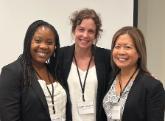
Elsa Chen (Political Science) and her co-authors Ericka Adams (San Jose State University) and Sarah Lageson (Northeastern University) have published a new article, "The Symbiotic Harm of a Criminal Record,” in the journal Criminal Justice and Behavior. Elsa also presented recent research on automated expungement policy passage in a webinar for an audience of state partners and policy advocates on Oct. 14. Image: Collaborators Ericka Adams, Sarah Lageson, and Elsa Chen.
Chris Weber (Physics and Engineering Physics) published an article, "Conditions of coherent-phonon excitation in SrMnSb2 films and crystals" in the Journal of Applied Physics. The work reported spanned seven years and three continents, and included student coauthors Hannah Aguirre '23 (Physics, Spanish Studies), Renee Chapla '26 (Engineering Physics), Javier Garcia de Castro '23 (Physics, Mathematics), Madison Masten '19 (Physics, Computer Science), and Yiyi Wang '23 (Physics).
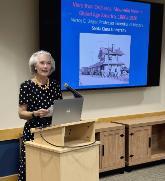
Nancy C. Unger (History, Emerita), presented "More than Orchards: Mountain View in Gilded Age America, 1880s-1920," to a packed house at the Mountain View Library on Nov. 2. The event was sponsored by the Mountain View Historical Society. Image: Nancy Unger speaking at the Mountain View Library.
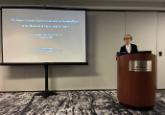
Ciara Ennis (Art and Art History, de Saisset Museum) presented a paper entitled “The Impact of Early Modern Collections on the Installation at the Musée de la Chasse de la Nature,” at the Sixteenth Century Society conference in Portland, Oregon on Oct. 30. This paper addressed the efficacy of utilizing a sixteenth century museal model—its various forms and display practices—as a conceptual framework for re-thinking exhibition practice and re-activating content at the Musée de la Chasse de la Nature, Paris. These ideas were examined in relation to the museum’s approach to aesthetics and display as well as its use of interdisciplinary and transhistorical objects for generating knowledge through wonder provoking installations. The presentation was included in the “Histories and Afterlives of Renaissance Collections II: Contemporary Engagements” session along with speakers from the Huntington Museum (San Marino, CA) and The Spurlock Museum (Urbana, IL). Image: Ciara Ennis presenting “The Impact of Early Modern Collections on the Installation at the Musée de la Chasse de la Nature,” at the Sixteenth Century Society conference.
On Oct. 28, as part of Jesuit Heritage Week, Francisco Jiménez, Kari Craighead and Victor Quiroz, all from the Modern Languages and Literatures department, participated in the Solidarity with Migrants exhibit. Francisco donated several signed copies of his books about his personal experience as an immigrant in the United States (like Taking Hold or La Mariposa) to be shared and given out at the event. In addition, Kari facilitated a knitting workshop in which students and faculty created souvenirs featuring motifs that promote empathy toward the immigrant community. Finally, Victor gave a talk on a visual display he curated, titled “Border Visualities,” featuring 48 contemporary artworks by ten different artists that explore border crossings and immigrant lives in the U.S.
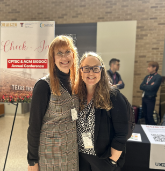
Heather Noel Turner (English) presented her research at the annual ACM Special Interest Group for Design of Communication (SIGDOC) Conference at Texas Tech University. Her research presentation focused on navigating organizational requirements and best practices in user experience research. Specifically, she discussed the harms and limitations of emerging AI tools that use synthetic users, arguing that these technologies reduce empathy-based approaches to procedural checklists that undermine their meaningful application in user experience research. This work advances scholarly discourse on ethical practices in human-computer interaction and technical communication. Image: Heather Turner and co-researcher Emma Rose (University of Washington) presented their research "Embracing and Resisting Industry Practices in User Experience."
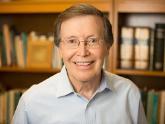
Francisco Jiménez (Modern Languages and Literatures, Emeritus) delivered a presentation introducing the screening of The Unbroken Sky, a short dramatic film based on his memoirs, on Oct. 9 at the San Francisco Public Library. On Oct. 23, he visited Dolores Huerta Elementary School in San Francisco, where students had read his book Cajas de cartón. During the visit, a teacher and the students performed a song they had composed, inspired by Cajas de cartón. That evening, he delivered a presentation in Spanish to the students’ parents, expressing his appreciation for their dedication to their children’s education. Also, following the screening of The Unbroken Sky at the Jesuit School of Theology at Berkeley on Oct. 28, he gave a talk on the importance of sharing stories. He emphasized that when we take the time to listen to and learn from the many voices that make up our diverse society, we build connections and come to recognize the hopes and struggles we all share. Through these connections, we break down walls that divide us and discover the joy and strength in our shared humanity. In addition, on Nov. 6, he served as the guest speaker, via Zoom, for Family Literacy Night at Mayacamas Countywide Middle School in Napa. Students had read Breaking Through, while their parents read the Spanish edition, Senderos fronterizos. His presentation emphasized the value of reading and education and the significance of honoring one's cultural heritage.
Leaders described servingness as creating student-centered, equity-focused environments that promote belonging and use mentoring as a key support strategy. They highlighted successes such as strong relationships and inclusive mentoring practices but also pointed to six major structural challenges, including unstable funding and limited institutional support. Drawing on the experiences of leaders working directly with students, the study shares practical ways HSIs can improve mentoring and create more supportive environments for Latinx and other marginalized students.
Alberto Ribas-Casasayas (Modern Languages and Literatures) was invited to present his co-edited volume Otras iluminaciones: Narrative, cultura y psicodélicos at ITESO, the Jesuit University in Guadalajara, México. The event was preceded by an interview at the campus radio show "Tinta Radio" and followed by another presentation at Cine Mayahuel, a movie theatre and cultural space in the city's historic center.

Sonja Mackenzie (Public Health), SCU graduate Neha Mann '25 (Public Health Science), and high school youth activist October Hertenstein published an article in the American Journal of Public Health (Nov. 13, 2025) entitled “Transgender youth health and joy: A model of evidence-based school district policy change to support transgender and nonbinary youth health.” There are currently 1,000 anti-transgender bills across the United States, more than one quarter of which target educational settings. School districts are an increasingly critical policy domain through which transgender and nonbinary youth health is harmed—and can be protected. This paper presents a case study of one California school district’s policy advocacy process as a model for building transgender youth health through a community and youth-led participatory process that, in itself, has supported transgender joy. This collaboration of trans and nonbinary youth, parents of trans and nonbinary youth, district administrators and the school board led to the passing of a policy resolution entitled Reaffirming Support for Transgender and Gender Expansive Children and Youth. While at SCU, Neha conducted research in Sonja's LGBTQ Health Equity Research Lab, attending meetings with the school district's superintendent and policy committee, and documenting forms of resistance to the onslaught of anti-LGBTQ+ policies across the U.S. Neha is now working as a research assistant with The PRIDE Study at Stanford. Image: Transgender pride flag, courtesy of the American Journal of Public Health.
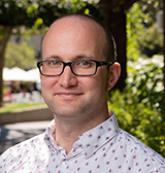
Erick José Ramirez (Philosophy) published an article with SCU alumni Laura Clark ’24 (Philosophy, Religious Studies), Sydney Campbell ’22 (Neuroscience, Philosophy), Julian Dreiman ’21 (Political Science, Individual Studies), Dorian Clay ’22 (Individual Studies, Computer Science and Engineering), Raghav Gupta ’24 (Neuroscience), Shelby Jennett ’24 (Neuroscience) in the journal Science and Engineering Ethics. The article, "Embodiment, Relationships, and Sexuality: An Ethical Analysis of Extended Reality Technologies," explores the impact of extended reality technologies on the ethics of identity-related concepts, including relationships, sexual orientation, and consent. Erick, et al., argued that contemporary conceptions of the self, sex, consent, and love emerged in purely physical contexts to help us navigate the limitations of physical embodiment and that XR embodiment requires new ethical frameworks to make room for these possibilities. The paper ends by assessing ethical risks XR embodiment can introduce for developers and researchers.
Six students from Laura Cocas' (Biology, Neuroscience) lab presented their data at the Society for Neuroscience Conference in San Diego. Got IT Questions or Issues?Stop by the virtual IT drop-in sessions with Charles Deleon! These sessions are designed to provide faculty and staff in the College of Arts and Sciences a friendly and casual setting for addressing general IT questions and concerns. Feel free to drop in and out at any time during the scheduled session, whether you have a quick question, need assistance with something and don't know where to start, or simply want to learn more about our IT resources. Biweekly. Next sessions: Today, Nov. 21, and Friday, Dec. 5, 11:30 a.m.–12:30 p.m. Zoom link
Faculty Development
Get connected!      |
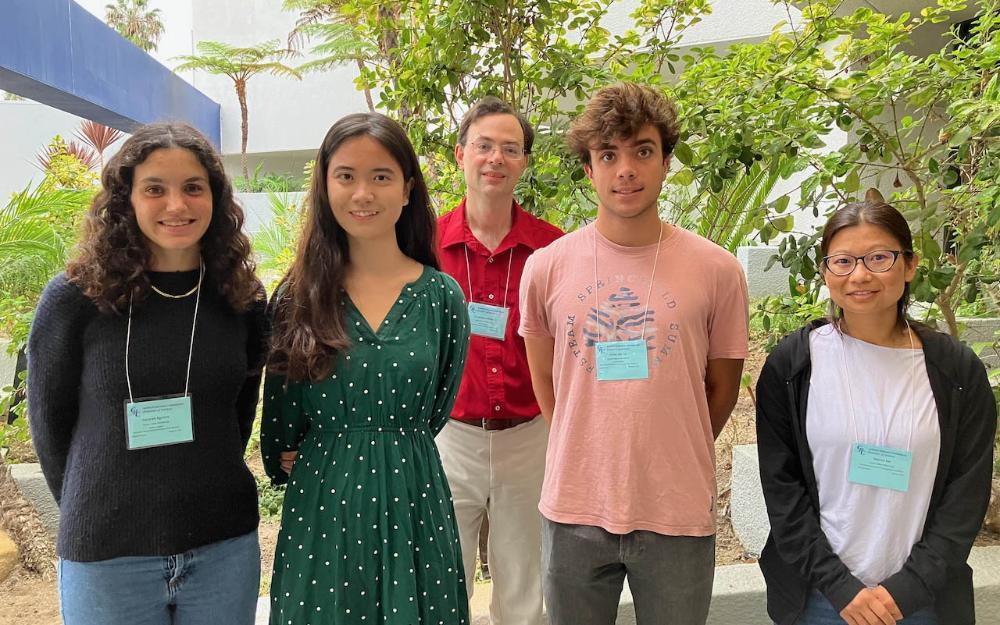 Some of the co-authors at the Gordon Research Conference on Ultrafast Phenomena in 2022. Left to Right: Hannah Aguirre, Yiyi Wang, Chris Weber, Javier Garcia de Castro, Manita Rai (post doc).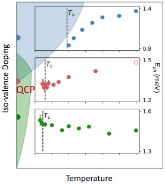
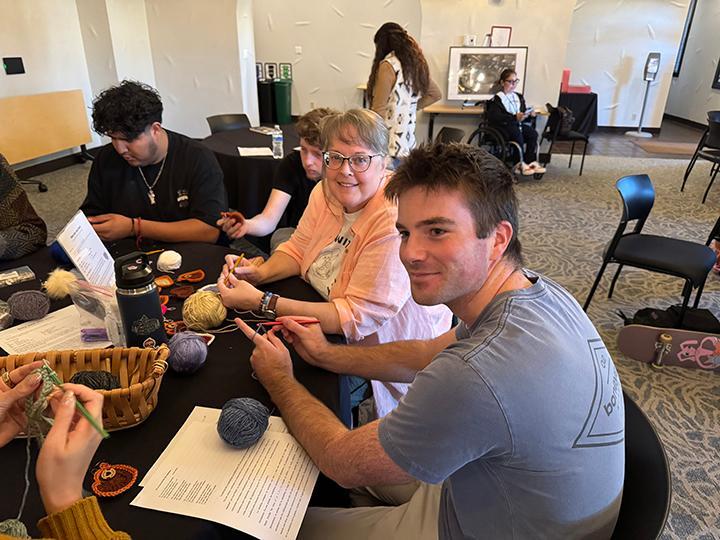 Kari Craighead (center) and SPAN 100 students at the Solidarity with Migrants exhibition.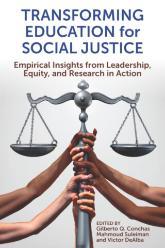
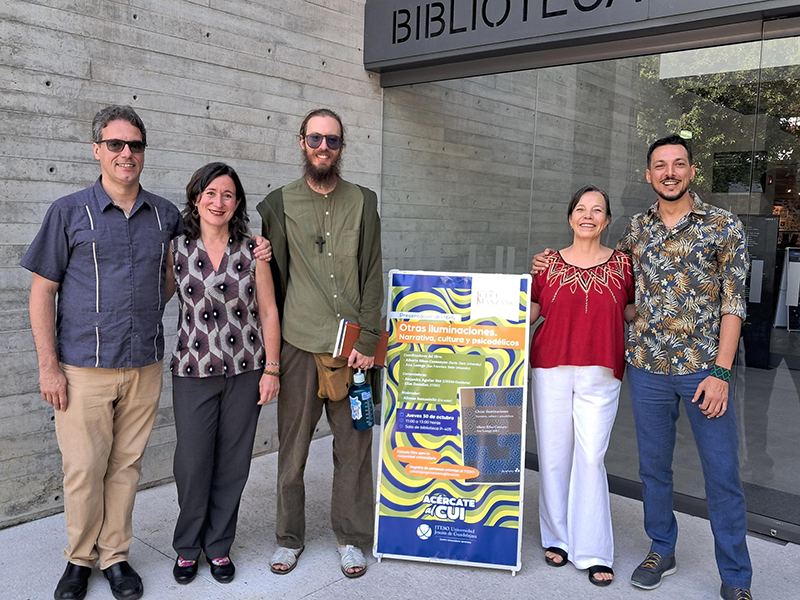 Left-right: Alberto Ribas-Casasayas, Ana Luengo (Modern Languages, SFSU), Elías González (Philosophy, ITESO), Alejandra Agruilar Ros (Anthropology, CIESAS Occidente), Alfonso Romaniello (Anthropology, CIESAS Occidente).
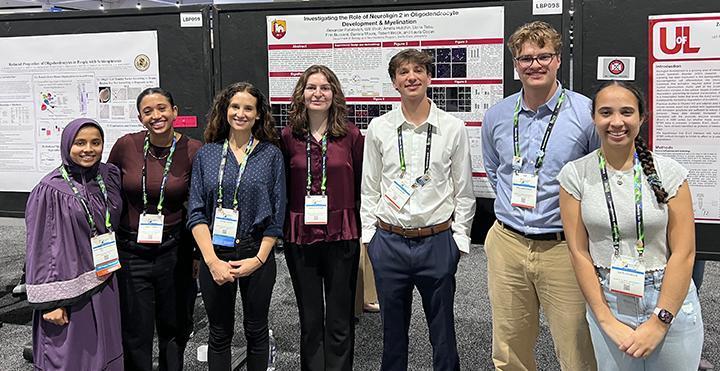 hereLeft-Right: Mariyam Lokhandwala ’26 (Neuroscience), Sahej Sidhu ’26 (Biology), Laura Cocas, Amelia Hutchin ’27 (Psychology, Neuroscience), Zander Rafalovich ’26 (Neuroscience, Psychology), Will Stroh ’27 (Biology), and Caitlyn Rock ’26 (Biology, Neuroscience).
| College of Arts and Sciences |
Submit a College NoteQuestions? Contact Sandy Boyer |