| Trouble viewing this email? Read it online. |

| January 9, 2026 | Submit a College Note |
Happy New Year, Happy January! Winter's gray skies and rain started the quarter, but quickly gave way to the brilliant January sunshine, just in time to welcome our students back to campus. I hope each of you had a restful, fun and healthy winter break, filled with time to disconnect from work and recharge with family and friends. The first week of any quarter is a monumental lift – from navigating registration hurdles to launching new projects and welcoming our students back into the rhythm of academia. The transition from the holiday quiet to the “Week 1 rush” can be hectic yet there is a noticeable satisfaction to getting back into the swing of things. As we conclude Week 1 and look ahead to what awaits in Winter Quarter, I want to draw your attention to our REAL Program. Applications are now open for students to get funding—up to $6,000—to engage in summer research, internships, projects, or creative works that allow them to discern their career goals, explore future employment fields, and grow their professional networks. Please encourage your students to apply! We are hosting weekly information sessions through February, with applications due March 1. This week's poem is from the great W.S. Merwin, one of my favorites, much beloved by environmentalists and humanists, especially on the West Coast and Hawaii. In Maui’s Pe’ahi Valley, Merwin planted and tended one of the world’s foremost palm tree collections, representing over 480 species, many of them endemic or endangered. Warm regards, Daniel January By W.S. Mervin
Highlights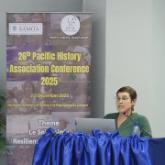
Maggie Wander (Art and Art History) presented at the Pacific History Association Conference in Apia, Sāmoa on December 4, 2025. Maggie's talk focused on three contemporary Indigenous artists from Oceania who make visible and material the colonial histories at the root of environmental injustice in the region. Image: Maggie Wander presenting at the Pacific History Association Conference in Apia, Sāmoa.
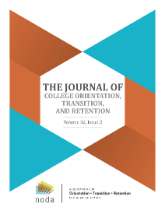
This retrospective mixed-methods study examines the experiences of first-generation college students participating in the LEAD Scholars program. Comparing LEAD alumni with a national sample (n = 29,560), they found that alumni were more likely to participate in nearly all Gallup-Purdue "Big 6" high-impact practices. Follow-up interviews with alumni surfaced key impactful experiences, such as awareness building, peer support, and professor support, as well as opportunities to expand career and emotional support. Image: A cover of the Journal of College Orientation, Retention, and Transition.

Jesica S. Fernández (Ethnic Studies) published an article with Dr. Ben Kirshner (CU Boulder), titled "Youth Community Organizing as Connected Learning for Political Thought in Action" in a special issue on The Development of Political Thought and Action in the journal Psicologia Sociale. Drawing on empirical evidence from the International Youth Organizing Study, the article purports that connected learning can offer a compelling framework for designing and studying interest-driven learning environments outside of school in the digital age. Typically applied to digitally mediated spaces that foster artistic development or STEM learning, Jesica and Ben make the argument that connected learning can help conceptualize young people’s social and political development, specifically collective action. In addition to this publication, Jesica delivered a virtual workshop at in the Urban Public Health & Psychology program at Charles R. Drew University of Medicine & Science. The workshop, "Dreaming Otherwise: What a decolonial praxis can foster in challenging times," invited the audience into a meditation on decolonial dreaming. Structured as a reflexive dialogue, the presentation encouraged participants to come together to reflect with the intention to learn about decolonial theory and praxes – and to see realities of liberation and freedom come into being through interwoven theoretical and practical reflections from Jesica's community-engaged research collaborations.

Tom Plante (Psychology) published the following journal article: "Ethics Corner: Ethics calls us to be our best selves while the law helps us to stay out of trouble" in On Board with Professional Psychology, Issue 7. Ethical issues and challenges are inevitable in our personal and professional lives and the more we look for them the more they will become apparent. Ethics call us to be our best selves following agreed upon virtues and values whereas the law helps us to do the minimum to stay out of trouble. This is the difference between ethical and professional floor versus ceiling (i.e., minimum expectations for behavior versus aspirational expectations for behavior). Keeping these distinctions in mind between law and ethics might be helpful when reflecting on the challenges that we experience in our professional and personal lives. Yet, often our professional challenges are complex where both ethical and legal issues and potential conflicts are intertwined. We may wish to intentionally reflect on our lives and career with ethical lenses in mind as much as we can do so in order to be our best selves.
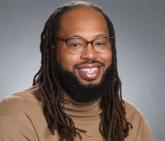
In mid-December, Justin Clardy's (Philosophy) 2018 article, "‘I Don't Want To be a Playa No More': An Exploration of the Denigrating Effects of ‘Player' as a Stereotype Against African American Polyamorous Men" was translated into Portuguese and published by Dr. Rhuann Fernandes in the special issue “Masculinidades nos espaços-tempos” of the journal Diversidade e Educação. This is the first time Justin's work has been translated—merit that speaks to the widespread impact of Justin's research agenda around race and non-monogamy. In this article, Justin shows how amatonormativity and its attendant social pressures converge at the intersections of race, gender, romantic relationality, and sexuality to generate peculiar challenges to polyamorous African American men in American society. Justin argues that the label ‘player’ when applied to polyamorous African American men functions as a pernicious stereotype and has denigrating effects—more specifically, that stereotyping polyamorous African American men as players estranges them from themselves and it constrains their agency by preemptively foreclosing the set of possibilities of what one’s sexual or romantic relational identities can be.
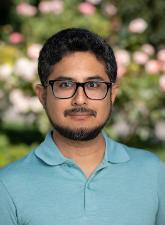
Towards the end of the Fall 2025 quarter, Victor Quiroz (Modern Languages and Literatures) gave a guest lecture for the LIT 105 Fiction Narrative course at Pontificia Universidad Católica del Perú (PUCP). The invitation was extended by Professor Guillermo Raffo, who included in his syllabus a discussion of Victor’s article “La carnavalización del Archivo en Adiós, Ayacucho de Julio Ortega,” published in 2014. During the lecture and conversation with PUCP students, Victor revisited the main arguments of his paper on the novella Adiós, Ayacucho (1986/2008) by Peruvian author Julio Ortega, a fictional narrative that offers a parodic perspective on Peru’s Internal Armed Conflict (1980–2000). Victor also expanded on his research by analyzing shifts in the use of humor between the 1986 and 2008 editions of Ortega’s text, reflecting on their historical and political implications, and by examining differences between the novella and its Quechua-language theatrical adaptation performed by Grupo Cultural Yuyachkani.
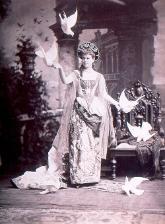
Fans of HBO Max's "The Gilded Age" may recognize Alva Vanderbilt as the model for Bertha Russell, played by Carrie Coon. The BBC's podcast History Extra featuring Nancy Unger (History, Emerita) examines Vanderbilt's lows (she forced her daughter into a loveless marriage to the 9th Duke of Marlborough) as well as her highs (she was a talented architect and tireless campaigner for women's rights). Image: A young Alva Vanderbilt at her extravagant 1883 costume ball. Photo credit: The Museum of the City of New York.
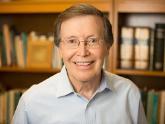
Francisco Jiménez (Modern Languages and Literatures, Emeritus) was honored by Brother Rice High School in Bloomfield Hills, Michigan, through the establishment of the “Francisco Jiménez Chapter” of the Spanish National Honor Society. The Spanish National Honor Society, sponsored by the American Association of Teachers of Spanish and Portuguese (AATSP), recognizes high school students who demonstrate excellence in Spanish or Portuguese studies. On December 2, 2025, Francisco delivered a presentation on the transformative power of education at the Performing Arts Center to approximately 180 students at Del Mar High School. The students had been reading his works The Circuit: Stories from the Life of a Migrant Child and Breaking Through as part of their coursework.
OLLI@SCU courses range from 4 to 10 hours of instruction per quarter. We hope this will inspire you to stay updated on OLLI news and possibly teach a class for our members. OLLI instructors are compensated for their time and knowledge; to learn more about the joy of teaching adult learners, contact olli@scu.edu.
REAL Program Information SessionsThe REAL Program is providing information sessions on the following dates: January 12, 9:30 - 10:15 a.m. (Daly Science 310) Final Drop In Session Application deadline: March 1
Get connected!      |

| College of Arts and Sciences |
Submit a College NoteQuestions? Contact Sandy Boyer |