| Trouble viewing this email? Read it online. |
| Fall 2025 |
Fostering community-driven research and learning for social and environmental justiceNewsEnvisioning the Future of Environmental Justice in Jesuit Education
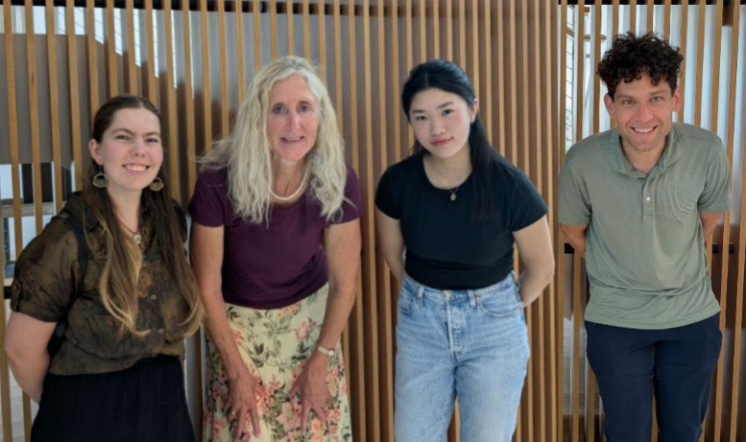
This past summer, members of the Initiative were invited presenters at four international conferences on environmental justice, integral ecology, and the future of Jesuit education.
They drew several collective conclusions from these gatherings:
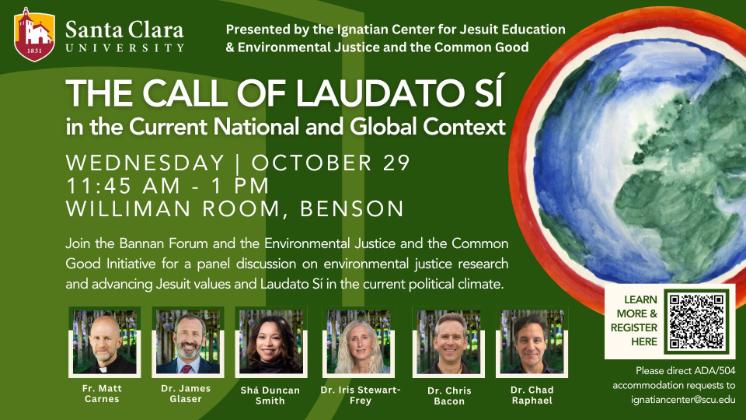
Stewart-Frey, Bacon, and Raphael shared these conclusions and potential steps with the campus community at a panel discussion at SCU in October, co-organized by Stewart-Frey and Aaron Willis of the Ignation Center for Jesuit Education, which included Provost James Glaser, Vice-President of Mission and Ministry Fr. Matthew Carnes, and Vice-President for Inclusive Excellence Shá Duncan Smith. Read more about our reflections and potential action steps here. Pilgrimages of Hope for Creation
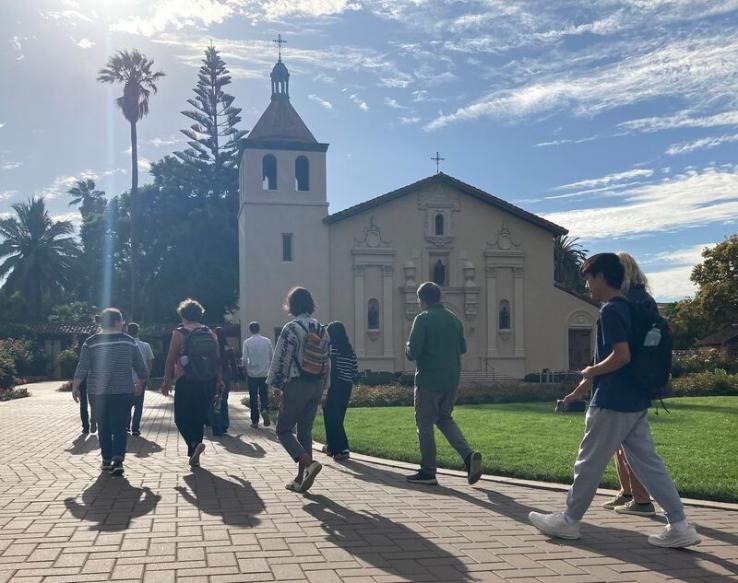
The Initiative contributed two events to the national Catholic Pilgrims of Hope for Creation movement to lift a unified voice for integral ecology and the importance of care for creation. In October, the Initiative co-organized a “Pilgrimage of Hope for Creation and Indigenous Reconciliation” at SCU, with the SCU Center for Sustainability, The Forge Garden, Ignatian Center for Jesuit Education, de Saisset Museum, and Community Heritage Lab. Faculty, staff, and students walked and reflected on the history of Mission Santa Clara and the university’s current reconciliation work with the descendants of the Ohlone and Muwekma Ohlone people who were missionized here. The first stop was The Forge Garden's Ohlone Native Plant Garden, where Muwekma Ohlone Vice-Chairwoman Monica V. Arellano and Professor Amy Lueck spoke about SCU’s Ohlone Youth Camp and Muwekma Ohlone scholarship. Proceeding to the heart of campus, participants learned from Professor of Anthropology Lee Panich about the original Muwekma Ohlone settlement there. In front of the Santa Clara Mission, Panich spoke about the missionization period and recent collaborations with tribal leaders to incorporate their perspectives and experiences into campus history exhibits at the de Saisset Museum, and a Google Earth site and augmented reality app created by the Community Heritage Lab. At the Saint Clare Garden, Aaron Willis and Paulina Salinas of the Ignatian Center for Jesuit Education explained how the plantings told the story of the stages of Clare of Assisi’s life. The pilgrimage of hope ended at the de Saisset Museum, which held an artist’s reception for Californiana, Monica Rodriguez’s installation exploring the enduring impact of this history on the people, land, and culture of California. In September, Chris Bacon and Maria Eugenia Flores Gomez partnered with Veggielution and the Forge Garden to host a networking event on values-based food purchasing with local sustainable food vendors, SCU administrators, and students, entitled “Ethical Sourcing: Local Food Tasting with East San Jose Catering Cooperatives.” (See more about this event below in the section on our networking). Stewart-Frey Wins SCU Award for Excellence in Scholarship
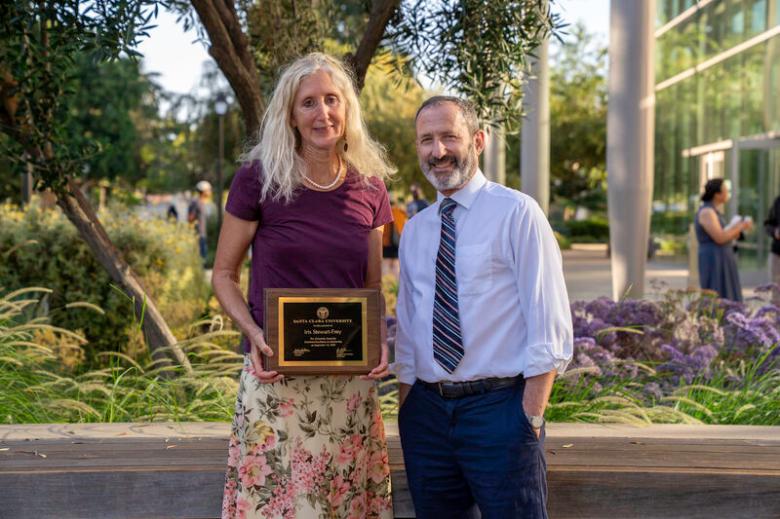
Iris Stewart-Frey earned Santa Clara University's Award for Sustained Excellence in Scholarship. In bestowing the award, Provost James Glaser praised Stewart-Frey as a “prominent hydrologist whose research centers on the effects of climate change on water resources, environmental justice, and sustainability in California, Central America, and Mexico.” Glaser highlighted the NicaAgua climate forecasting app – developed with communities in Nicaragua and colleagues in SCU’s Water and Climate Justice Lab to support smallholder farmers in adapting to climate change – as an example of her community-engaged and interdisciplinary approach to research. Over the past decade, Dr. Stewart-Frey has published 16 peer-reviewed papers, most co-authored with SCU faculty colleagues and undergraduates. Her research has received support from the Rose Foundation, California Environmental Protection Agency, and National Science Foundation. Stewart-Frey noted that “I’m incredibly grateful to my brilliant colleagues and students whose insights, passion, and commitment make this work possible every day. Thank you to SCU and to all who support, challenge, and inspire me.” In Our ResearchLessons from Italy about Sustainability, Community, and the Common Good
Jesica S. Fernández published several reflections inspired by her Fulbright fellowship in Italy. In Siena’s Contrade: A Reflection on Environmental Interconnectivity, Fernández reveals that the medieval city of Siena isn’t just a tourist town, but has important contemporary lessons to teach about sustainability, community, and the common good. She focuses on how Siena’s districts, each with its own traditional emblems of animals and plants, foster a sense of belonging and connection to nature that is preserved through traditions such as the city’s annual Palio games. In a contribution to The Community Psychologist, What Italy Taught Me About Community (and) Psychology, she writes about how experiencing “a different conception of time not as quantity but quality” is necessary to be in community with others and to ensure that our relationships with them reflect our best values. She expands on this reflection in Time as Water: A Metaphor to Embrace the Fulbright Experience, which offers advice to future Fulbright scholars about how to approach time for research abroad through the lenses of fluidity, impermanence, and expansion. Stakeholder Processes to Control Nitrate Contamination of Groundwater
Iris Stewart-Frey, Jake Dialesandro (SCU Environmental Studies and Sciences), and undergraduate researchers Samantha Lei (’26) and Lilah Foster (’21) published an article in Water Resources Research, one of the most highly-ranked journals in the water field. In the article, "Toward the Human Right to Water for Vulnerable Communities: The Effectiveness of Stakeholder Processes to Control Regional Shallow Groundwater Contamination by Nitrates," the authors demonstrate that despite stakeholder processes, regional nitrate contamination is rising, and is significantly higher with severe drought and proximity to Concentrated Animal Feeding Operations (CAFOs). A new metric developed in the study supports the prioritization of monitoring in areas of high nitrate variability, maximum contaminant level exceedance, and low observational density. The authors argue that to guarantee the Human Right to Water, policies to include interannual sampling, domestic well regulations, and source reduction must be enacted. (Learn more about their lab by reading this recent article in Santa Clara Magazine). Groundwater Pollution Presentation at Environmental Justice Conference
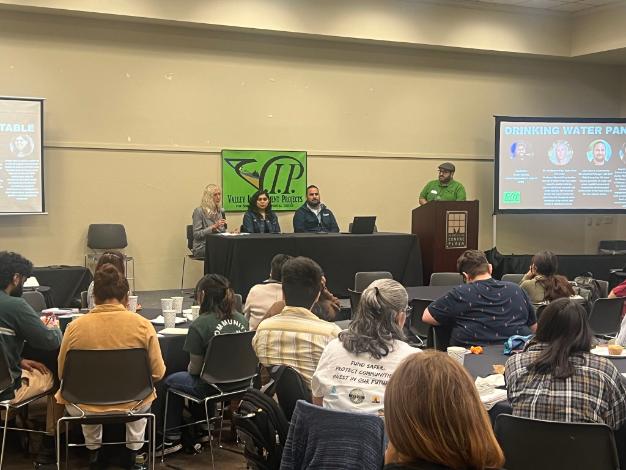
In October, Iris Stewart-Frey was invited to speak on a panel about groundwater pollution at the Valley Improvement Project’s (VIP) 4th Annual Environmental Justice Conference in Modesto, CA. Co-organized by the Initiative’s advisory board member Edgar Garibay of VIP, the conference brought together community organizations, community members, agency and government representatives and academics to learn from each other about current issues of air and water quality, land use, and zero waste. Stewart-Frey discussed the challenges of characterizing shallow groundwater contamination over space and time, its impact on disadvantaged communities, existing data gaps, and the regulatory processes, opportunities, and barriers involved in reducing contamination. Sharing Research on Values-based Food Procurement in San José
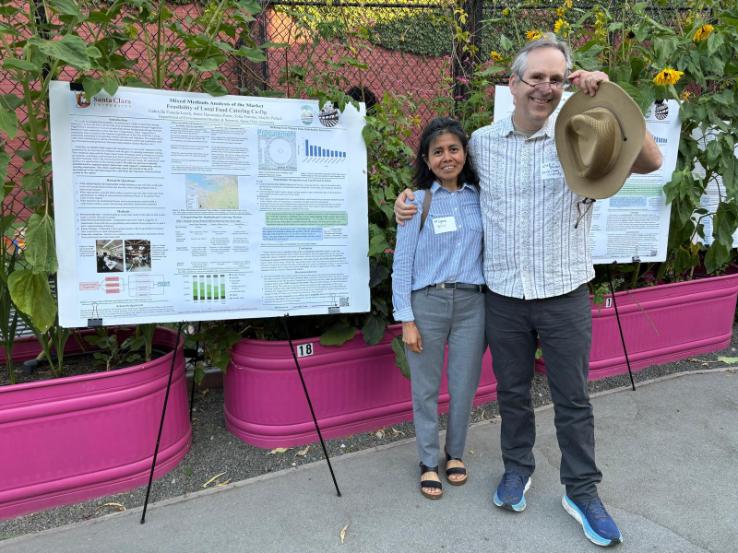
In June, the Initiative’s Chris Bacon and Maria Eugenia Flores Gomez shared research results from student capstone projects that partnered with Veggielution to incubate a new food worker catering cooperative in East San José. The posters summarized the design of a food systems data dashboard and a values-based purchasing feasibility study to more than 20 local agencies, non-profit organizations, community supporters, and residents' associations that gathered to celebrate the launch of Raíces, Fusión y Sazón, a new worker-owned food catering cooperative. The co-op served small plates while attendants participated in an interactive garden workshop hosted by We Start Gardens. The co-op’s formation has been supported by La Cocina, Ventures and Democracy at Work Institute, which also attended the event at SoFA Pocket Park - a vibrant urban garden in the heart of downtown San José. Reclaiming our Roots: Food Systems and Food Sovereignty
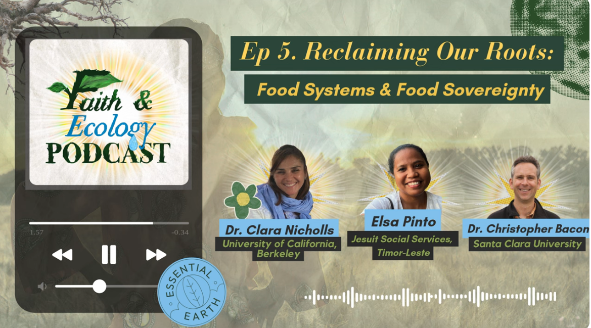
Chris Bacon contributed to the EcoJesuit Youth and Ecology podcast on "Reclaiming our Roots: Food Systems and Food Sovereignty." The episode examined the vital concept of food sovereignty — the right of communities to healthy, culturally meaningful food grown through sustainable, ecologically sound practices. Bacon, Clara Nicholls (UC Berkeley & Stanford), and Elsa Pinto (Jesuit Social Services, Timor-Leste) explored why reclaiming food sovereignty is urgent for protecting culture, health, and indigenous rights, and how it paves the way toward climate justice rooted in respect for our common home. Listen on YouTube, Spotify, or Apple Podcast. New Edition of Teaching Sustainability Competencies across the Disciplines
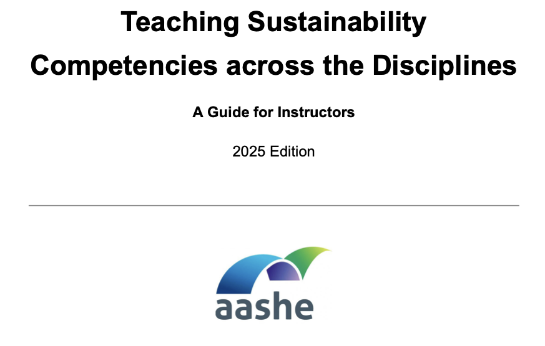
Chad Raphael led members of the Association for the Advancement of Sustainability in Higher Education’s (AASHE) Scaling Up Sustainability Community of Practice to publish a second edition of the group’s guide for instructors to teaching sustainability competencies – such as systems thinking, strategic thinking, and futures thinking – across the higher education curriculum. The guide, which is available for free on AASHE’s website, is widely used by AASHE training centers across North America and has been translated into Spanish for use in Latin America. The revised edition includes additional resources and teaching examples, and a new section on teaching tools, including examples of national and global mapping databases, visualizations, simulations and games, and datasets that can be used in sustainability education. In Our NetworkingCatalyzing SCU Scholarship on Youth, Environmental Justice, and Health
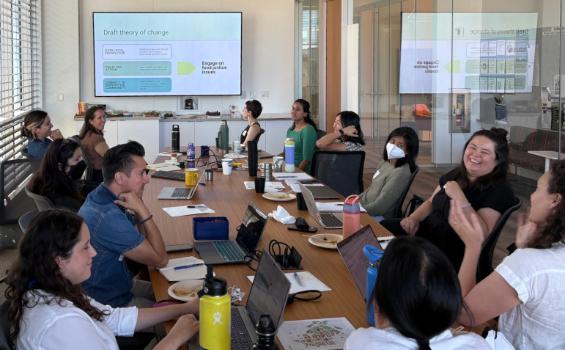
This fall, Jesica S. Fernández and Chad Raphael are convening SCU faculty members interested in developing community-based learning and research projects focused on youth, environmental justice, and health equity. The workshops include an online component with a library of training materials and resources on designing projects with community partners, as well as in-person project design meetings. The first in-person meeting in October focused on how to develop mutually beneficial partnerships with community organizations, funding opportunities, and ways to disseminate findings in multiple formats. Participants from eight different academic departments worked in small groups to identify shared interests and give feedback on each other’s plans. At the second meeting in December, participants will meet with potential SCU and community collaborators to explore projects on such topics as nutrition and early childhood development; mapping religious assets for community organizing on health; improving access to greenspace for historically-excluded youth; arts education and installations on environmental justice themes; and improving food security and health justice. SCU’s Ignatian Center for Jesuit Education is supporting this work to bring SCU and community partners together to catalyze interdisciplinary faculty and student scholarship that improve youth health and wellbeing in our region. The online training materials will be a useful resource for additional faculty and students to use in the future. Research on Nitrate in Groundwater Presented to State Water Board Panel
With colleague Dr. John Dialesandro of SCU’s Water and Climate Justice Lab, Iris Stewart-Frey presented critical data analysis to the State Water Resources Control Board’s Nitrate Expert Panel in August. Their findings showed that despite educational programs and voluntary reduction efforts, nitrogen pollution in groundwater continues to worsen—harming both people and ecosystems. The data reveal a statistically significant, positive relationship between nitrogen discharge (A-R or applied minus removed) and nitrate concentrations in groundwater wells. The researchers concluded that targeting the largest nitrate dischargers and areas with the highest nitrate concentrations in groundwater will yield the greatest health and environmental benefits. This research supports a coalition of over 20 environmental justice organizations and communities impacted by nitrate pollution in the Central Valley and Central Coast. Field Visit to Center on Race, Poverty & the Environment
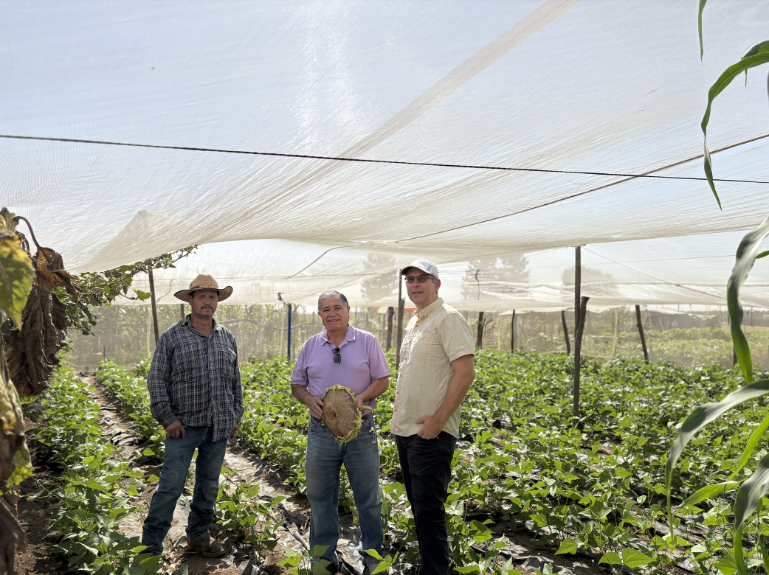
On August 21, 2025, Chris Bacon and Maria Eugenia Flores Gomez drove to the Southern San Joaquin Valley to meet with Gustavo Aguirre from Center on Race, Poverty & the Environment (CRPE), a long-term community partner of the Initiative. Bacon and Flores Gomez shared results from a past SCU Environmental Studies and Sciences department capstone project and explored future collaborations. They also observed first-hand the risks of heat exposure (exceeding 100 degrees), air pollution, pesticide pollution, and contaminated water from Confined Animal Feeding Operations. Aguirre was an inspiring host, sharing about CRPE’s Toxic Free Communities, Forgotten Voices, and Climate Justice campaigns, as well as the role of organized farmworkers and local communities in leading change. The area is undergoing rapid changes in land use, transitioning from agriculture to industrial warehouses and residential development. In response, CRPE continues to use its powerful organizing model, which combines leadership development and legal advocacy for environmental justice, winning tangible victories for communities across the valley. One example of this is the people's testimonies at the Richland Community Garden in Shafter, a 15-year-old garden that CRPE and local residents established in collaboration with the local school district. Dialogue Advances South Bay Place-Based Food Justice Curriculum Project
In September, Christopher Bacon co-organized a dialogue in collaboration with the South Bay Food Justice Collaborative, Veggielution, and the UC Cooperative Extension, aimed at co-producing a place-based food justice curriculum in the South Bay. Representatives from nine organizations, agencies, and two universities gathered at SCU to initiate a participatory curriculum design process. The dialogue focused on understanding the current needs for food justice education in the South Bay, including training goals, primary audiences, potential curriculum uses, content, and delivery formats. This work is supported by a grant from Western Sustainable Agriculture Research and Education. Ethical Sourcing: Catering Cooperatives and the Good Food Purchasing Program
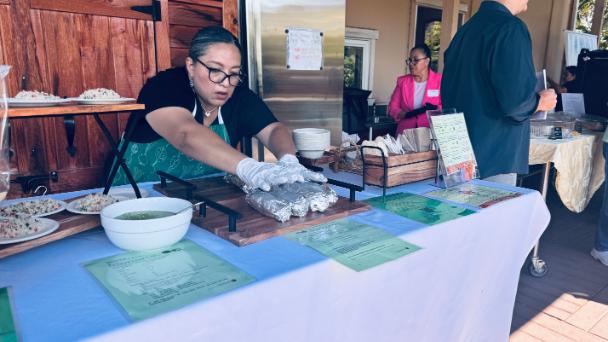
In September, the Initiative partnered with Veggielution to facilitate a networking event at SCU’s Forge Garden connecting six local sustainable food vendors from East San Jose with SCU administrators and students. The students, from Chris Bacon’s capstone course, will help Veggielution and the vendors to create a place-based food justice curriculum. The food vendors, mostly women, have organized into worker-owned catering cooperatives and home cooking enterprises, supported by Veggielution’s Eastside Grown Program, which helps residents start their own food businesses. They shared their testimonies, business values, information, and a wide range of vegan and vegetarian food options. SCU administrators, as potential buyers interested in implementing values-aligned procurement, had the opportunity to ask questions, sample the food, and establish connections.
Recent ProgrammingAnnual Sustainability and Justice across the Curriculum Workshops Train Faculty and Staff
In June and July, Chad Raphael and SCU Center for Sustainability’s Lindsey Kalkbrenner and Veronica Johnson taught three online workshops on integrating sustainability and justice into the curriculum to over 75 faculty and sustainability staff participants from SCU and 17 other institutions across the country. Thanks to support from SCU’s Sustainable Business Institute, we welcomed almost all of the instructors in the Leavey School of Business’s introductory undergraduate course, Contemporary Business Issues, which is one of the most popular courses at SCU. The new curricula that participants developed in the workshops will reach thousands of students per year in fields such as Anthropology, Biology, Economics, Education, Engineering, English, Ethnic Studies, History, Psychology, Sociology, and Spanish, and in community-based learning placements, fellowships, and immersions. Participants came from private and public universities around the U.S., California Community Colleges, and Jesuit high schools. Over the past three years, all participants agreed that the workshops fulfilled their goals and 98% said that they would recommend the workshops to a colleague. The workshops are offered each summer by the Initiative and SCU's Center for Sustainability, which is a national training center affiliated with the Association for Advancement of Sustainability in Higher Education. Anyone interested in joining next summer’s workshops can apply using the link on our webpage, starting in early February. Data Centers and Vulnerable Resources: The AI Explosion and Our Water
Iris Stewart-Frey and Irina Raicu, Director of the Internet Ethics Program at SCU’s Markkula Center for Applied Ethics, discussed the growing water demands of artificial intelligence (AI) data centers, including case studies about their impacts on nearby communities. The session addressed the impact of AI on vulnerable water resources and communities, options for conserving water in data center operations, the tension between the need for power and water, recent promises of greater sustainability by the industry, and proposed regulations. Moderated by Kristin Kusanovich, the panel was organized as part of SCU’s tUrn week, and co-presented by the Initiative, the SCU Department of Environmental Studies & Sciences, and the Markkula Center for Applied Ethics. Research Grant SpotlightHighlights of research supported by our research grant program. Resilience after the San Bruno Pipeline Disaster: A Follow-Up Study
Jasmín Llamas’ (Counseling Psychology) follow-up study explores resilience in the aftermath of the 2010 San Bruno, California gas pipeline explosion, which killed eight people and damaged or destroyed over 70 homes. The disaster highlighted environmental justice concerns related to oversight, safety, and obstruction of justice. The initial project was guided by community-based participatory research employing a mixed methods design to test a model of resilience. To explore how resilience and coping has evolved over time, the study will track residents’ recovery process to identify if new themes have emerged and to provide an additional data component to the initial resilience model developed. This information will be shared back to community partners to highlight residents’ strengths and resilience, and areas of continued support. Student SpotlightMorgan Billington
Morgan Billington (’23), who graduated from SCU with majors in Environmental Studies and Economics, is now the Sustainability Program Coordinator at Northeastern University’s Mills College campus in Oakland. Morgan returned to us this past summer to complete our workshop on Pedagogy for Sustainability and Justice, discovering new teaching materials and techniques she can share with her faculty colleagues at Northeastern. At SCU, Morgan’s senior capstone team, supervised by Chris Bacon, researched food systems policy in collaboration with Santa Clara County’s Food System Alliance, the county’s Consumer and Environmental Protection Agency, and Joint Venture Silicon Valley. Morgan’s team conducted a participatory mixed-methods study on municipal food programming in the county that examined the extent to which each municipality prioritized food justice and equity. The team developed recommendations to address gaps in local food systems’ policies, programs, funding, and resources. As an undergraduate, Morgan was also Vice-President of Into the Wild, SCU’s wilderness adventuring student organization. “I'm open-minded and committed to trying new things,” says Morgan. “I like to push myself into uncomfortable situations because I firmly believe that risk-taking equates to learning. And as someone who has lived in several geographical regions, I know that diversity is power. I have always been keen to learn from those who have different backgrounds and values.”
Check us out on our social media channels:
|







| Home | Privacy Policy | Unsubscribe |
|
Environmental Justice and the Common Good Initiative Santa Clara University 500 El Camino Real Santa Clara, CA 95053 environmentaljustice@scu.edu |