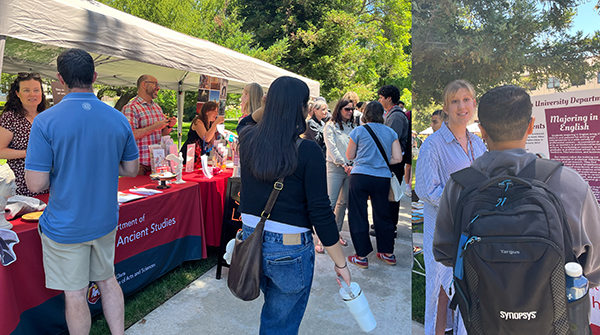
Orientation Resource Fair, July 8.
Dear College Faculty and Staff,
This week SCU hosted our first of many summer orientation sessions for the Class of 2030. I am so grateful for the warm welcome our faculty and staff are giving to incoming first year students. Beyond making orientation a fun visit, the SET team and our faculty advisors work hard to make sure that students know their way around Workday, learning platforms, and the campus. Crucially, we now do a lot of pre-enrolling, especially for students in STEM majors. That reduces the stress of figuring out what classes they have to take, and makes it clearer to them what room they have in their schedules for their preferred core or introductory courses. We've noticed that all of this summer work makes a big difference to students when they arrive in September. They can just move in and relax. Many thanks to everyone who puts in all this work during the summer!
Last month, SCU held their annual Staff Recognition Event. We had a number of staff members celebrated for their years of service, whom I wanted to call out here.
- Vicky Gonzalez, Religious Studies - 35 years
- Daryn Baker, STEM - 25 years
- Andrea Saade, OLLI - 20 years
- Jessica Szyndrowski, English - 20 years
- Naomi Arnst, Theatre and Dance - 5 years
- Britt Cain, Dean’s Office & CAH - 5 years
- Pam Doherty, Political Science - 5 years
- Steven Fetter, Theatre and Dance - 5 years
- Heidi Kobara, Biology - 5 years
I also want to congratulate Andrea Saade, from the Osher Lifelong Learning Institute, who received this year’s Charles Ambelang Award for her work serving the OLLI community. This award recognizes an individual, unit, or department that embodies Charlie’s mission to foster a more connected, healthy, and empowered SCU community. In his introduction to this award, Staff Senate president, Ray Plaza, said, “Always leading with compassion, conscientiousness, and an even temperament in the face of any challenge, [Andrea] has created a safe, welcoming, and joyful home for our older adult community and volunteers.” Congratulations, Andrea!
This week's poem is by Amy Gerstler and spoke to me of nature and the secret lives of trees.
Happy July!
Daniel Bon Courage
By Amy Gerstler
Why are the woods so alluring? A forest appears
to a young girl one morning as she combs
the dreams out of her hair. The trees rustle
and whisper, shimmer and hiss. The forest
opens and closes, a door loose on its hinges,
banging in a strong wind. Everything in the dim
kitchen: the basin, the jug, the skillet, the churn,
snickers scornfully. In this way a maiden
is driven toward the dangers of a forest,
but the forest is our subject, not this young girl.
She’s glad to lie down with trees towering all around.
A certain euphoria sets in. She feels molecular,
bedeviled, senses someone gently pulling her hair,
tingles with kisses she won’t receive for years.
Three felled trees, a sort of chorus, narrate
her thoughts, or rather channel theirs through her,
or rather subject her to their peculiar verbal
restlessness ... our deepening need for non-being intones
the largest and most decayed tree, mid-sentence.
I’m not one of you squeaks the shattered sapling,
blackened by lightning. Their words become metallic
spangles shivering the air. Will I forget the way home?
the third blurts. Why do I feel like I’m hiding in a giant’s nostril?
the oldest prone pine wants to know. Are we being freed
from matter? the sapling asks. Insects are well-intentioned,
offers the third tree, by way of consolation. Will it grow
impossible to think a thought through to its end? gasps the sapling,
adding in a panicky voice, I’m becoming spongy! The girl
feels her hands attach to some distant body. She rises
to leave, relieved these trees are not talking about her.
Highlights
Tanya Gupta (Psychology/Neuroscience) published an invited Outlook article, "Time Does the Teaching," in the Journal of Experimental Psychology: Animal Learning and Cognition (2026). The article reviews Burke et al. (2026), which demonstrated that the rate at which learned behaviors and their associated dopamine signals emerge scales proportionally with the time between rewards. Tanya discusses implications for the formalization of learning rate in behavioral and dopamine-based models of associative learning, and considers extensions to interval timing and operant conditioning.
Paul Soukup, S.J., (Communication) presented a paper, "Translation, Media Ecology, and the Global Church," at the PIETRA Communication and Translation conference at the University of Galway, June 8-9.
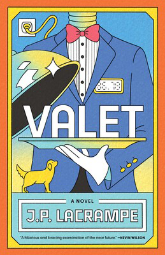
J.P. Lacrampe's (English) debut novel, Valet, was published by Saga/Simon & Schuster on June 2. Valet was recently mentioned in the June issue of People magazine as part of their “best books of June” and highlighted in their funny fiction coverage: "This fable for the AI age follows a robot personal assistant who must help an AI company in peril, a shiftless rich boy seeking love and a fellow bot who goes on the lam."
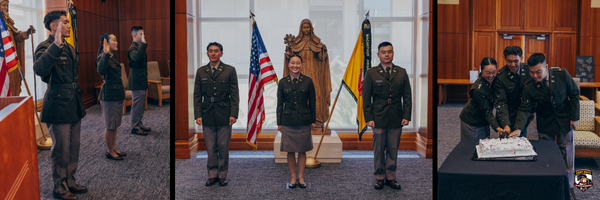 Center Image: 2LT Aaron L. Martinez, SCU, Political Science; 2LT Rachel S. Oh, San Jose State University, Management Information Systems; 2LT Alexander K. Truong, San Jose State University, Mechanical Engineering. Center Image: 2LT Aaron L. Martinez, SCU, Political Science; 2LT Rachel S. Oh, San Jose State University, Management Information Systems; 2LT Alexander K. Truong, San Jose State University, Mechanical Engineering.
The Military Science Program celebrated the commissioning of three U.S. Army Second Lieutenants from Santa Clara University and San Jose State University. These new officers have received extensive training and leadership development to prepare for their careers in the U.S. Army Armor, Military Intelligence, Cyber, and Corps of Engineers.
Giselle Laiduc (Psychology), along with co-authors Rebecca Covarrubias (UC Santa Cruz) and Ibette Valle-Luján (Northern Illinois University), recently published "Mobilizing the Capital of First-Generation Students of Color Through Counterspace Processes" in the Journal of First-generation Student Success. At a four-year Hispanic-Serving Institution (HSI), the team examined how a dedicated university "counterspace" can empower and validate the strengths of first-generation students of color. Using a case-study design, they found that this supportive environment provided healing and affirmation through identity sharing, mentorship, and collective resistance, ultimately redefining which backgrounds and cultural wealth are valued in higher education. The findings offer concrete strategies for universities to better recognize and build upon the unique strengths these students bring to campus.
 Nathan surveying the Alia Palace, Saudi Arabia last November. Nathan surveying the Alia Palace, Saudi Arabia last November.
On June 5, Nathan Anderson (Anthropology) was elected as a Fellow to the Society of Antiquaries of London. Nathan will be joined by the archaeologists, art historians, anthropologists, historians, and various other heritage professionals who constitute the Society's members for a formal ceremony at Burlington House in London in the Fall of this year.
Admission into this fellowship recognizes Nathan for his contributions to the study of early Islamic practice in the Mozambique Channel and the Middle East.
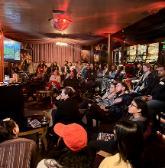
Mythri Jegathesan (Anthropology) gave an invited lecture, "The Hidden Histories being Hollywood's Filming Locations" in the Big Brain SF lecture series at San Francisco's Hawthorn SF on May 26. The lecture was based on archival and ethnographic research on the shooting of Elephant Walk (1954) and Indiana Jones and the Temple of Doom (1983) and presented evidence of the agro-industrial labor and conditions of ethnonationalist violence that made the filmings possible on Sri Lanka's plantations. Audience members also received an art zine and resource created by Jegathesan. Big Brain SF is part of a larger Bay Area popular lecture series that invites audiences to listen to scholars share their work in creative and community spaces and recently expanded to South Bay.
Image: Audience members at Hawthorn SF participating in Mythri's Big Brain SF lecture on May 26 in San Francisco, CA.
Tom Plante (Psychology) co-authored a journal article with colleagues from the University of Kurdistan (Iran): Sajadi, S. A., Azizi, A., & Plante, T. G. (2026), titled, "Conceptualizing mindful-based social-emotional learning in college administration: A grounded theory study." in Psychology of Consciousness: Theory, Research, and Practice.
Abstract: While mindful-based social–emotional learning has been widely studied in education, its application to academic leadership remains underexplored. This study, using a constructivist grounded theory approach, examines the lived experiences of university leaders regarding mindful-based social–emotional learning. The analysis revealed two interrelated levels of mindful leadership. Surface-level practices included mindful communication, transparent and trust-based governance, and conflict management, behaviors that promote participatory dialogue, build institutional trust, and reframe conflict as an opportunity for collaboration. At a deeper level, participants described internal capacities such as self-regulation, emotional well-being, ethical decision making, and a commitment to institutional improvement. This study introduces the concept of dual-level mindful socioemotional leadership, a novel theoretical framework that integrates surface practices with deep capacities, thereby extending existing models of mindful and ethical leadership in higher education.
Alberto Ribas-Casasayas (Modern Languages and Literatures) closed his sabbatical period with two in-person interventions in late June in Bogotá. He participated in a roundtable: “Plans, Fungi, and Territory: Sensing Beyond the Visible” at Artífice coffee house, moderated by environmental activist and educator Julián Santa, with the participation of the digital artist Bárbara Santos. He was also invited to a conversation with the staff and volunteer team of Échele Cabeza, entitled “The Shadow of the Psychedelic Renaissance in Latin America: From the Global to the Local.” Échele Cabeza (which roughly translates as “Think it through”) is one of the longest-standing harm reduction organizations in Latin America, specializing in drug testing as well as care and education for drug users.
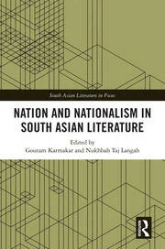
John C. Hawley (English, emeritus), presented a paper, “Silenced Tongues, Speaking Spirits: Freedom, Censorship, and Political Agency in Postcolonial Fiction,” about Ngugi, Rushdie, Kincaid, Dangarembga –and Andres Serrano (!), at the Canadian Association for Commonwealth Literature and Language Studies, in Montreal in June. His essay, “Intizar Husain’s Basti, Megha Majumdar’s A Burning, and the Evolution of Nationalism Since the Partition” (pp. 21-48), is the opening chapter in Nation and Nationalism in South Asian Literature, edited by Goutam Karmakar and Nukhbah Taj Langah (Routledge Press).
|
|
Summer Academic Technology classes calendar
|
|
|
Orientation 2026
July Sessions
- Session 2: July 13-14 (on campus)
- Session 3: July 16-17 (on campus)
- Session 4: July 20-21 (on campus)
- Session 5: July 23-24 (on campus)
- Session 6: July 27-28 (on campus)
Final Session: September 15 (on campus)
Orientation for transfer students and July admits will be held in August. |
|
|
Workday Financials Training - Expense Reports / T-cards / P-cards
10 - 11:30 AM | On Zoom
Topics Covered:
- IRS Accountable Plan: Why Receipt Requirements Exist
- Expense Reports
- Procurement Card Verification
- P/T-card Program Overview
Also held on September 3. |
|
|
College of Arts and Sciences Convocation
|
|
|