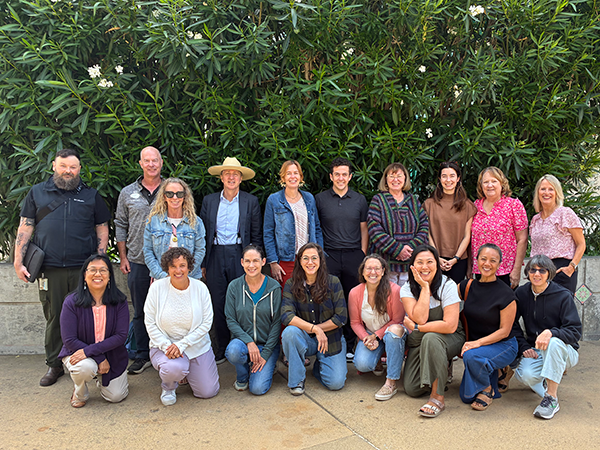
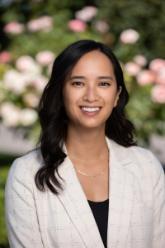
CAS Dean's Office at a day-long retreat on August 31: standing - Charles Deleon, John Birmingham, Alison Lucas, Dean Daniel Press, Danielle Perryman, Calvin Miller, Kathleen Schneider, Alex Patton, Sue Khalipa, Britt Cain; kneeling - Sandy Boyer, Maggie Hunter, Kat Saxton, Ali Reimer, Sarah Hays, Denise Ho, Casey Robertson, Kathy Aoki.
Dear College Faculty and Staff,
The new academic year is upon us! I’d like to welcome our new faculty, announced last spring, who are officially here now! I’d also like to welcome a few new staff members who have joined the College over the past few months.
Casey Robertson is no stranger to the College or the university. She re-joined the staff of the College as a department manager at-large based in the Dean’s Office last May, and will be assisting the departments and the Dean’s Office with administrative and event-related needs.
Alex Patton is new to the University, but no stranger to Jesuit education. She is the program manager and liaison to university relations, and started with us in June. She has taken over the College’s strategic initiatives (Sinatra, DeNardo, Vari, etc.) and will be the College’s liaison for everything Development-related.
Lastly, I’d like to welcome Jeffrey Bott and Lydia Martin, both of whom started this week. Jeffrey is our new department manager for the Military Science Program and Lydia is our new Imaginarium Manager. Lydia is a recent SCU graduate and was involved with the Imaginarium as an Engineering student.
I would also like to give a shout out to our incoming chairs this year: Kirstyn Leuner (English), Mukta Sharangpani (Gender and Sexuality Studies) who started last Spring, Laura Cocas (Neuroscience), Katy Bruchmann (Psychology), and Patrick Lopez-Aguado (Sociology) who is covering for the fall. A generous thank you goes to all of the chairs who recently completed a turn at the helm: Michelle Burnham (English), Sharmila Lodhia (Gender and Sexuality Studies), John Birmingham (Neuroscience), Kieran Sullivan (Psychology), and David Popalisky (Theatre and Dance) who covered for the Spring. It is no small job to lead our departments, so I am thankful to those who have been doing this work and to those who are just taking it on.
Earlier this week, you should have all received an invitation to our annual Convocation on September 15. Following the program, we’ll provide lunch on the Ignatian Lawn. I look forward to seeing you all there!
Here is a poem for the end of summer (literally, that’s the title!) from the distinguished poet Rachel Hadas.
Sincerely,
Daniel The End of Summer
By Rachel Hadas
Sweet smell of phlox drifting across the lawn—
an early warning of the end of summer.
August is fading fast, and by September
the little purple flowers will all be gone.
Season, project, and vacation done.
One more year in everybody’s life.
Add a notch to the old hunting knife
Time keeps testing with a horny thumb.
Over the summer months hung an unspoken
aura of urgency. In late July
galactic pulsings filled the midnight sky
like silent screaming, so that, strangely woken,
we looked at one another in the dark,
then at the milky magical debris
arcing across, dwarfing our meek mortality.
There were two ways to live: get on with work,
redeem the time, ignore the imminence
of cataclysm; or else take it slow,
be as tranquil as the neighbors’ cow
we love to tickle through the barbed wire fence
(she paces through her days in massive innocence,
or, seeing green pastures, we imagine so).
In fact, not being cows, we have no choice.
Summer or winter, country, city, we
are prisoners from the start and automatically,
hemmed in, harangued by the one clamorous voice.
Not light but language shocks us out of sleep
ideas of doom transformed to meteors
we translate back to portents of the wars
looming above the nervous watch we keep.
Highlights
Be sure to check out the Center for the Arts and Humanities summer blog! In an effort to stay connected to one another during the break, faculty and staff members – Justin Clardy (Philosophy), Jesica Siham Fernandez (Ethnic Studies), Missy Donagan (English) Paul Schutz (Religious Studies), Ruby Mendoza (English), Michelle Velasquez-Potts (Gender and Sexuality Studies), and Nic Calande (UMC) – have contributed blog posts related to the CAH 2026-2027 theme of joyful rebellion with a special focus on summer, sharing personal experiences of choosing joy, laughter, and self-care as a way to resist or disrupt oppression. Read the summer blog posts and please feel free to contribute!
Homer scholar Daniel Turkeltaub (Classics and Ancient Studies) was asked to write a review of Christopher Nolan's The Odyssey for the California Classical Association. If you are interested, you can read his review here.
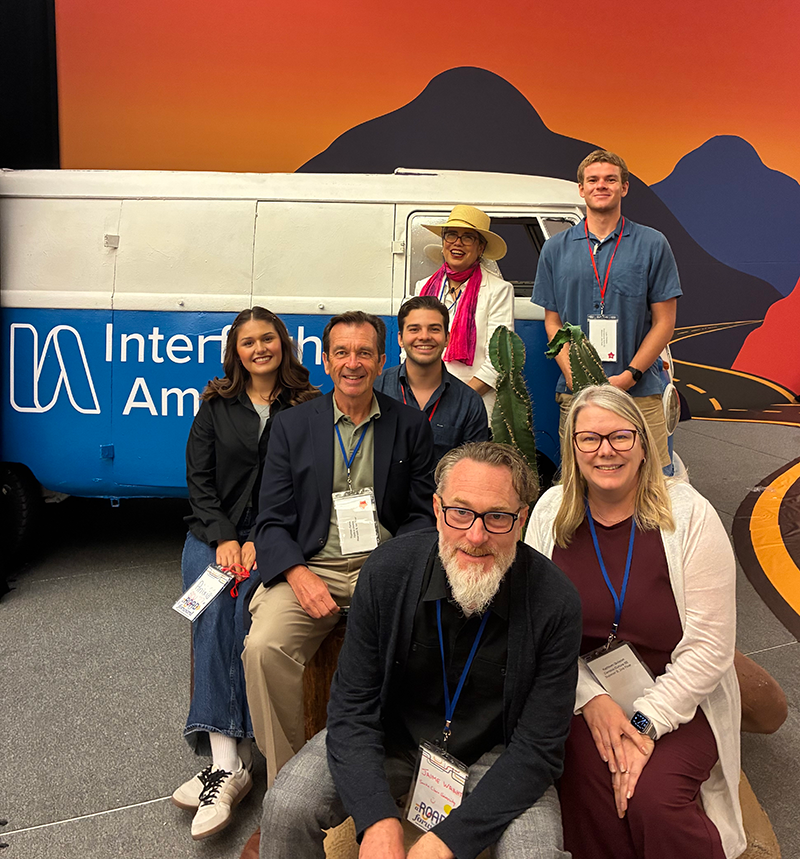 SCU delegation to the Interfaith America Summit. SCU delegation to the Interfaith America Summit.
Tom Plante (Psychology), Jaime Wright (Religious Studies), Sarita Tamayo-Moraga (Religious Studies), Kathleen Quiazon ’99 (Religious Studies, Music), currently director of the SCU Center for Spirituality and Faith, and SCU students, Anixia Davila ’28 (Public Health Science), Luke Childers ’28 (Biology), and Flavio Olivieri Villelvazo ’27 (Mechanical Engineering) were delegates to the Interfaith America Summit and Conference in Chicago, August 6-9. Tom and Jaime, along with Dan Turkeltaub (Classics and Ancient Studies), are co-PIs on an Interfaith America Faith and Health grant to support teaching and research projects that enhance interfaith dialogue and collaboration on university campuses.
Also, Tom was awarded the Outstanding Investigator in Applied Psychology of Religion and Spirituality Award from the American Psychological Association's Society for the Psychology of Religion and Spirituality at their annual national convention in Washington, DC, August 8. The award was "in recognition for leadership and excellence in research and implementation of psychology of religion and spirituality."
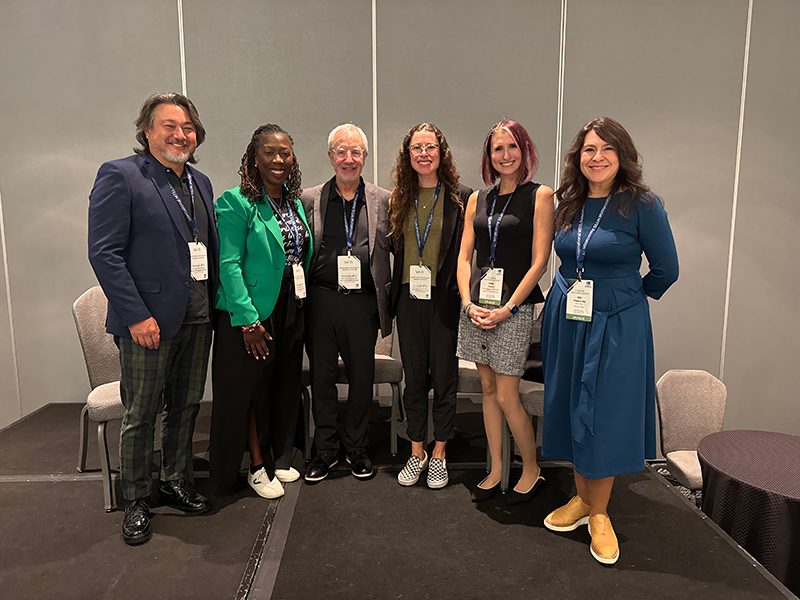 Panel participants (L-R): Daniel Russell, Joyce Debrah, Russ Skiba, Brita Bookser, Jodie Soracco, and Erin Chaparro. Panel participants (L-R): Daniel Russell, Joyce Debrah, Russ Skiba, Brita Bookser, Jodie Soracco, and Erin Chaparro.
Brita A. Bookser (Child Studies) presented on the panel, "School Discipline Reform – What Does the Evidence Actually Say?" at the International Multi-Tiered Systems of Support Association's Global Summit in San Francisco in July. The panel included practitioner, researcher, and policy perspectives addressing how contemporary political issues influence school discipline reform and what is needed to sustain efforts toward educational equity. Brita's contribution to this panel extended from research in collaboration with Russ Skiba and colleagues from the Federal School Discipline and Climate Coalition, a coalition that advocates for eliminating school-to-prison and school-to-deportation pipelines, eliminating exclusionary school discipline polices, and supporting the full inclusion of racialized and disabled students in a positive, healthy, and police-free school environment.
Birgit Koopmann-Holm (Psychology) presented her latest research at the July 2026 convention of the International Society for Research on Emotion (ISRE) in Brisbane, Australia. Her presentation “When Grief Gets Real: Cultural Differences in What Bereaved U.S. Americans and Germans Consider Compassionate” examined whether previously observed cultural differences in perceptions of sympathy messages also emerge in real-life experiences of grief. The study included bereaved U.S. Americans and Germans who had lost someone close within the previous three months. Compared with Germans, U.S. Americans reported a stronger motivation to avoid negative feelings and were less likely to prefer sympathy cards that focused on grief and loss. Instead, they showed a stronger preference for cards emphasizing a silver lining. Notably, however, the cultural differences were smaller than those observed in previous research using hypothetical scenarios. These findings underscore the importance of distinguishing between hypothetical and real-life contexts when examining cultural differences in emotion and highlight how the experience of actual grief may shape people’s emotional preferences differently than imagined situations.
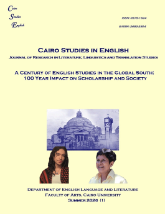
Written jointly by Aparajita Nanda (English) and Alexis Alvarez Figueroa '27 (Psychology, Sociology), “Cyborgian Relationalities in the Global South: The Posthuman in Octavia Butler’s Lilith’s Brood and Eve Gil’s Virtus” moves beyond the limits of single-author focuses to engage the complex intersections of multiple Indigenous voices and colonial histories. We utilize Chadwick Allen’s multiperspectivism to create a creative friction between Octavia Butler’s Lilith’s Brood and Eve Gil’s Virtus. This dialogue moves on a horizontal scale, dismantling the centrality of Western discourse and redefining African Americans as part of a sociopolitical Global South through their shared history of systemic marginalization and colonial trauma. While Western thought has traditionally privileged a mind-body dualism, these science fiction traditions from the Global South center on the materiality of the flesh, presenting the posthuman cyborg as a deeply political subject shaped by techno-domination. By juxtaposing the relational potential of Butler’s hybrid protagonist, Akin, with Gil’s contrast between the alienated cyborg-consumer and the liberatory cyborg-historian, our study reveals how marginalized perspectives jointly articulate a multiplicity of visions for a posthuman future. Ultimately, these narratives function as allegories for historical trauma and colonial invasion and repurpose technology toward solidarity, challenging the deterministic mechanisms of capitalist global power.
Giselle Laiduc (Psychology) recently published an article, “(Critical) Multicultural Cues Promote Identity Safety and Desire to Learn About STEM Inequity Among Students of Color,” in the Journal of Social Issues with co-author Rebecca Covarrubias (UC Santa Cruz). Through an experiment with undergraduate STEM students of color, they examined how different ways of communicating about diversity shape students' perceptions and expectations in the classroom. The study compared three approaches to discussing diversity: one that emphasized similarities between students and downplayed social group differences, one that recognized and valued those differences, and one that also acknowledged the role of systemic inequities in shaping them. Compared with the statement emphasizing similarities, the diversity statements that recognized and valued group differences increased students' sense of identity safety by reducing their expectations of encountering bias in the classroom. They also strengthened perceptions of the instructor as an ally and increased students' interest in learning about inequity in STEM, with the messages about systemic inequity having the strongest effects among students who were more aware of the possibility of experiencing identity-based stigma. The study advances theory on identity-safety cues by demonstrating how subtle messages about diversity can shape the expectations of students of color before they enter the classroom.
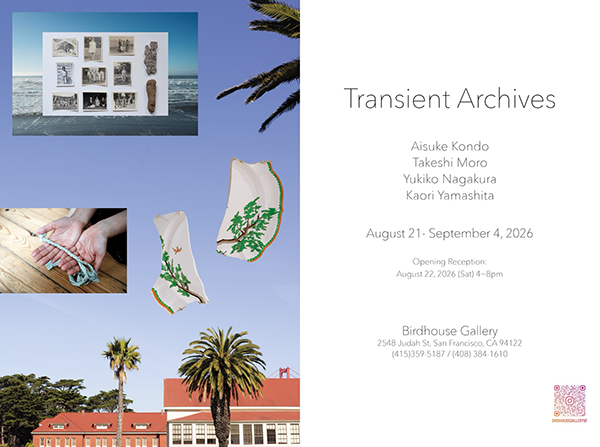
Takeshi Moro (Art and Art History) is exhibiting in Transient Archives at Birdhouse Gallery in San Francisco. The group exhibition runs from August 21 through September 4, 2026, with an opening reception on Saturday, August 22. The show features new photography works by Takeshi created in the Presidio, presented alongside works by Aisuke Kondo, Yukiko Nagakura, and Kaori Yamashita.
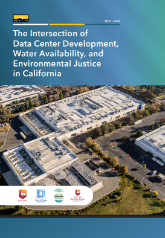
Iris Stewart-Frey (Environmental Studies and Sciences), with Irina Raicu (Markkula Center for Applied Ethics) and undergraduate research assistants Briana Guingona ’25 (Environmental Studies), Gabrielle Henrich ’25 (Environmental Science), Rachel Lin-Peistrup ’26 (Environmental Science) and Anna Keenan ’27 (Environmental Science, French and Francophone Studies), released a report on May 12 on how hyperscale data centers, environmental justice communities, and water scarcity interact. They found that data centers are rapidly being proposed for locations that are more vulnerable from both a socio-economic as well as a water supply perspective, and that transparency about projected and actual water use and the level of environmental review is sorely missing and has eroded public trust. Examples of communities being drained of their water supplies from other states, and proposals for large data centers in Imperial County have radically shifted public perception to where many communities in California have now implemented moratoria on new developments and communities are looking for guidance from the State. Bills 2619 and 2919 are now before the legislature. In that context, the report has received widespread attention in the media, including KQED, NPR, Bloomberg, CalMatters, Mercury News, and many more. The most recent article in Western Reports summarizes the current state of the debate, including its contradictions.
|
|
Summer Academic Technology classes calendar
|
|
|
Teaching-track reappointment and/or promotion petitions due
8:59 PM | Interfolio
Complete your reappointment and/or promotion petition and backup documentation in Interfolio and forward your case to your department. |
|
|
All-Day Accessibility Working Session
8:30 AM - 4:30 PM | Varsi Hall, Room 222
Faculty Development will host full-day working sessions dedicated to helping you get your course materials ready in community with others! This event will provide you with an opportunity to get support from Academic Technology and trained student workers, gain input from your colleagues, and fully focus on creating an accessible course. We will provide breakfast and lunch, as well as a $200 stipend to faculty who complete the session and submit an accessible course (or significantly improved accessibility score) at the end of the event. |
|
|
California Environmental Justice Policy Futures Panel
10 - 11:15 AM | webinar
Leaders from community-based organizations and government agencies reflect on the future of environmental justice policy, research, and advocacy.
The conversation will be moderated by Iris Stewart-Frey and Christopher Bacon from the Environmental Justice and the Common Good Initiative at Santa Clara University. |
|
|
New Student Orientation
Orientation make-up sessions: September 15 and 16 (on campus). |
|
|
College of Arts and Sciences Convocation
|
|
|
Shut Up & Prep
9 AM - Noon | Varsi 222
Faculty Development invites you to their first session of the academic year: Shut Up & Prep!
Whether you’re preparing your FAR case, getting your teaching materials finalized for the term, or finishing out that last bit of summer writing, please join us for this working session. |
|
|
Teaching Professor Reappointment & Promotion Procedure Meeting
3-4 PM | Zoom
A review of the procedures for department and process chairs, deans, and members of school Teaching Professor Rank & Promotion Committees, hosted by the Office of the Provost. |
|
|