
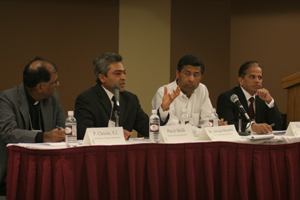
L-R: P.Christie, S.J., Pravir Malik, Arvind Bhambri and Vic Kulkarni
Four panelists gave their perspectives on India’s future and how it will affect the global economy at the Markkula Center for Applied Ethics’ fourth biennial business ethics conference on March 9. The topic of the conference was “Business Ethics in a Global World,” with a focus on China and India.
P. Christie, S.J., director of the Loyola Institute of Business Administration in Chennai, India, began his presentation by saying India is poised for strong economic growth. The country is emerging as a knowledge economy, not just a place for business process outsourcing.
Christie reminded the audience that culture plays a role in determining ethical attitudes. Some practices that, in the West, are considered unethical or even illegal may not be viewed that way in India. However, he said, India needs to overcome its reputation as a difficult place to do business. And he noted that several changes are taking place.
Christie sees “a greater awareness” of business ethics and corporate social responsibility developing in India. He started a center for corporate governance that gives an award each year to a good corporate citizen. Every year, he said, both the number and the quality of the applicants increase.
Pravir Malik, managing director of advisory services at Business for Social Responsibility, said he has learned in his work consulting with both Indian and U.S. companies that there are key ways to make an ethical policy a true part of an organization’s culture.
The first is how to change a company’s business model to reflect its ethical policy. “I think that’s a major implementation problem,” he said. The key, according to Malik, is to understand what the business imperative is for the ethics policy. He takes a “very pragmatic view” of this: An ethics policy must be on equal footing with other business priorities, he said, or it won’t make much difference.
The second problem is how to spread the responsibility for ethics, which is often the purview of a corporate social responsibility department, across the organization. Moving ownership of ethics to the executive level can help here, he said.
Malik said that although some universal patterns can be applied across cultures, it’s also important to customize these ideas depending on the region.
Arvind Bhambri, a professor at the Marshall School of Business at the University of Southern California, spoke of his experience with Trianz, a consulting firm where he is on the board of directors.
Bhambri cited his experience with Trianz in discussing how to get ethical thinking to permeate every aspect of an organization. Trianz was founded, he said, with the goal of “combining the best of the East with the best of the West.”
The company started out with basic tenets such as making a social impact, creating a global culture--and beating the larger firms by delivering value to clients. The company’s leaders soon discovered that the challenges were not so much academic questions, such as whether to follow local laws in each place the company operates or to have the same standards in all its locations. Rather, he said, the company found itself trying to lower its employee turnover rate, which meant creating an environment where employees wanted to stay. He considers this an ethical issue: balancing how employees are treated with what shareholders receive.
Vic Kulkarni said he has learned practical ways to manage a global workforce as president and chief executive officer of Sequence Design.
Kulkarni talked about two common phrases used by Indian workers, translated roughly as “no problem” and “it’s OK,” that he says illustrate some of the issues in managing a global workforce. “No problem,” he said, may mean that the person will do what you’re asking, but not necessarily by the deadline. Using the phrase “everything is OK,” he said, is a strategy people use for day-to-day stress management. But it can lead to people not taking pride in their work and, therefore, not putting in their best effort.
Kulkarni said it was easy to get used to day-to-day problems, such as the power outage that occurred when he was speaking at a meeting in India, and even consider them normal. But he said he had learned specific ways to manage a global workforce, which he called a fundamental part of modern business ethics.
Margaret Steen is a freelance writer.
March 2007