
Indian Perspectives
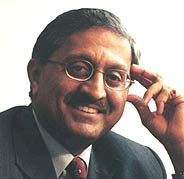
Drawing on Indian mythology, company folklore, personal experience, and a sense of humor, R. Gopalakrishnan offered his observations on what it takes to develop and maintain an ethical organization to a group of Silicon Valley businesspeople convened by the Markkula Center for Applied Ethics this June. Gopalakrishnan is executive director of Tata Sons, one of India’s largest private-sector business groups.
He began by retelling the story of the Arjuna, master archer from the Hindu epic Mahabharata, who is sent by Lord Krishna to rescue the women from a city under siege. Comparing Arjuna to “a turnaround CEO,” Gopalakrishnan related Arjuna’s success at freeing the women (“the assets of the company”) from the besieged city using his bow and arrows. “Everyone clapped,” Gopalakrishnan said, likening their reaction to that of shareholders believing they will now have a better year.
Yet, on the way back to Krishna, while passing through a forest, Arjuna’s chariot came under attack and his arrows were ineffective. The “moral of the story” for businesspeople, according to Gopalakrishnan, is: “You are only as good as your context shows you to be.” The same techniques that worked in one context may not in another. The same CEO who was successful may not retain his or her “magic” over time or at a different company or industry setting.
With that caveat, Gopalakrishnan offered five general principles for executives who are interested in contributing to a company culture of integrity.
Complete the cycle of whom you earn from and whom you return money to. Gopalakrishnan described how Tata has incorporated into its corporate memorandum of association the idea that the company exists to serve society. He confessed that when he first came to Tata in 1998, he was somewhat skeptical about the seriousness of this goal.
In his early days at the company, he traveled widely to visit various subsidiaries—“people selling trucks, writing code, generating electricity”—and talked with them about their work. “What was unique,” he said, “was that every PowerPoint presentation I saw ended with a chart labeled ‘Community.’” Each group gave this subject its own spin: in some cases fostering AIDS awareness, in some cases helping local women find markets for their woven baskets. These projects are funded out of 13 charitable trusts initiated in 1932 by Sir Dorab Tata, but are initiated and executed by local Tata management and employees. About a third of the company’s $3 billion in profits go into these trusts.
Gradually, Gopalakrishnan said, his cynicism began to dissolve. “What has this meant to me personally? It’s part of why I go to work every day. In some surrogate way, one third of every dollar I earn for the company goes into these charitable trusts.”
Work like a bricklayer. Gopalakrishnan recalled a story he learned when he worked at Unilever, suggesting that the person who clears and paves a road is the greatest servant of humanity. “Millions of people will travel that road following their dreams,” he said, “without ever thinking about the person who built it.” He proposed this model for managers, suggesting that they should concentrate on their work and not on appreciation or even outcomes in the near term.
Gopalakrishnan likened the story to a teaching of Krisha in the Bhagavad Gita: “To action alone hast thou a right and never at all to its fruits; let not the fruits of action be thy motive.”
You don’t have to change the whole world, but you also don’t have to become corrupt if the world around you is corrupt. Tata, he pointed out, has 300,000 employees, and it would be impossible to control the ethical standards of every one of them. Yet, Gopalakrishnan argued, the company can encourage ethical behavior on the part of all of its employees.
As an example, he pointed to a 2002 scandal within the Tata companies, in which the chairman’s protégé and CEO of Tata Finance was involved in a fraud that threatened to cost clients, shareholders, and creditors more than $200 million. At a meeting, an ordinary shareholder got up and told how he might lose his life savings. As Gopalakrishnan describes what happened, “At that point, we didn’t know the size of the scandal, but the chairman made a statement: ‘You have my assurance. Not one of you will lose a rupee.’ We could have filed for India’s version of Chapter 11; he could have said we’d stand behind the 22 percent of Tata Finance that we owned. But the chairman stood for 100 percent of the losses.” This kind of attitude has also helped Tata to resist some of the petty bribery demands that are endemic to doing business in India, he said.
Ethics and standards have to be understandable for common people. By this, Gopalakrishnan said he meant not only that companies should avoid abstract philosophical or theological terminology in discussing ethics, but also that they should provide guidance and specific examples for employees on how codes could be applied. “For management to spend time creating a unique code of ethics is a waste of time,” he argued. Tata, GE, even Enron, he said, have similar documents. “It’s what you do with them that counts.”
At Tata, the code is published in 15 different languages. Every employee signs it every two years, which, for illiterate workers, may mean putting their thumbprint on the document. More important, the company runs almost 300 workshops a year where employees discuss the issues they face. “No great truths” come out of this process, Gopalakrishnan said. “There’s no new enlightenment except in our own hearts” as employees talk about how to apply these principles to real-world situations.
The child’s behavior is shaped by the first 10 years. So it is with a company. Gopalakrishnan talked about instilling ethics in an organization from the very beginning. To illustrate, he pointed to Jamsetji Tata, founder of the Tata Group, who created the JN Tata Endowment in 1892 to send promising Indian students, regardless of class, to pursue higher education in England. That philanthropic attitude was so ingrained in the company that the creation of other charitable foundations was simply an extension of that beginning.
For entrepreneurs who don’t think they have time to worry about ethics in the early years, Gopalakrishnan had this advice. “That’s negligent if you intend for your company to be around a long time. It’s like saying, ‘I don’t have time to shape my child’s character right now. I’ll do it when he’s 20.’”
As Gopalakrishnan has written elsewhere, “History …sheds some light on what I call the samskar, or values, of any given business. Much like individuals, business enterprises, too, have a samskar. It is the mark of a successful business that profits are earned competitively in the early days. It is a mark of a great business that, in addition, good samskar gets so deeply embedded that it becomes part of its DNA.”
Miriam Schulman is communications director of the Markkula Center for Applied Ethics.