
As a specialized agency of the United Nations, the World Bank’s chief mission is to eradicate global poverty by funding projects in developing countries to build bridges, construct hospitals, distribute pharmaceuticals, and other worthy causes. But with corruption running rampant in the form of $2.7 billion being paid in bribes per day, that mission is at serious risk, as are projects funded by the Bank worldwide.
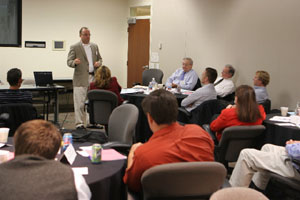
Glenn T. Ware, chief investigative counselor for the World Bank, discussed the problem and ongoing tactics to curb corruption at a recent meeting of the Business and Organizational Ethics Partnership. In his talk, “Doing Business with Integrity: The World Bank’s Department of Institutional Integrity,” Ware outlined how loaned money is distributed to worldwide projects, how bribery puts those projects at risk, and how efforts are underway to ensure that money lent by the Bank goes to its intended purpose. “The most serious impediment to effective development anywhere in the world is corruption,” he said.
An international organization, the Bank is owned by governments, including the United States government. Typically, in investment lending, the Bank will lend money to the government of a developing country for a specific project. The recipient country will often co-mingle that money with revenue from other sources, such as taxes, private financing, and bilateral donors. The government then distributes the funds to the appropriate ministry for the project, such as the ministry of roads for a highway project. The ministry in turn sets up a procurement operation for the project, bidding out contracts for the needed supplies and work.
Unfortunately, Ware said, the system can be corrupted, with bidding companies paying kickbacks to government officials for a share in lucrative contracts.
“If you think about bribery as in, ‘We had to pay some commission to get the contract, but we otherwise performed the work and we do good work’—that’s not what’s going on,” he stressed. “Bribery is also being paid by companies who also don’t do the work, or grossly under perform.
But, he emphasized, the kickback amount itself does not represent the true damage. The real loss can be measured by shoddy workmanship, shortcuts taken to finance the bribes, or completely sham projects. Ultimately, the corruption shortchanges the people in developing countries whom the projects were intended to help. “It can lead to real social decay,” Ware said.
One key elements of the World Bank’s strategy to combat corruption in Bank-financed projects is the investigative unit, which began in 1999. Investigation helps strengthen risk mitigation measures and deter malfeasance by promulgating sanctions. “We seek to determine who is paying those government officials, colluding, or defrauding the projects, and then seek remedy—either contractual remedy from our loan agreements, or law enforcement remedy from a law enforcement organization somewhere in the world who will take jurisdiction and prosecute that case,” he said.
An investigation that reveals corruption typically leads to one or more of the following: a criminal referral to authorities in the host country; sanctions against the bribing company; or remedial action on the loan. “It’s a very big deal to be blacklisted from being eligible to receive World Bank financing,” Ware said. Repercussions of the sanctions can ripple throughout a company’s business contracts.
Initially, investigations proceeded slowly and seek to leverage information to build a case to uproot corruption on a larger scale.
“One thing that we wanted to do was to get this information from the private sector in a meaningful, cross-cutting way, instead of digging it out case by case,” Ware said. If they could get one big multinational corruption that had worked on numerous Bank infrastructure contracts across multiple countries to tell the Bank whom they paid, where and when, this would allow the investigators to make “an asymmetrical leap.”
To encourage that, the Bank launched a new anti-corruption tool called the Voluntary Disclosure Program in August 2006 after piloting it for two years. The program allows companies to tell the Bank about improper conduct in exchange for confidentiality and no debarment.
“We can take the fruits of that information to launch other investigations,” Ware said. “Our big incentive is confidentiality. It’s always been our belief that the business and private sector knows exactly the anatomy of corruption—who gets paid, the modalities of transmission.” In return, the disclosing firms agree to cease misconduct, launch an internal investigation, engage a monitor for three years, and pay the associated costs. Failure to do so results in a 10-year debarment. “Why would a company come into our program? Because if they don’t come in and we find them out, then they don’t get the protection,” he explained.
Using the disclosed information, the Bank can target known corruption, rather than digging it out. “We know exactly where to look, we just exercise our audit rights, and we can go right to the file drawer and say, ‘We want to see the contracts you have with so-and-so subcontractor.’”
On average, they get about 30 calls a month from all over the world on the hotline. Sources of information include the business community, private citizens, journalists, project or government officials. “We get the small fry complaint to the grand corruption complaint. We triage them and try to work on the complaints that [will] have the biggest impact,” Ware said.
The investigative efforts are beginning to pay off. “We’ve been going at it for six years now, and we’ve publicly sanctioned over 330 firms and individuals. We have 25 criminal convictions,” he said. ”This is our agenda. This is what we do.”
Anne Federwisch is a freelance journalist.