A Selective List of Sources about
- St. Clare of Assisi
- Medieval Gardens and Spiritual Gardens
- Sustainability and Spirituality
I. St. Clare of Assisi
Assisi (Photo Tour). Franciscan Web Page.
Clare of Assisi. The Legend and Writings of Saint Clare of Assisi. St. Bonaventure, New York, 1953.
__________. Early Documents. Ed. Regis Armstrong. New York, New York, 1988.
__________. Life and Writings.
Gagliardi, Sister Claire Andre, OSC. "Celebrating St. Clare of Assisi." St. Anthony’s Messenger, August 2003.
Karper, Karen. Clare: Her Light and Her Song. Chicago, Illinois, 1984.
Miller, Ramona, O.S. F. In the Footsteps of St. Clare: A Pilgrim’s Guide Book. St. Bonaventure, New York, 1983.
Muscat, Fr. Noel, O.F.M. "The Franciscan Experience." Cyber Course on the Lives and Writings of St. Francis and St. Clare. Franciscan Institute Outreach, Malta, 2001. http://www.christusrex.org/www1/ofm/fra/FRAmain.html
Peterson, Ingrid J. Clare of Assisi: A Biographical Study. Quincy, Illinois, 1993.
II. Medieval Gardens and Spiritual Gardens
Bayard, Tania. Sweet Herbs and Sundry Flowers : Medieval Gardens and the
Gardens of the Cloisters. New York, New York, 1985.
Bayleaf Medieval Garden. Weald and Downland Open Air Museum, West Sussex, England. http://www.wealddown.co.uk/quick-tour-open-air-museum-singleton-4.htm
Coffin, David R. Gardens and Gardening in Papal Rome. Princeton, New Jersey, 1991.
Harvey, John Hooper. Mediaeval Gardens. London, 1981.
Hozeski, Bruce W. Hildegard’s Healing Plants. Boston, Massachusetts, 2001.
Jacobus, Pauline. "The Mission Santa Clara Garden." Pacific Horticulture (July, 1976) 37/3:2-6.
Krymow, Vincenzia. Mary’s Flowers: Gardens, Legends, and Meditations. Cincinnati, Ohio, 2002.
Landsberg, Sylvia. The Medieval Garden. New York, New York, 1995.
Larkin, Deirdre. "A Short History of Herb Garden Design." Brooklyn Botanic Garden, 2005. http://www.bbg.org/gar2/topics/design/handbooks/herbgarden/1.html
Lazzaro, Claudia. The Italian Renaissance Garden. New Haven, Connecticut, 1990.
MacDougall, Elisabeth B. Medieval Gardens. Dunbarton Oaks Colloquium on the History of Landscape Architecture IX. Washington, D.C., 1986.
"Mary’s Gardens."
Masson, Georgina. Italian Gardens. New York, New York, 1961.
Mayell, Hillary. "Medieval Garden Intrigues British Archaeologists," National Geographic News, February 10, 2003. http://news.nationalgeographic.com/news/2003/02/0210_030210_medievalgarden.html
McGowen, Sarah. "The Bonnefont Cloister Herb Garden." Medieval New York, 1996-98. http://www.fordham.edu/halsall/medny/herbgdn1.html
Oxford Botanic Garden. Oxford, England.
Padua Botanic Garden. Padua, Italy.
Pennsylvania State University, Center for Medieval Studies. "The Medieval Garden".
Talbot, Rob, and Robin Whiteman. Brother Cadfael’s Herb Garden: An Illustrated Companion to Medieval Plants and Their Uses. London, 1996.
Turner, Tom. "Sacred Space: Religion and Garden Design History" and "Historic Garden Types" www.gardenvisit.com ( Homepageà History and Booksà Types and Styles).
Ziegler, Vicki. "The Medieval Garden." Medieval Academy News, The Medieval Academy of America.
III. Sustainability and Spirituality
Andrews, Brother David, CSC. "A Spirituality for Sustainability: Partnership with Nature and God." National Catholic Rural Life Conference, 2001.
Dallman, Peter R. Plant Life in the World’s Mediterranean Gardens. Berkeley, California, 1998.
Dreyer, Elizabeth. "God Whose Beauty the Sun and Moon Admire: Clare and Ecology." In Franciscan Theology of the Environment: An Introductory Reader. Quincy, Illinois, 2002.
The Earth Charter, UNESCO, Paris, 2000.
History of the charter http://www.earthcharter.org/innerpg.cfm?id_page=106
Text of the Charter http://earthcharter.org/discover/download-the-charter/
Ecolandscape. "Resources for Sustainable Landscaping in California"
http://www.ecolandscape.org/resources.html PDF
Fredette, Karen and Paul.
Raven’s Bread: Food For Those in Solitude. Quarterly Newsletter. Hot Springs, North Carolina.
John Paul II. "The Ecological Crisis: A Common Responsibility." Vatican City, 1990.
O'Dell, Owen. "The Sustainable Garden." ( Pacific Horticulture Magazine, Winter, 1998.)
Rohr, Richard.[ http://www.cacradicalgrace.org/aboutus/founder.html] "Christianity and the Creation: A Franciscan Speaks to Franciscans." In Embracing Earth: Catholic Approaches to Ecology." Maryknoll, New York, 1994.
Wild Ones Natural Landscapers, Ltd. "Resources for Sustainable Landscaping." http://www.for-wild.org/hotlinks.htm
Witcombe, Christopher. "Sacred Places." Sweet Briar College, Sweet Briar, Virginia. http://witcombe.sbc.edu/sacredplaces/sacredplacesintro.html
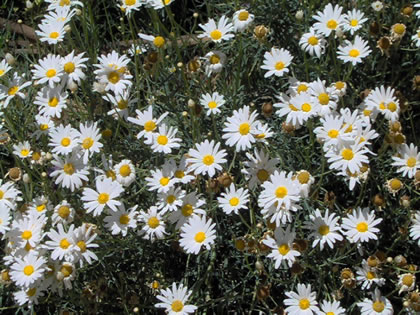
The name daisy comes from the flower’s old name, “day’s eye.” The yellow disc of the daisy flower was thought to symbolize the orb of the sun. Traditionally, daisy flowers were sacred to the Virgin Mary.
This web site was written and designed by Nancy Lucid whose research was supported by a generous grant from the Bannan Institute for Jesuit Educational Mission at Santa Clara University.
For questions regarding the web site contact Nancy Lucid. All rights reserved.