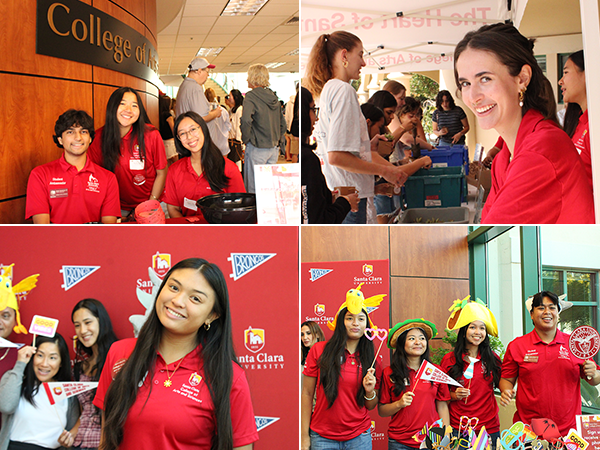
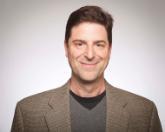
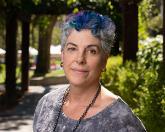
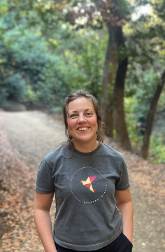
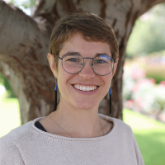
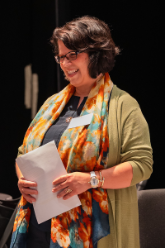
CAS ambassadors at Welcome Weekend.
Dear College Faculty and Staff,
We are officially back at it! I hope this first week of classes was energizing with minimal bumps in the road.
Last week, the new Global Languages and Cultures Center, housed in the Department of Modern Languages and Literatures, was blessed by Fr. Arthur Liebscher. Located in Daly 304 and 305, this center will be a meeting space for students, faculty, staff and the community who want to engage in deeper language studies, dialogue, and inter-cultural activities. Tremendous thanks go to the principal donors who made this possible—Geoff and Josie Fox and Tom and Wendy Stutzman—and to the department and the team in the Dean’s Office. It took unfaltering commitment to ensure that the vision of the Foxes and Stutzmans could become a reality for our community. It is rewarding to see years of behind the scenes planning finally come to fruition, and I look forward to all the activities that will take place in the new space!
It’s National Hispanic Heritage Month, so it’s fitting to feature a poem by Salima Rivera, a poet, activist and community organizer, and “...a notable figure in the Chicago Latino literary renaissance of the 1960s and 70s by co-founding the literary workshops Los Otros Poetry Collective and La Taller,” as her bio in Poetry notes.
Sincerely,
Daniel A Bumper Crop
By Salima Rivera
Words, like weeds,
are sprouting everywhere.
My mouth and throat are choked with them,
wild fairy rings waiting to be gathered and dried.
I pick through them and press them between
sheets of cheap paper,
stuff them into envelopes
and mail them out
to anyone who’ll have them.
I’m running out of space.
My kitchen drawers, closets, file cabinets
are overflowing with words,
spilling into every nook and cranny
of the house.
Sell them, my friends say, sell them.
Finely shred them and steep them in deep mugs
to make intoxicating brews
or tamp them into exotic pipes
and smoke them to induce
psychotic visions.
No, I say.
Socrates sipped a tea like this
and look what happened to him.
The D.E.A. may bust me for
illegal trafficking.
This harvest of verbiage
has grown out of hand.
What I need is a drought
so I can winnow out the chaff,
storing the remaining grain
for the famines to come.
Come explore the Imaginarium!
Located in Heafey 237, the Imaginarium is a space where students, staff, and faculty can experiment with:
- Virtual reality and interactive storytelling
- Digital art and game design
- Data visualization
Past projects have used VR to practice ancient languages, explore ethical dilemmas, and study how avatars can affect identity and body image. Your idea could inspire what we explore next.
During open hours, you can:
- Try out the technology
- Explore current projects
- Discuss an idea for a course or research project
- Get help turning a creative idea into an XR experience
You’re also welcome to stop by simply to see the space and learn what’s possible. No prior experience or appointment is required.
Open hours: Monday–Friday, 9 a.m.–12 p.m. and 1–5 p.m.
Location: Heafey 237 (up the stairs behind the atrium)
Highlights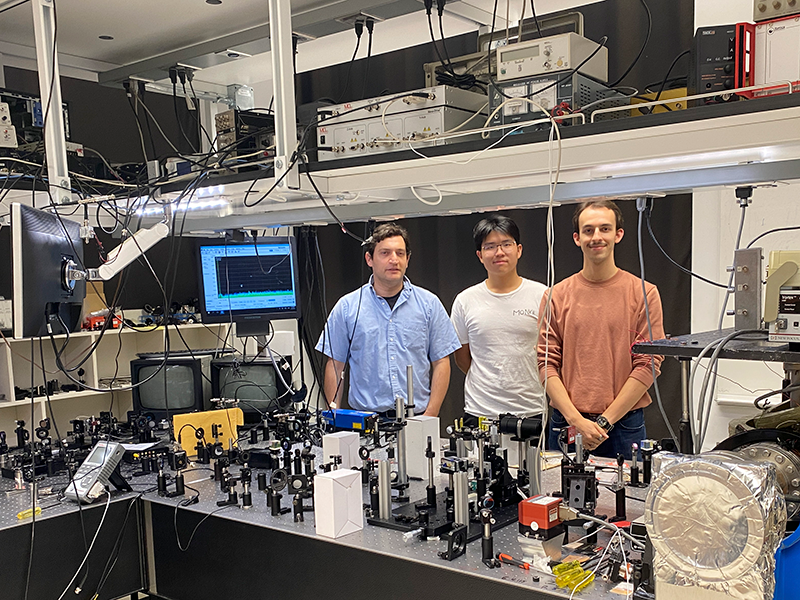
Bachana Lomsadze (Physics and Engineering Physics), along with Physics minor Roman Junes ’26 (Electrical Engineering) and Johnason Yao ’28 (Physics), published an article, “Multiatom Dipole-Dipole Correlations in Rubidium Vapor Revealed by Dual-Comb Spectroscopy,” in Physical Review A. The work uses nonlinear dual-comb spectroscopy to reveal spectral signatures arising from interactions among rubidium atoms. They observed signals involving two atoms, as well as more complex features involving three atoms, providing new insight into dipole-dipole interactions, a fundamental mechanism through which atoms and other quantum systems influence one another and give rise to collective behavior.
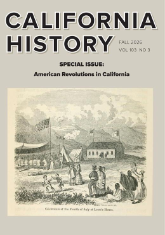
Rose Marie Beebe (Modern Languages and Literatures, Emerita) and Robert Senkewicz (History, Emeritus) published an article, “Promise and Betrayal: Californios and the Challenge of American Politics, 1849-51” in the Fall 2026 special edition of California History.
When the United States invaded Alta California in 1846, the region was home to hundreds of ranchos, often owned by the Mexican California elite. This group, many of whom had established good relationships with Yankee traders, originally thought that they would do reasonably well in American California. A number of them were delegates to the 1849 California Constitutional Convention and members of the first California legislature. However, the Gold Rush brought in many Americans who resented the fact that much of the best land in coastal California was in the hands of these “foreigners.” In a short amount of time, squatters and new laws that disadvantaged the existing landholders dispossessed many rancheros and put the Mexican community as a whole into an inferior social and economic position.
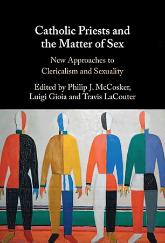
Tom Plante (Psychology) published a book chapter entitled, "How clericalism contributes to sexual problems among Catholic priests." In P. McCosker, L. Gioia & T. LaCouter, & (Eds.), Catholic Priests and the Matter of Sex: New Approaches to Clericalism and Sexuality (pp. 389-399). Cambridge University Press. Published September 1, 2026.
Book summary: Catholic Priests and the Matter of Sex confronts one of the most urgent crises facing the contemporary Catholic Church: the pervasive culture of clericalism. Through an interdisciplinary approach, this volume offers a penetrating analysis of how clericalism distorts priestly identity, undermines the Church's mission, and erodes lay participation. But this book does more than critique-it explores how clericalism intersects with sexuality, masculinity, and institutional power, revealing how these dynamics shape Catholic life today. With essays from diverse voices, this collection asks difficult but necessary questions: What is clericalism? How does it function? And how can it be overcome? The authors are driven by a deep love for the Church and a desire to support awareness, integrity, and renewal. Bridging theology, ecclesiology, and lived experience, Clericalism and Sexuality is both a prophetic challenge and a hopeful call to reform―a timely resource for anyone committed to revitalizing the Church's mission in the twenty-first century.
Tim Urdan (Psychology) gave a keynote address at the International Conference on Motivation in Lisbon, Portugal this summer. The title of his talk was "The Relationship between Motivation and Self-Regulated Learning: A Complexity Perspective" and is based on a manuscript he co-authored with his colleague Michelle Rivers (Psychology). For the first half of the talk the projector system was not working so he had to present without slides. It was a life-changing experience!
At the same conference, two recent graduates, Macey Pizitz ’26 (Psychology) and Emeline Siberell ’26 (Psychology, English) presented a paper co-authored with Tim and colleagues from Greece. This paper was titled "Role Identity, Motivation, and Burnout: A Comparison of Greek and American Teachers." They did a fantastic job!
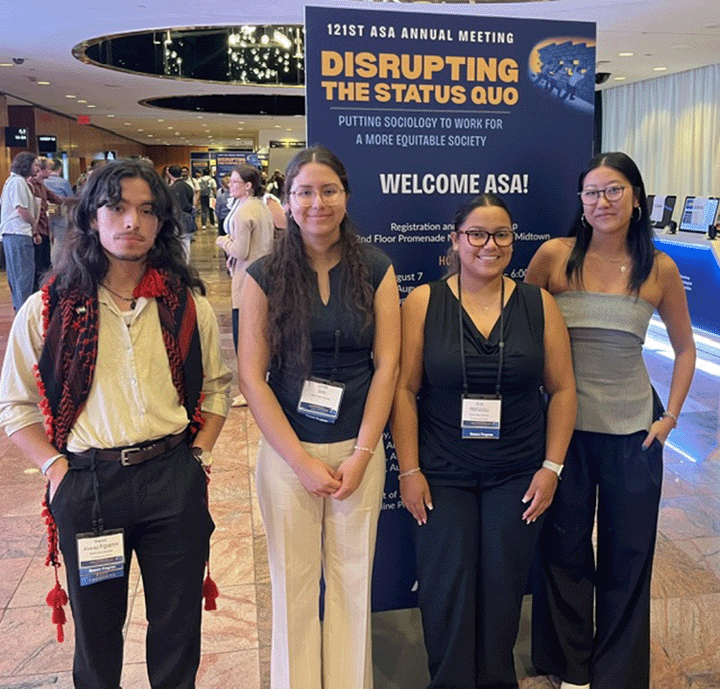 SCU ASA Honors Society students: Alexis Alvarez Figueroa, Linda Soto, Eva Hernandez, Gwyneth Choi (not pictured, Ella White).
Five Sociology majors were selected by the American Sociological Association's Honors Program. The program provides students the opportunity to meet other undergraduate Sociology majors in the United States, attend the annual conference (this year in NY), and learn more about graduate school and careers in sociology. Students also presented their own research at roundtables. The department is very proud of these students for completing the rigorous application process and participating fully in the conference! The students are: Gwyneth Choi ’26 (French and Francophone Studies & Sociology), Alexis Alvarez Figueroa ’27 (Psychology, Sociology), Eva Hernandez ’27 (Sociology), Linda Soto ’27 (Child Studies, Sociology), Ella White ’27 (Sociology). They were mentored by Maggie Hunter, Patrick Lopez-Aguado, and Laura Nichols.
Chad Raphael (Communication, Environmental Justice & the Common Good Initiative) presented “Community-Engaged Research as a Response to Democratic Crisis” at the American Political Science Association conference in Boston, MA. The paper shows how community-engaged research (CER) is a democratic innovation that can help counter contemporary strains of authoritarianism that exploit populist attacks on expertise and science’s disconnection from public values and interests. Drawing on principles of participatory and deliberative democracy, CER fulfills criteria of credibility, integrity, and benevolence, which the public uses to assess whether science is trustworthy. CER does so by engaging experts and the public in co-producing common knowledge, improving communication of and deliberation about research, and resisting misinformation, manipulation, and censorship. CER’s role should be expanded in academic and government research agendas, including by integrating it into other democratic innovations to resist authoritarian control of knowledge. This is especially so for CER involving natural and social science research that informs regulation of public health, the environment, the economy, and technology, which are particularly consequential domains for democracy and frequent targets of authoritarian control.
The New York Times interviewed Andrea Pappas (Art and Art History) about the upcoming exhibition at the American Folk Art Museum, "Locating Girlhood: Place and Identity in Early American Schoolgirl Art." Andrea's influential scholarship appears throughout the catalogue, to which she contributed the Afterword. In it, she discusses the contribution of the exhibition and the catalogue authors to scholarship on embroidery, as well as suggesting directions for future research.
Keziah Poole (Modern Languages and Literatures), in collaboration with Ivan Kilgore, a currently incarcerated writer and Founder/Director of the United Black Family Scholarship Foundation (UBFSF), Erika Duncan, Director of the Herstory Writers Network, and Rowan Bayne (USC), has been awarded a $100,000 Digital Justice Development Grant from the American Council of Learned Societies (ACLS) for "Writing Beyond the Prison." The 18-month project will support the publication of 30 manuscripts by incarcerated authors, edited by student and faculty volunteers at The Readers’ Circle, a national prison writing program Keziah founded in 2022. The grant will also allow for the development of two new digital curricula for incarcerated authors and archival preservation of their work at Stony Brook University. SCU students Gianna Madden ’27 (Political Science, French and Francophone Studies) and Erena Daniel ’27 (Engineering Physics) – who completed a REAL-supported internship with UBFSF last summer after participating in the ELSJ course, FREN 120E: Writing Beyond Walls – will continue to assist UBFSF and The Readers’ Circle in carrying out this project.
The ACLS Digital Justice Grant Program supports digital projects across the humanities and social sciences that critically engage with the interests and histories of people of color and other historically marginalized communities through the ethical use of digital tools and methods.
Image: Keziah Poole.
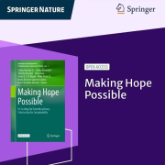
Iris Stewart-Frey (Environmental Studies and Sciences, Environmental Justice & the Common Good Initiative) published a book chapter on creating community-academic partnership models for social and ecological change: Stewart, I. T. (2026). "Hope Needs Courageous Action: Local-to-Local, Cross-Border Community-Academic Partnerships can Serve as Models for Social and Ecological Transformation" in Making Hope Possible: On Scaling Up Transdisciplinary Scholarship for Sustainability (pp. 147-158). Cham: Springer Nature Switzerland.
In a world where political narratives - and sadly, public policies - are being created around fear of the other or the different, and where the exploitation and destruction of human and ecological communities are normalized, it’s necessary to shift the discussions into “how to make hope possible.”
This open access book addresses the subject. With voices from academia and practice, and with environmental justice as a horizon, it’s aimed to explore different experiences from around the world.
Maggie Wander (Art and Art History) presented her paper "Placing the Past: Site-Specific Contemporary Art and Ecological Collapse in Oceania" at the Pacific Arts Association (PAA) International Symposium in Leiden, Netherlands. The paper investigated the material implications of three site-specific artworks in Oceania to bring the past to bear on today's climate crisis. Maggie is heavily involved in the PAA, serving as co-Executive Editor of the affiliate journal, Pacific Arts, since 2020. Additionally, at this recent symposium, Maggie was elected to serve as Vice President of North America, and is excited to strengthen and grow the vibrant network of scholars and artists in the region.
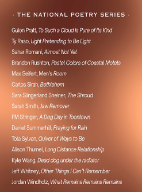
The National Poetry Series is a prestigious American literary awards program established in 1978 that sponsors the publication of five new books of poetry each year. The series reviews more than 1000 manuscripts and highly acclaimed judges select five to be published by established trade and reputable independent presses. Daniel Summerhill’s (English) forthcoming collection, Praying for Rain, which engages with the poetic’s of the late James Baldwin was selected as a finalist for this year’s competition.
Image: List of finalist for this year’s National Poetry Series competition.
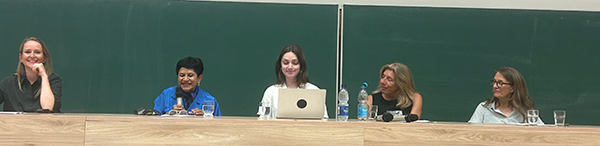
Aparajita Nanda (English), a Fulbright Specialist Awardee (2025–2028), was featured prominently as a key panelist at the historic event celebrating 250 years of American Independence, held in the university town of Tübingen, Germany. The event was attended by other notable academics from Europe and the U.S., who offered critical insights into American literary history, cultural identity, and political thought. The U.S. Consul General also attended as an honored guest, underscoring the enduring geopolitical and cultural alliance between the United States and Germany. Additionally, the German-American Institute (dAi Tübingen) and the University of Tübingen arranged academic panels and public lectures to explore the global legacy of the U.S. Declaration of Independence and examine its historical influence on German democratic movements. As a Fulbright Specialist, Apara was also invited to give public talks at the Universities of Würzburg and Freiburg, Germany.
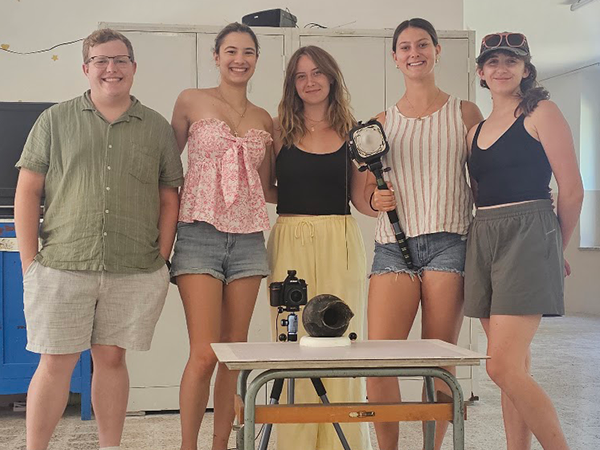 Sean Hayden, Sophia Soto, Kat Lennon, Samantha Anderson, and Annika Kayser.
In June and July, Carolynn Roncaglia (Classics and Ancient Studies) and a team of 5 Santa Clara students—Samantha Anderson ’26 (Accounting), Sean Hayden ’27 (Classics), Annika Kayser ’27 (Theatre Arts, Classics), Kat Lennon ’27 (English), Sophia Soto ’27 (Public Health Science)—joined the San Giuliano Archaeological Research Project at Barbarano Romano, Italy (just north of Rome). The Santa Clara team used Reflectance Transformation Imaging, an innovative imaging technique, on recently unearthed finds from the 7th century BC to the medieval period.
The team also participated in the ongoing archaeological excavations there, which have explored how settlement of the San Giuliano plateau evolved in the Etruscan and medieval periods. The project is spearheaded by a Baylor University-led consortium of universities and done in close collaboration with community partners at Barbarano Romano. The students also had the chance to explore Orvieto, Spoleto, Assisi (including the Basilica di Santa Chiara!), the Etruscan sites of Tarquinia and Cerveteri, the castle at Santa Severa, and Rome.
Anna Sampaio (Ethnic Studies) recently presented at the Women in American Democracy Summit hosted by the Center for American Women and Politics. The summit was a first-of-its-kind gathering that brought together leading activists, scholars, journalists, and donors committed to strengthening women’s role in American democracy. In response to ongoing challenges facing democratic institutions, the summit provided opportunities for research and information sharing, as well as forging cross-sector partnerships; developing tangible, research-informed strategies across the multiple dimensions of the women’s political participation space; and collaborative agenda-setting that included new, activist-informed questions for research, as well as new strategies for intervention.
As part of the conference Anna was invited to share research from her recently published report “Mujeres y Movidas: Latina Congressional Candidate Emergence and Experiences in California and Texas,” focused on the historic rise of Latina candidates for national office since 2018. The research is part of an ongoing project that centers on interviews with Latina Congressional candidates, sitting Congressional representatives as well as key political professionals and activists. With the support of a grant from the APSA, this summer Anna worked with Ashley Orozco-Plata ’27 (Ethnic Studies, Child Studies) to expand the field of interviews and research to include candidates from AZ, IN, IL, GA, and FL.
Image: Anna Sampaio at the Women in American Democracy Summit 2026.
Daniel J. Morgan (Religious Studies) recently published a chapter in Islamic Intellectual History in the Mughal Era. The chapter provides an analysis of Shāh Walī Allāh Dihlawī's Hawāmiʿ, a little-known Persian-language treatise on the science of "angelic invocation." The chapter draws on four manuscripts of the text to make two arguments. First, it shows that despite generations of scholars asserting that the famous reformer Walī Allāh lost interest in "magic" or "superstition" as he matured into Islamic "orthodoxy," this sophisticated occultist text was written in 1752 and was thus product of his later life. Second, I argue that despite its content this was nevertheless a reformist text, seeking to articulate a scripturally rooted occult science directed towards the angels that sought to replace superseded forms of occultism that sought to harness the power of the celestial bodies/planets.
Francisco Jiménez (Modern Languages and Literatures, Emeritus) continues to extend the reach of his work through educational and cultural initiatives in the United States and Mexico.
Fondo de Cultura Económica (FCE) selected the electronic edition of his book Cajas de cartón, along with other titles, for Mexico’s National Reading Program, an initiative of the Ministry of Culture to promote literacy. Through the program, selected FCE titles are made available free of charge in small community libraries throughout the country, particularly in areas without established libraries or reliable access to books.
Excerpts from three of Francisco’s books also appear in widely used Spanish-language learning materials: Más allá de mí in Contraseña, published by LingroLearning in New York; “Expulsados,” from Senderos fronterizos, in Temas, published by Vista Higher Learning in Boston; and an excerpt from Cajas de cartón in Reporteros 3, published by Difusión in Barcelona, Spain.
A story about Mayacamas Countywide Charter Middle School in Napa appeared in the Napa Valley Register, highlighting a project-based learning initiative centered on Francisco’s autobiographical book, The Circuit: Stories from the Life of a Migrant Child. “Through creative projects rather than traditional tests, students explored themes of poverty, language barriers, and resilience, inspiring meaningful conversations among students, educators, and families.”
College of Arts and Sciences Calendar
|
|
Parallel VIsions
Thru Nov. 21 | Edward M. Dowd Art and Art History Building
Curated by Kelly Detweiler. SCU Artists: Ryan Carrington, Kathy Aoki, Takeshi Moro, Ryan Reynolds and Pancho Jimenez. Japanese Artists: Kineta Kunimatsu, Rie Kawakami, Mitsugu Aikawa, Hiroshi Takeda, and Hiroyasu Kosukagawa
Reception: Sept. 30, 5:30–6:30 p.m., Dowd Lobby |
|
|
Technology Training Accessibility Classes
Ensure your Google docs (using Grackle), PowerPoint, and Word documents are accessible. |
|
|
Core Syllabus Submission Deadline
Core syllabus submission deadline for courses scheduled for Winter 2026. Faculty Resources. |
|
|
Theatre and Dance Majors, Minors and Enthusiasts meeting
4:30 – 6 p.m. | Fess Parker Studio Theatre
Come meet Theatre and Dance faculty and staff, fellow majors, minors and enthusiasts, and learn about many exciting projects planned for the year. |
|
|
Giving an Account of Our Hope: Catholic Social Teaching Today
9 – 11:30 a.m. | St. Clare Parish Hall, 725 Washington St., Santa Clara
Pope Leo XIV recently reminded us in his encyclical Magnifica Humanitas that Catholic Social Teaching (CST) is “not a handbook of principles and norms to be applied, but a process of shared discernment” (no. 27). It is a living tradition “that safeguards and interprets humanity’s vocation to a fully and just life” (no. 3). In this workshop, the Markey Center for Leadership and Ministry will explore how we live this tradition by giving an account of our hope (1 Pet.3: 15) to Christian and non-Christian alike. |
|
|
CAFE: Student Mentorship
11:45 a.m. - 12:45 p.m. | Varsi 222
Student mentorship occupies space in both visible and invisible areas of faculty responsibility. Often considered an extended responsibility of teaching, faculty engage, support, and learn with students through academic advising, research, and a variety of other formal and informal professional and personal learning development roles. |
|
|
Who Gets to Define a Good Life? AI, Inequality, and Human Agency in Indonesia
3:30 p.m. | On Zoom
Join the Departments of Sociology and General Engineering for a talk by Dr. Ressa Uli, Muhammadiyah Palangka Raya University, as she examines the AI-powered smartwatch as a “distributional technology” rather than a neutral gadget, asking who gets to be an algorithmic companion, who is companioned, and who is excluded altogether. This event is part of the Digital Sociology Speaker Series. |
|
|
Images 2027 dance auditions
5:15 – 7:30 p.m. | Dance Studio A, Music and Dance
All dancers welcome to audition. Modern/contemporary, ballet, hip hop & jazz dance.
Performance dates: Feb 4-7, 2027 - Mayer Theatre
Yes, faculty and staff can participate in our theatre and dance productions too! |
|
|
Student Immigration Administration Town Hall for SCU Faculty and Staff
Noon &ndash 1 p.m. | On Zoom
Global Engagement invites you to attend our Town Hall session to learn more about recent immigration updates and ask questions. |
|
|
Fall One Act Festival auditions
4 – 6 p.m. | Fess Parker Studio Theatre
No experience or preparation required.
Yes, faculty and staff can participate in our theatre and dance productions too! |
|
|
BAMA 1: Christelle Vincent, “Quantum Computing and Post-Quantum Cryptography”
7:30 p.m. | On Zoom
Professor Christelle Vincent of the University of Vermont, gives a lecture, “Quantum Computation and Post-Quantum Cryptography.”
You may RSVP through the form provided or email George Schaeffer (gschaeffer@scu.edu) and ask to be added to the BAMA email list. |
|
|
Emotional Affairs: A Philosophical Account of Emotional “Cheating”
11:45 a.m. – 12:50 p.m. | Learning Commons Viewing and Taping A
A Brown Bag Speaker Series talk featuring Justin Clardy (Philosophy). Discussions about infidelity typically emphasize sexual or physical transgressions while overlooking emotional infidelity almost entirely. This talk offers a philosophical account of what emotional affairs are by identifying three individually necessary and jointly sufficient conditions that help clarify what they are and when (if ever) they are wrongful. Bring your lunch. |
|
|
The Four Panel Conversation
3:30-6:30 p.m. | de Saisset Museum
Join the de Saisset for a panel conversation celebrating The Four (Revisited), the first in The de Saisset Exhibition Histories series excavating and re-staging significant projects that took place at the museum during the early 1970s.
Moderated by Andrea Pappas (Art and Art History).
Co-sponsored by the Center for the Arts and Humanities |
|
|
FARs due
All day | Interfolio
Complete your Faculty Activities Report by adding activities and supporting documentation in Interfolio and forwarding your case to your department. |
|
|
Sabbatical applications due
All day | Online
Submit your sabbatical application using the Qualtrics link on the Sabbatical Leave page. Applications are automatically routed to department chairs for review. |
|
|
Faculty Recital Series – Teresa McCollough: Music and Ecstasy
7:30 p.m. | Music Recital Hall
Pianist Teresa McCollough presents Music and Ecstasy, a solo recital exploring music’s power to inspire contemplation, transcendence, and transformation. Featuring George Crumb’s iconic Vox Balaenae (Voice of the Whale) with Ráyo Furuta, flute, and Gianna Abondolo, cello. |
|
|
Physics and Engineering Physics Student Research Symposium
9 a.m.–12:30 p.m. | SCDI 1308 and
Monday, October 5, Daly Science 207, 4–5 p.m.
The Department of Physics and Engineering Physics is hosting its annual SCU Student Research Symposium. Come hear undergraduates present their research results from summer 2026. Talks will cover a wide range of modern topics. There are so many talks that the symposium will reconvene on Monday, October 5. |
|
|
Banned Books Week Film Screening: The Librarians Documentary
2:30 – 4:30 p.m. | Learning Commons Viewing and Taping A
Join the Center for the Arts and Humanities for the screening of the 2025 award-winning documentary, The Librarians. The documentary, which is directed and produced by Kim A. Snyder, follows school and public librarians on the front lines of the national fight against book bans and censorship. The screening will be followed by a short discussion with SCU librarian, Sophia Mosbe. |
|
|
Music@Noon - Echoes in the Woods: Flute, Viola, Harp Trio
Noon | Music Recital Hall
Echoes in the Woods brings together three of the Bay Area’s most sought-after chamber musicians: flutist Ráyo Furuta, harpist Amy Ahn, and violist Jessica Chang, for an afternoon spanning Ravel, Debussy, Uebayashi, and Timo Andres. |
|
|
Grand Reunion Weekend
Oct. 8-11
|
|
|
Banned Books Week Spotlight: The Day The Books Disappeared
9:15 – 10:45 a.m. | St. Clare Room, Learning Commons
Talk by co-authors of The Day The Books Disappeared, Joanna Ho and Caroline Kusin Pritchard |
|