Executive-Level Workshop
The AI-Centered Enterprise Transformation Workshop is a one-day executive education program at Santa Clara University designed for senior leaders driving AI strategy and enterprise-wide transformation. Through three 2-hour sessions, participants learn how to align AI initiatives with business strategy, governance, and measurable outcomes, presented with a strategic, organization-wide lens. A copy of the book "The AI-Centered Enterprise" and certificate from Santa Clara University are included.
Date: Saturday, May 30, 2026
Time: 9am - 4pm PST
Location: Santa Clara University, Guadalupe Hall, Third Floor
Price: $695
Early Bird Discount (through April 30): 10% (no code needed)
Santa Clara University Staff, Faculty and Alumni Discount: 10% (apply code AI4SCU at checkout)

What You'll Gain
By the end of this workshop, you'll leave with more than ideas, you'll walk away with practical frameworks and executive-ready deliverables to advance AI transformation within your organization.
1. A Clear AI Transformation Roadmap
Translate strategy into action with a structured, organization-wide blueprint for becoming an AI-centered enterprise. Identify priority initiatives, sequencing, and measurable milestones.
2. Executive-Level AI Governance Framework
Develop a high-level governance model addressing oversight, accountability, risk management, bias mitigation, and responsible AI deployment.
3. A Prioritized AI Initiative Portfolio
Evaluate and map AI opportunities across your enterprise, distinguishing high-impact initiatives from experimental use cases. Focus resources where they drive competitive advantage.
4. A Draft Set of AI-Aligned Objectives & Key Results (OKRs)
Define transformation objectives and supporting strategic initiatives aligned to business outcomes, not just technology adoption.
5. A Change Enablement Strategy
Outline a practical approach to aligning people, processes, and culture around AI transformation; ensuring adoption, cross-functional coordination, and sustained momentum.
6. Executive Clarity on AI Capabilities and Limitations
Strengthen your ability to assess vendors, guide internal teams, and make informed investment decisions by understanding what AI can, and cannot, realistically deliver.
Workshop Details
Key Takeaways
- Transformation Objectives leveraging AI (Initial Draft)
- Strategic Initiatives supporting transformation (Initial Draft)
- Change Management strategy to enable transformation (Initial Draft)
- Objectives and Key Results (Initial Draft aligned to transformation objectives)
Who Should Attend
- Executives of traditional/legacy, non-tech companies seeking transformation using AI.
- Senior Program Managers driving business transformation leveraging AI
- Chief of Staff, PMO leaders, and transformation champions
Workshop Agenda
Session 1
Objectives
- Grasp how AI-driven decision-making reshapes organizational structure, competitiveness, and traditional hierarchies.
- Understand how AI unlocks unstructured data and breaks down silos, requiring redesign across the enterprise.
- Align people, processes, and technology to support a cohesive, AI-ready transformation strategy.
Executive Exercises
- AI Usage Mapping: Identify current AI use cases and envision how they could evolve into more context-aware, autonomous systems.
- Decision Flow Diagnostic: Select one critical decision process slowed by silos or coordination gaps, and brainstorm how AI or centralized data could improve speed and quality.
Expected Outcomes
- A shared vision of what becoming an AI-Centered Enterprise entails and an initial assessment of readiness.
- A preliminary blueprint for AI-enabled information flow that reduces silos and identifies priority restructuring areas.
- Leadership alignment on where AI can drive competitive advantage and agreement on initial transformation priorities.
Session 2
Objectives
- Clarify modern AI technologies (including generative AI and LLMs) and how core functions—perception, interpretation, reasoning, prediction—translate into practical business value.
- Understand how AI augments productivity by automating or supporting cognitive tasks such as analysis, content generation, and decision evaluation.
- Explore how AI improves communication, coordination, and resource orchestration using frameworks like SEE (Search, Evaluate, Engage).
- Recognize the shift from simple automation to AI-driven information reengineering.
Executive Exercises
- AI Capability Mapping: Break down a key business process into tasks and match each to suitable AI capabilities.
- Future-State Interaction Design: Redesign an interaction with AI enhancements.
Expected Outcomes
- Stronger executive understanding of AI capabilities and their limits.
- A preliminary task-to-AI opportunity map.
- Early workflow redesigns illustrating improved information flow.
Session 3
Objectives
- Data Security & Privacy: Ensure AI initiatives follow strong security practices.
- Model Reliability & Transparency: Demand transparent AI models.
- Bias & Fairness: Mitigate algorithmic bias.
- Responsible & Ethical Use: Apply ethical frameworks such as the 3C model.
- Executive AI Governance: Define oversight structures.
Executive Exercises
- AI Initiative Risk Assessment: Identify and mitigate AI risks.
- Governance Strategy Exercise: Draft a high-level AI governance model.
Expected Outcomes
- Clear executive awareness of AI risks.
- Agreement on responsible AI principles.
- An initial AI governance framework.
- A balanced AI roadmap integrating risk controls.
Meet the Speakers
Ram Bala, Founder & Chief AI Scientist, Samvid AI
Associate Professor of AI & Analytics at the Leavey School of Business, SCU
Ram Bala received his Ph.D. in Operations Research from UCLA and his undergraduate degree in Engineering from IIT, Bombay. He is one of the world’s leading thinkers on Enterprise AI Transformation and the author of the bestselling book The AI-Centered Enterprise. He has conducted executive workshops on AI transformation for leading companies such as Adobe, Saudi Aramco and Paypal.
His past research includes numerous publications in top journals on machine learning and optimization applied to pricing,marketplace design, and supply chain analytics. Ram has led AI teams across startups, Fortune 500 companies, and non-profits, such as GrandCanals, C.H. Robinson, Project Stanley, and Andela. He also leads the Prometheus Lab on AI& Business at Santa Clara University.
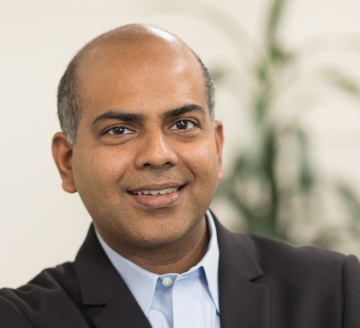
Arun Rao, Founder & CEO, Samvid AI
AI Transformation Leader for Supply Chain, Procurement & Logistics
Arun Rao helps enterprises turn unstructured operational data into measurable financial outcomes. A CTO, CEO, andformer Head of Advanced Analytics at Fortune 500 company, he has led AI-driven transformation across global supply chains—improving delivery speed, reducing logistics costs, and modernizing pricing and contract execution.
He has built and scaled AI systems in parcel and freight optimization, pricing governance, and contract intelligence at companies including Flex, C.H. Robinson, Gap Inc., and high-growth startups. Today, as Founder & CEO of Samvid AI,Arun leads the development of an enterprise agentic platform that uses knowledge graphs and multi-agent orchestration to modernize the contract-to-cash cycle.
Arun works closely with CXOs to operationalize AI with clarity, governance, and P&L impact—bridging strategy, technology, and execution to drive transformation that actually sticks.