Introduction
As it is a critical component of the strategic sourcing process, it is the policy of the Procurement Department to obtain competitive bids for goods or services whenever possible and if appropriate, and applies to all staff, faculty, students, and other individuals who procure goods and services that advance the University’s values, mission, and objectives. All bids must be in writing, with the bidding requirements dependent upon the dollar amount of the planned transaction.
In certain situations, it may not be advantageous to seek bids. See section titled “Exceptions to Competitive Bidding” for more information.
Benefits of Competitive Bidding
Competitive bidding helps SCU maintain responsible stewardship of University dollars by securing optimal value, ensuring fairness, and maintaining transparency in purchasing decisions. By following a formal competitive bidding process through RFPs/RFIs/RFQs, SCU can:
- Clarify specifications and requirements to ensure SCU’s needs are fully met.
- Reduce costs by encouraging competition for SCU’s business.
- Explore new suppliers that can support SCU.
When is Competitive Bidding Required?
Competitive bidding is required when:
- Purchases exceed the established threshold of $15,000. See the table below for bidding requirements based on the planned spend amount.
- New engagements for new services/goods where multiple qualified suppliers can fulfill the requirement.
- Goods and services are standardized and widely available.
- The funding source (i.e., grants) requires a certain number of bids to be obtained per the contract terms.
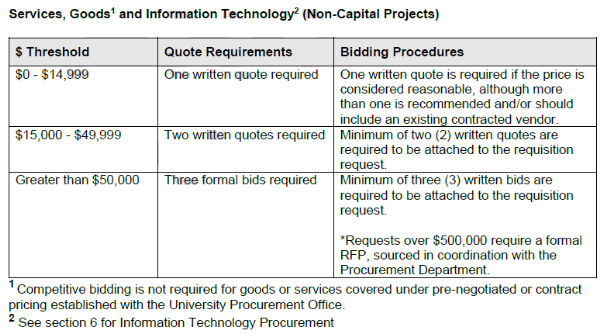
Competitive Bidding Process
Step 1: Planning and Preparation
- Clearly define the specifications and requirements (technical, functional, qualitative, and/or quantitative), as well as the intended goals and outcomes
- Estimate the budget, establish timelines, and identify stakeholders.
- Note: If bidding out an ongoing service, determine the deadline for renewal per the existing agreement.
- Consider the current provider/incumbent and seek opportunities for improved costs and quality of service.
- Conduct a preliminary search of potential suppliers/respondents.
Step 2: Solicitation
- Use SCU’s template RFPs or RFQs to put requirements in a standardized format.
- Notify potential suppliers and ensure sufficient response time.
Step 3: Evaluation and Selection
- Evaluate bids based on predefined criteria (budget, price, quality, service, proposed team that will service SCU, diversity).
- Maintain documentation (i.e, bid responses/proposals) for transparency and audit purposes.
- Work with Procurement to negotiate pricing whenever possible (ask for potential discounts for educational institutions).
Step 4: Award and Contracting
- Issue formal notifications of award.
- For services, begin working with the selected supplier on contract drafting and execution.
- For goods/capital equipment, inform the winning supplier.
- Send a respectful communication to those who did not win the bid.
Exceptions to Competitive Bidding
Exceptions include:
- Approved sole or single-source justification (built into Workday Requisition workflow [In Progress]).
- Emergency procurements impacting safety or operational continuity (i.e., natural disasters, campus-wide event).
- Specialized professional services with documented rationale.
- Purchases with catalog vendors that we have preferred/contracted pricing with (i.e., Amazon, Blaisdell’s, Apple, Dell, etc.)
- Renewals for services for ongoing projects/services
- Note: It is highly recommended that the quality of service be assessed to determine if it is best to remain with the incumbent or go out for proposals.
Best Practices for Competitive Bidding
- Engage Procurement early for assistance with sourcing activities and to understand the suppliers and spend.
- Communicate clearly and regularly with potential bidders.
- Encourage supplier diversity and inclusion.
- Utilize existing RFP/RFI/RFQ templates to help formalize and standardize the bidding process.
Roles & Responsibilities
- Procurement Team: Oversight, guidance, and final review.
- Departments: Requirement definition, technical evaluation, and timely engagement.
- Suppliers: Clear and responsive bids, adherence to timelines.
Frequently Asked Questions
Does a funding source affect whether or not a good/service needs to be competitively bid?
Yes, certain funding sources, like federal grants/sponsored projects grants, may have bidding requirements as part of the contract. Seeking the number of bids per the contract ensures that SCU is compliant.
Are renewals required to go through the competitive bidding process?
Best practice would be to bid this out where it makes sense. For example, if a software service can be provided by multiple suppliers/distributors, it would be ideal to solicit bids to see who can offer the service at the best price.
It may not make sense to consider changing services that are embedded deeply enough within SCU’s current infrastructure, where changing vendors would be unduly disruptive. It is highly recommended that the quality of service be evaluated ahead of the renewal deadline to determine if continued use of the supplier is warranted. If it is determined that renewal is the best option, work with Procurement to potentially renegotiate terms and pricing.
What if a purchase was finalized without both the purchase order being issued and without competitive bidding?
After-the-Fact Purchase Orders (PO ATFs) are against University policy and open both the individual and the University up to undue risk. The end user will be required to complete a PO ATF Justification Form (Coming Soon!), requiring approval from their unit’s financial authority, and may be ultimately responsible for the expense if the request is denied.