Stories
Inside Flavio Olivieri ’s Benson ESL Classes
More Than Words
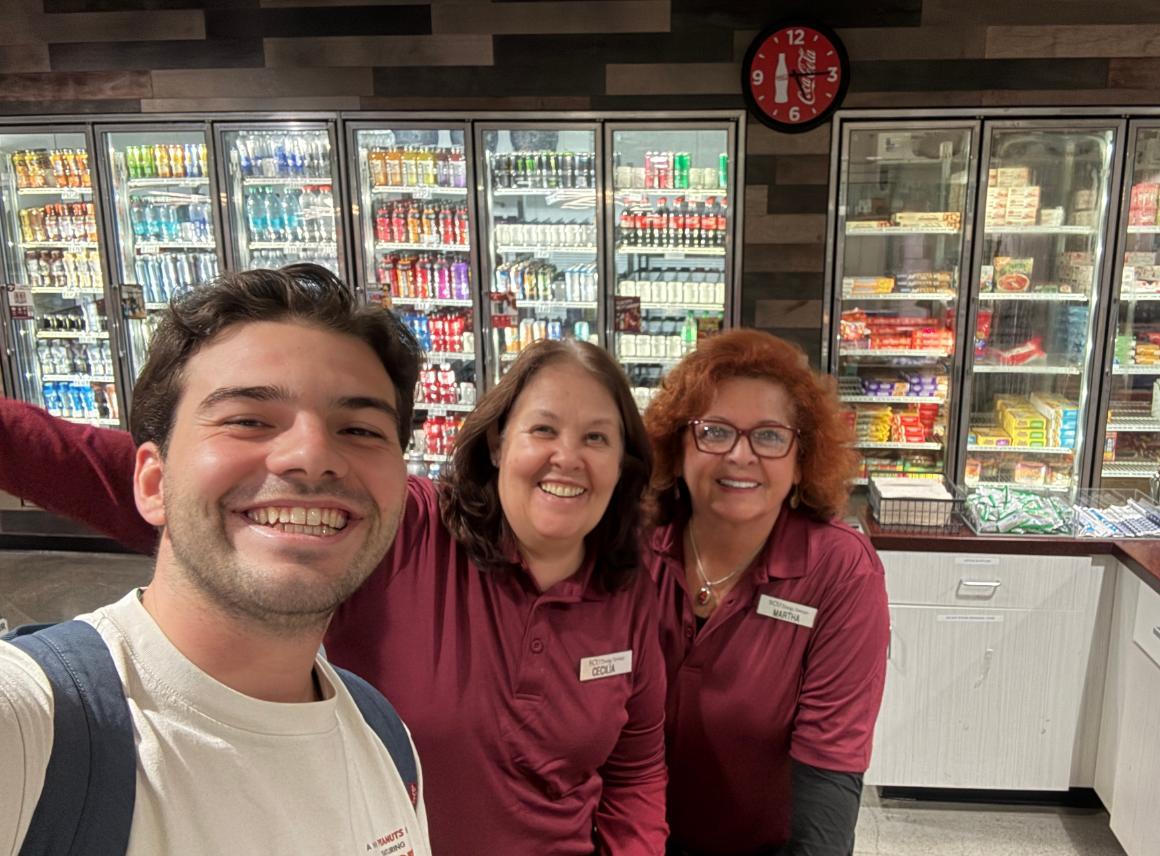
At the sandwich station in Benson, Christina greets nearly every student with a warm “¡Hola!” But when the order comes back in English, the conversation sometimes stalls. She doesn’t always know the words, and the student doesn’t always know how to help. Flavio Olivieri ‘27 noticed, and he soon realized it wasn’t just Christina. The same gap showed up at counters across Benson.
“You immediately notice this kind of gap between the worker and the student,” said Olivieri, a senior mechanical engineering major from Tijuana, Mexico. “And it comes from a place of love. They want to communicate with each other. They want to talk and share about their day, or just say thank you.”
For three years, Olivieri has been working to close the gap. He runs free, informal English classes for the Bon Appétit employees who staff Santa Clara’s dining hall, held right in the building where they work.
Faith, then Friendship
Olivieri’s instinct for service started long before Santa Clara. At his Catholic high school in Tijuana, a group of priests drew him into liturgy, prayer, and social service. “All those dimensions,” he said. He wanted to keep that going in college.
One of the first people he met on campus was Father Julian Climaco, S.J., who is the Senior Program Director for liturgy and music at the Mission. Father Julian invited him to student Masses and encouraged him to apply for a liturgy internship at the Center for Spirituality and Faith. Now, Olivieri is three years into that role.
It was in Benson, though, that he found his other calling. As a Spanish speaker, he quickly became friends with the dining staff during his freshman year. He rattles off their names with obvious affection: Cecilia and Marta (“my queens”), Christina at the sandwich shop, Claudia at Global Grill, and Jesús who works downstairs in the Cellar.
Watching those friends struggle to connect with students gave him an idea. Before launching anything, he asked them directly: Would you come to a class like this? What would you want to learn? When could you show up? At the start of his sophomore year, the first sessions began.
A Classroom Between Shifts
The hardest part of the project wasn’t the grammar, it was the scheduling. Bon Appétit workers keep widely different hours. There are morning and night shifts, kitchen and station staff, supply crews, and days off vary from person to person.
“You can’t really have one specific time for everyone,” Olivieri said. One quarter he ran four separate sessions across two days, at 11 a.m., noon, 2:30 p.m. and 5 p.m., all so each group could get a single hour a week. He was juggling a mechanical engineering course load the whole time.
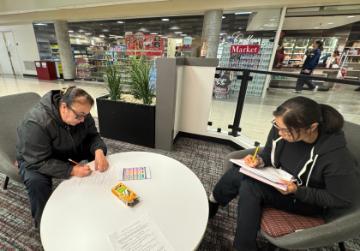
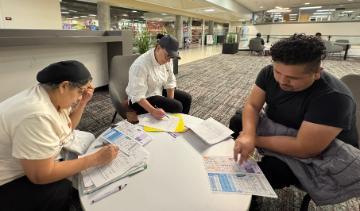
Classes meet downstairs in Benson, at a few small round tables in a lounge area between the Cellar and the California Mission Room. Some of the workers go straight from Spanish lessons to the locker room to change for their shift. Others arrive the moment they clock out. There are two principles that guide the program: flexibility and accessibility. Workers can miss a week, or two, and walk right back in. Olivieri supplies every copy, paper, and pencil himself. “Whatever time they can make it,” he said, “anyone can come.”
More than Vocabulary
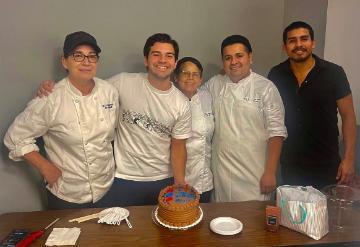
Olivieri is the first to say he isn't a credentialed teacher. Before this, he had never taught English, never taught a second language, and never taught adults. He opens every class by saying so and encourages workers to look for formal classes in their own communities.
“One hour a week won’t teach you a language,” he said. The real goal is confidence: getting comfortable with English, and with asking for help. For adults in their 40s and 50s, walking back into a classroom can be intimidating. Many discover they already know more than they thought.
Most of the workers have lived in the U.S. for 20 years or more. Many have children, grandchildren, even great-grandchildren, and have built full lives without English. But listening to their stories, Olivieri learned the cost of that barrier. Sometimes, he said, they don’t realize when someone is taking advantage of them, at work, or elsewhere.
“So part of teaching is also returning that dignity to their lives,” he said. “You are worth more than what little you are given.”
This quarter, the work counts for more than goodwill. Olivieri worried that a standard Experiential Learning for Social Justice (ELSJ) placement would impede on his teaching time. So he proposed his ESL classes instead, and the university approved them. He’s pairing the placement with a religious studies course taught by Professor Diana Gibson.
Right now, he teaches at a 3:30 p.m. session, attended by one of the Cellar workers, and is working to add a second session. Scheduling is still a puzzle, but Olivieri sees room to grow, and plenty of Benson workers who could still use an invitation.
Father Julian Climaco, S.J., who has known Olivieri since his first days on campus, has watched that spirit up close.
“Flavio Olivieri is, in a word, a character—and what a wonderful one at that!” Father Julian said. “His infectious energy, generous heart, and genuine enthusiasm for his ministry and studies never cease to inspire me. Flavio is a young man of deep faith who brings joy and authenticity to everything he does. He truly embodies the values of conscience, competence, and compassion, not simply in what he says, but in the way he lives and serves others.”
Downstairs in Benson, that is exactly what it looks like: a few round tables, a stack of copies, a pencil for everyone, and a seat saved for whoever can make it.
For the workers who gather there, the lesson has never been only about English. It is a weekly reminder of what Olivieri wants every one of them to hear: they are worth more than what little they were given.