Reconstructing Two-Level Fluctuators Using Qubit Measurements
Guy Ramon and Rob Cady, Physics
Qubits are the quantum computing version of classical bits, and they are notoriously sensitive to outside disturbances. In our research, a qubit’s signal attenuation is simulated in the presence of random telegraph noise, which is produced by one or more two-level fluctuators (TLFs). Qubit signal attenuation measurements are recorded after applying various control pulse sequences, and these data are then used by a minimization algorithm to reconstruct the TLF’s switching rate and coupling strength with the qubit. In order to simulate a more realistic noise environment, our code also accounts for the measurement errors that are inherent to any experimental apparatus. However, introducing a random element to our simulations necessitates averaging results over many trials, which makes the WAVE HPC’s parallel computing abilities indispensable for our work. Our procedure has successfully reconstructed scenarios involving both a single TLF and two independent TLFs operating simultaneously on the qubit, which suggests that our method could be used by quantum computing experimentalists to help diagnose noise sources in their own systems.
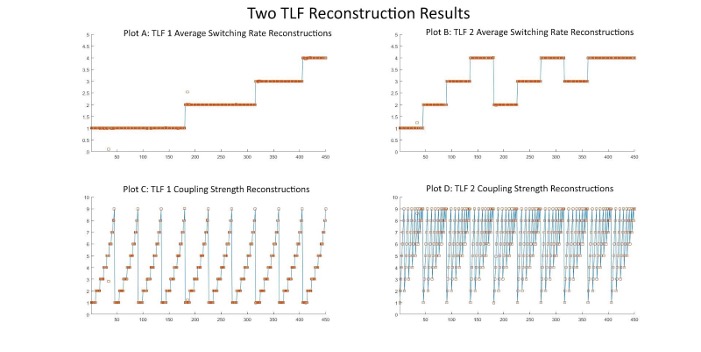
Results from a recent two TLF reconstruction test, blue lines represent the actual TLF parameters, orange squares represent our reconstructions. Plots A and C correspond to the first TLF’s characteristics and how the algorithm reconstructed them, and plots B and D do the same for the second TLF.