Bachana Lomsadze: What if we could actually see the quantum world at work?
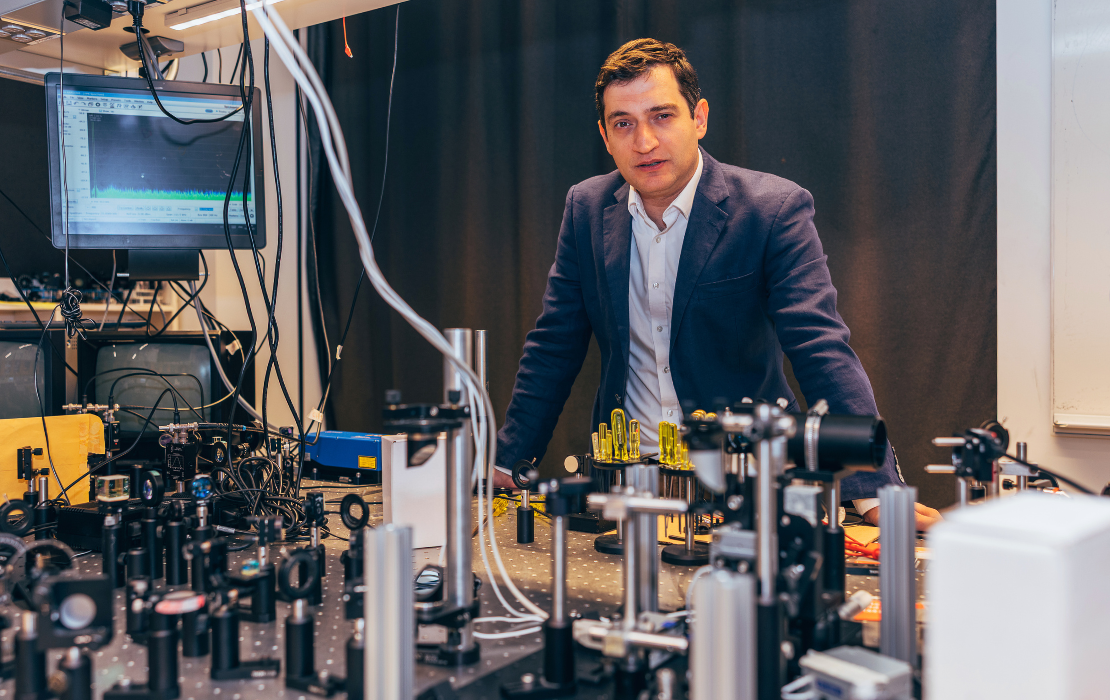
Bachana Lomsadze is an associate professor of physics at Santa Clara University and a recipient of the National Science Foundation’s CAREER Award and SCU’s Professor Joseph Bayma, S.J. Scholarship Award. A co-inventor of frequency comb–based multidimensional coherent spectroscopy, he develops advanced optical techniques to study ultrafast dynamics and light-matter interactions in quantum and nanoscale systems. His research, supported by the National Science Foundation, advances fundamental physics while laying the groundwork for innovations in quantum sensing, ultrafast electronics, and energy-efficient technologies.
This interview series invites Santa Clara faculty members to reflect on the questions, motivations, and impact that guide their work as educators and researchers.
What questions or challenges are at the heart of your current work?
My work focuses on understanding how quantum systems, from atoms and molecules to advanced semiconductor nanostructures, behave, interact, and exchange energy on extremely small spatial and temporal scales. My lab develops new optical techniques to capture these ultrafast processes at the nanometer scale (a billionth of a meter) and the femtosecond scale (a millionth of a billionth of a second), where quantum effects dominate, and even tiny structural variations can dramatically change behavior. By probing these events at the single-particle level, we aim to uncover fundamental optical properties and reveal how energy and information flow through quantum systems, deepening our understanding of fundamental physics and laying the groundwork for future technologies such as quantum sensors, ultrafast electronics, and energy-efficient devices.
Why is this issue important for the world to address at this time?
Quantum materials are advancing rapidly, opening the door to next-generation technologies in computing, sensing, and energy. But to fully understand and harness their potential, we need new tools that can reveal how these systems work at nanometer and femtosecond scales. Current optical techniques either show structural detail without capturing dynamics and interactions, or track dynamics without sufficient spatial resolution, leaving key questions unanswered. Our research bridges this gap by developing methods that probe materials with both nanometer precision and ultrafast timing, allowing us to uncover the mechanisms that drive the quantum behavior of individual quantum systems. This understanding is crucial as technology becomes smaller and more integrated, transforming what now fills an entire lab into compact, efficient devices that can power real-world advances in areas like quantum communication, environmental monitoring, and next-generation electronics.
Why have you chosen to dedicate your career to this research?
From a young age, I was highly curious about science and consistently sought to understand the causes of various phenomena around me. I loved conducting experiments, assembling circuits, and fixing broken devices just to see how they worked. That early curiosity grew into a passion for physics, leading me to pursue an undergraduate degree and then a Ph.D. focused on how light and lasers can manipulate matter at the quantum level. During my Ph.D, I explored how lasers control ultracold systems, and that fascination with light continues to drive my research today. My goal is to advance both our fundamental understanding of quantum materials and the technologies that emerge from them, bridging the gap between basic science and real-world applications.
How have your students impacted your research?
My undergraduate students have played an essential role in advancing my research. They helped build the lab from the ground up. They’ve helped set up equipment, align complex laser systems, and ensured everything operated smoothly. They have also been deeply involved in testing new ideas, conducting precise measurements, and developing analysis tools to interpret data. Their work has directly contributed to publications, successful grant proposals, and presentations at national and international conferences. Their curiosity and dedication have been an important part of our progress.
What is a book in your field that you think everyone should read?
That’s a tough question because there are so many great books in physics, but if I had to pick one, I would choose “The Feynman Lectures on Physics.” It never gets old. Feynman had a special talent for explaining really complex ideas in a simple, clear, and often humorous way. Reading it feels like sitting in on his lectures at Caltech, where he doesn’t just teach equations but shows you how to think about nature.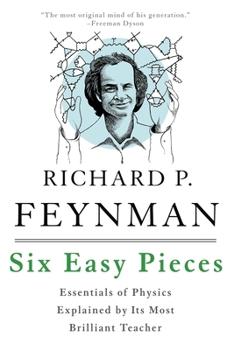
For those interested in my research area, I co-authored “Optical Multidimensional Coherent Spectroscopy,” published by Oxford University Press. It introduces the methods and applications of multidimensional coherent spectroscopy, a powerful optical technique for studying how quantum materials behave. We wrote it to introduce this technique to students and researchers from diverse backgrounds, including those new to optical or ultrafast spectroscopy. The book discusses how this technique can be applied to systems in physics and materials science, and concludes by highlighting several emerging materials and discussing future directions.

The Physics and Engineering Physics Department at Santa Clara University equips students with elite problem-solving skills, a deep appreciation for nature’s most fascinating phenomena, and the preparation to succeed across a wide range of careers.