‘Broadening the horizons of what arts and humanities work looks like’
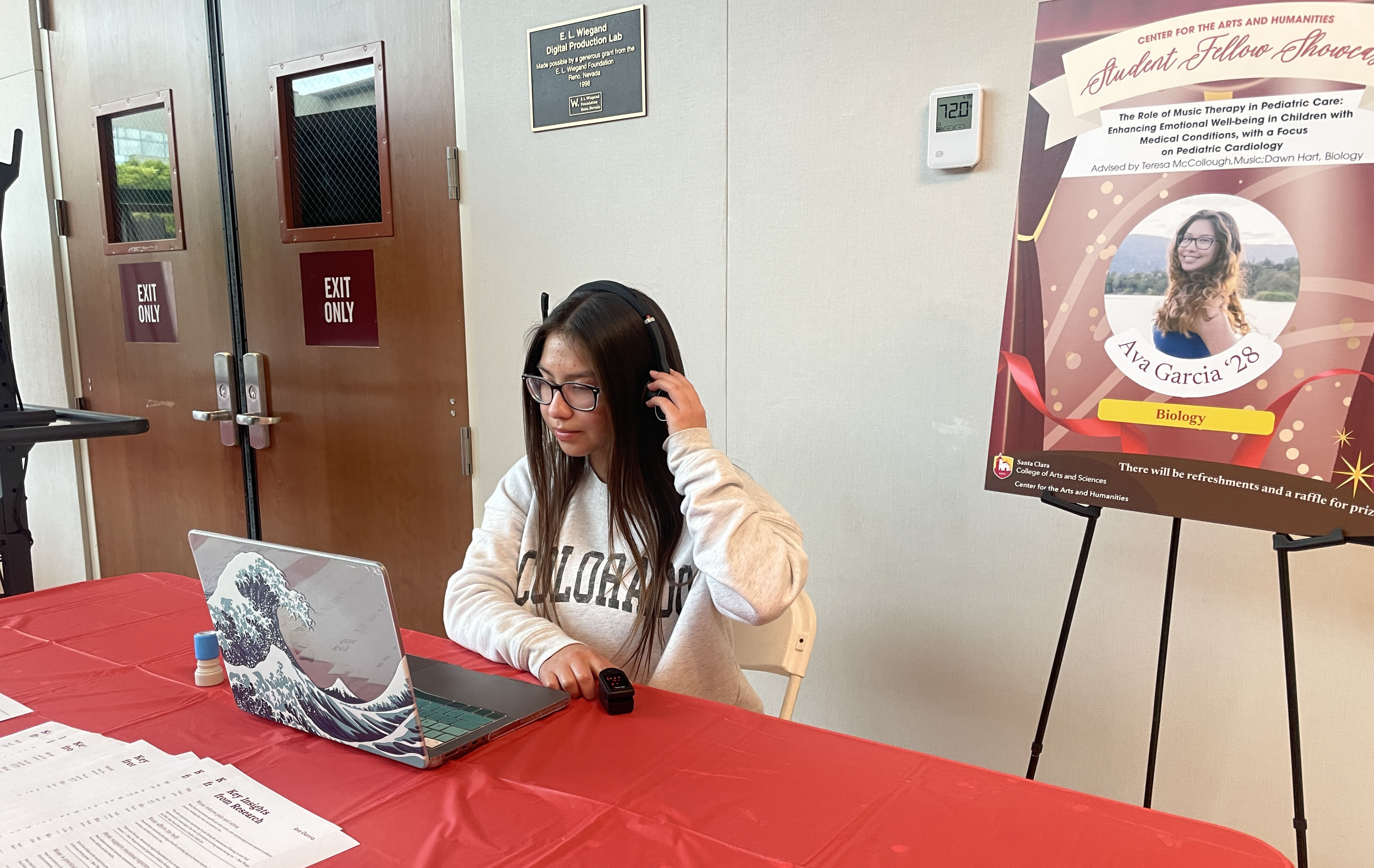
For Ava Garcia ’28, studying biology at Santa Clara University has always been about more than science. With dreams of becoming a pediatric cardiologist, she found herself also thinking about the emotional weight children carry when receiving medical care, and whether music could offer comfort that medicine alone cannot.
“I wanted to bridge music therapy and healthcare and figure out how something so universal could improve health outcomes, especially for pediatric patients,” Garcia explains. “I kept asking myself: If I were to open my own practice, work in a hospital, or become an advocate one day, what could I do to understand my patients better and actually make a difference?”
Driven by this curiosity, Garcia applied to the Center for the Arts and Humanities fellowship, which funds interdisciplinary research and creative projects for students and faculty across majors. This year, Garcia and five other students were selected to develop independent projects with faculty advisors from the College of Arts and Sciences, with topics including non-Western interpretations of mourning, modernist women writers long overlooked by the literary canon, and more.
“One of the things that’s so special about this group of fellows is the authentic way they’ve always shown up. They were really interested in creating projects that were personal and broadened the horizons of what arts and humanities work looks like,” says Danielle Fuentes Morgan, director of the Center for the Arts and Humanities and associate professor of English at Santa Clara University. “With Ava’s work, I was really impressed by the way that she’s coming from this biological standpoint and thinking about how the arts influence mental and physical health.”
To explore that connection, Garcia conducted a literature review of existing music and medical research and interviewed healthcare professionals, music therapists, and Santa Clara faculty. She found that music can have an impact on patients from birth through childhood—for example, it can shorten newborn ICU stays by up to five days and reduce reliance on opioids and other medications during procedures.
Garcia also discovered that music exposure generally lowers heart rate and raises blood oxygen levels, effects she invited visitors to experience firsthand at the showcase. Guests clipped a pulse oximeter to their finger, took note of their baseline readings, and listened to music through headphones. Within minutes, the numbers shifted.
“I found that there are actual measurable effects that music has on people dealing with health issues. Kids experience less anxiety and stress when they get to see music therapists,” Garcia says. “You can’t separate the physical from the mental, spiritual, or emotional part of healthcare. It’s all intertwined.”
She will translate her findings into a multimedia advocacy presentation to raise awareness about the role music can play in pediatric healthcare. Visit the Center for Arts and Humanities fellowship website to learn more about Garcia’s project and the full cohort of student fellows.

The CAH Fellows Program supports research and creative work in the arts and humanities by faculty and students. Each year, a cohort of faculty and student fellows pursue projects funded by the CAH, develop collaborative programming based on those projects, and join each other in community-building both on and off campus.