‘Life is a triathlon, not a sprint,’ says alum and NASA engineer
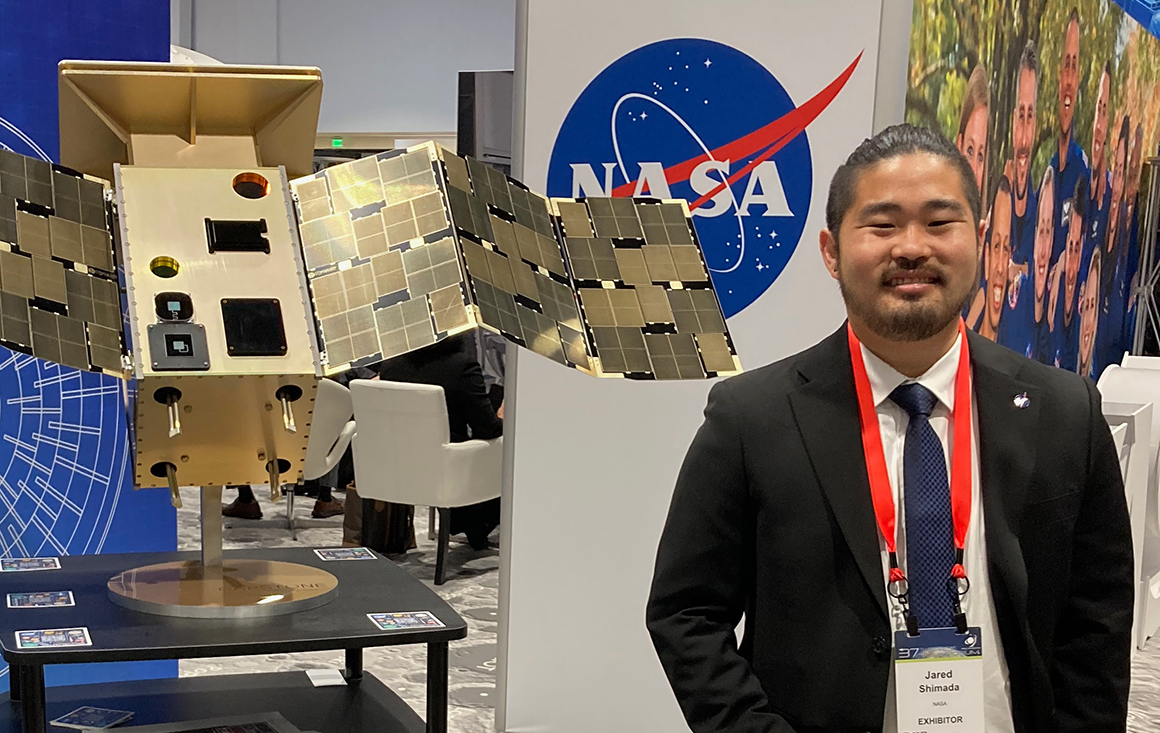
This December, a spacecraft will slingshot itself using Earth’s gravity toward an icy moon orbiting Jupiter called Europa, trying to answer one of the most audacious questions humanity has ever tried to answer: are we alone?
Launched in 2024, NASA’s Europa Clipper won’t arrive at its destination for another five years. But when it does, engineers like Jared Shimada ’16, MS ’18 hope to find evidence of life.
As a researcher at Astrion, a government contractor supporting NASA Ames Research Center, Shimada is busy at work building miniaturized instruments that can collect and analyze fluid samples autonomously on space probes that will never return to Earth. These probes will likely target moons such as Europa and Enceladus, whose vast, subsurface oceans are some of the most likely places in the solar system to contain the building blocks of life.
One instrument Shimada has worked on must split a sample of less than 50 microliters—roughly one drop of water—between multiple analytical tools, each hunting for something different: cell membranes, lipids, proteins, chemical signatures that shouldn’t exist unless something made them.
Another project he’s been working on, ExCALiBR, will look for life on Mars by sifting through dust and rocks for lipid biomarkers.
“We have to guess what we’ll encounter,” Shimada explains. “Is it carbon-based? Does it have the same molecular structure as life on Earth? Those are some of the things we try to look for.”
It’s the kind of complex work that requires you to hold chemistry, biology, mechanical engineering, electrical engineering, and software in your head simultaneously—and to know, with some honesty, which of those you need to hand off.
“Often when I’m working on programs, I usually just call up our software engineer,” Shimada admits, “and say, ‘Help! Is this even possible?’”
The approach mirrors two lessons he learned across classrooms, recital halls, and on the racetrack as a Bronco: 1) when you can’t be an expert in everything, you build a team that is; and 2) slow and steady wins the race.
Mind, body, and discipline
Looking back, Shimada received the epitome of a multidisciplinary education at Santa Clara. The Maui-born Bronco pursued two bioengineering degrees and a music minor while lifeguarding at the campus pool and running on the club triathlon team.
“Sleep, good grades, social life… I tried to hit every point as evenly as I could, even if it was a small triangle,” he explains. Luckily, each element of his Santa Clara experience bolstered the others.
Playing his trumpet in music ensembles gave him a scheduled mental release from the technical demands of engineering, something the advisors at Santa Clara’s Drahmann Center helped him protect even when his course load threatened to crowd it out. Meanwhile, the discipline of triathlon training gave structure to weeks that might otherwise have buckled under their own weight.
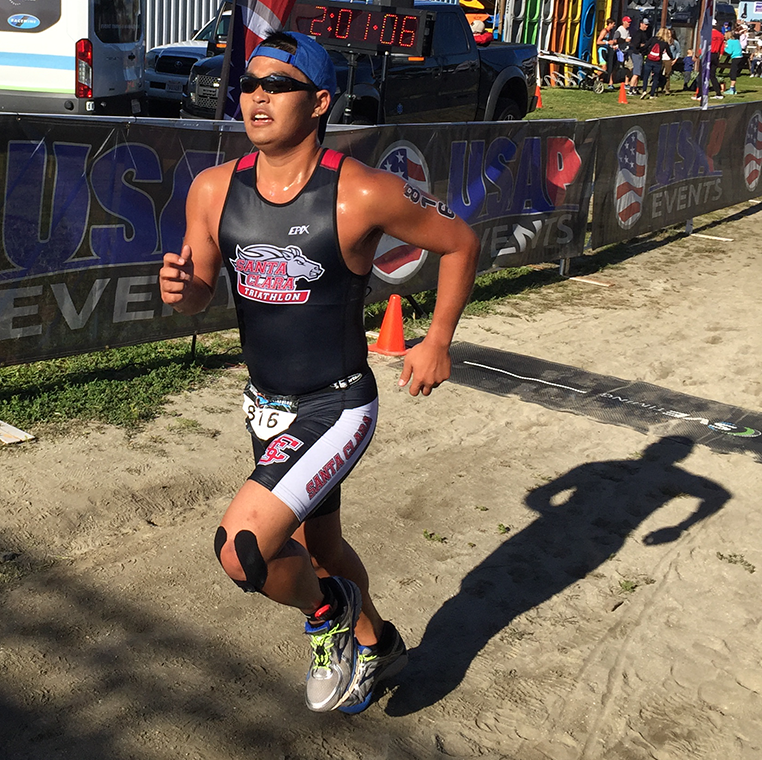
Shimada during his first winning race in 2016.
Over time, Shimada realized that triathlon is more than just running, biking, and swimming. It’s a system that demands nutrition strategy, transition planning, and the ability to compensate in one discipline when you’re having a bad day in another. Real, meaningful life skills.
It also proved to him that the most important thing is showing up—even when the results aren’t there yet.
When Shimada arrived at Santa Clara, he still saw himself as a “nerdy, geeky kid” whose main experience with sports came from a high school requirement. But by his senior year, Shimada was leading the triathlon team and had won his first race—a sprint distance in Half Moon Bay—topping the 20-24 age group without even stressing about placing. He didn’t even realize how well he had done until he checked the sheet.
“The race is against you,” he reflects. “It’s between you and the clock, and how you show up on the day.”
The student becomes the teacher
Ten years after graduating, Shimada’s schedule is surprisingly similar to his college days.
Coaching swim practice with the club triathlon team at 7 a.m., fielding work calls from the Cowell Health Center parking lot shortly after, then a full day of projects at NASA Ames, before band rehearsal in the evening. Dinner around 9:30 p.m., if he’s lucky.
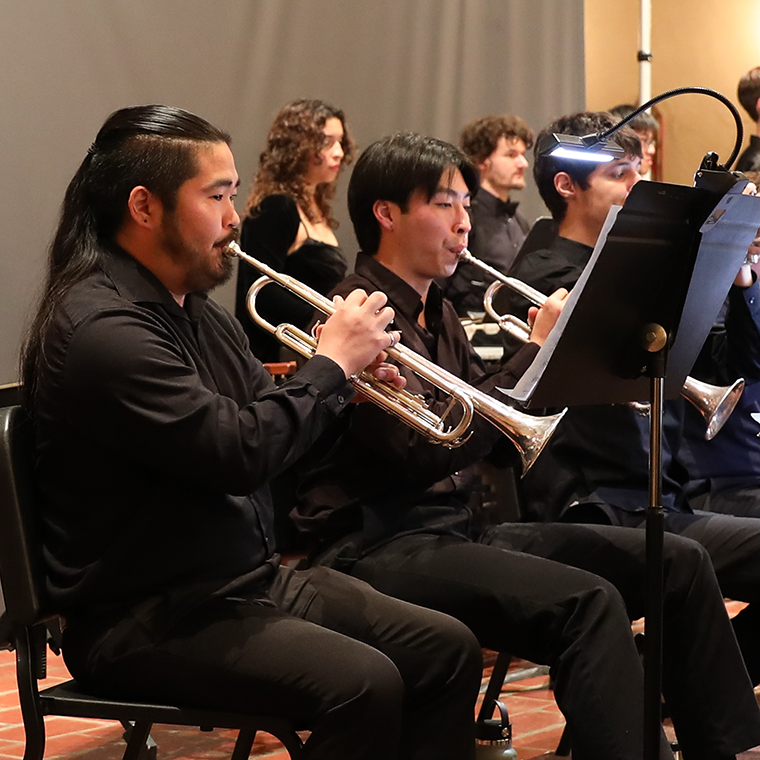
Shimada (far left) still plays his trumpet with Santa Clara’s orchestra.
He’s been volunteering to coach Santa Clara University’s club triathlon team for the last eight years. The roster had dwindled after Shimada's graduation, but with almost a decade of mentorship and support, the team is thriving, topping 30 students this year.
Those students are why he keeps showing up, Shimada says, especially the ones he’s watched grow across multiple years, like Charlotte Ryder ’27.
This past spring at the National Championships in Mississippi, Ryder finished 39th out of 427 women. She’d finished somewhere in the 80s as a freshman and the 60s the year before. When she crossed the finish line and found Shimada in the crowd, she had one awe-struck question: “I don’t feel dead! Is this how it’s supposed to feel?“
It was. Shimada’s biggest coaching focus with her all year had been simple: Figure out your fueling, or you’ll crash before the finish. It was something they worked on collaboratively, up until the night before the race when they sketched out a day-of nutrition plan on the back of a napkin. It paid off.
“She’s made steady progress since her first year. That’s what coaching’s about—watching someone build something over time.”
Patience. Diligence. The same principles that inspire him both on and off the racetrack.
Europa Clipper won’t reach its destination for another four years. Between initial research, funding, development, launch, and travel time, the life detection instruments Shimada is working on will take the better part of a decade to reach their intergalactic destinations. But he isn’t in a hurry. He knows: It’s not a sprint. It’s a triathlon.

Mechanical Engineering applies the fields of physics, mathematics, and materials science to the design and realization of mechanical and thermal systems. For over a century mechanical engineers have played a central role in creating the infrastructure of modern society while addressing the emerging interdisciplinary challenges of tomorrow.