Rethinking campus ministry at Santa Clara
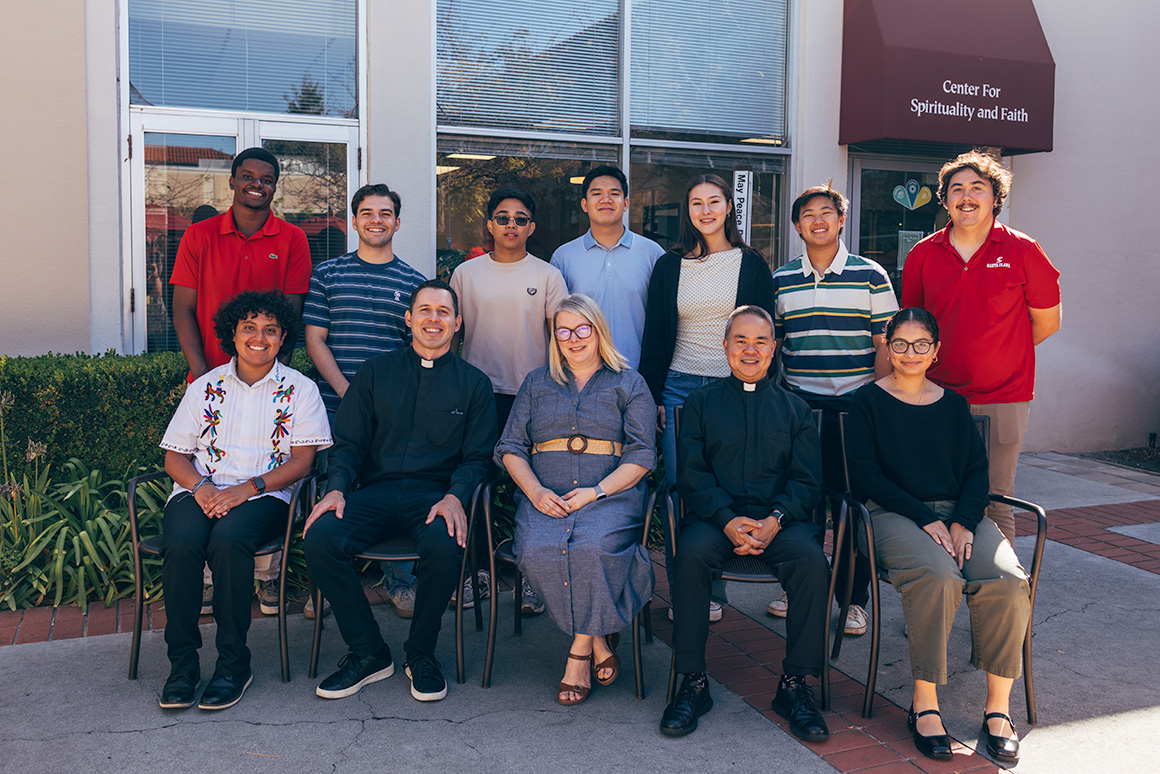
As a university based in the Jesuit, Catholic tradition, it has always been a priority at Santa Clara University to accompany students in forming their faith identity—whether they hail from Catholic, Jewish, Muslim, Sikh or any of the many religious traditions—or if they have no formal faith tradition at all.
For more than 50 years, the primary department at Santa Clara serving students on their faith journeys has been called Campus Ministry. Starting this year, the office has a new name: the Center for Spirituality and Faith.
For Santa Clara, the change is about far more than semantics. It’s about meeting students where they are today.
For some students, seeing the term Campus Ministry on a door might have felt like ”a church, where they can see the door to go in, but it might seem like it’s only for those who are really into religion, or who are already practicing Catholics,” said Matthew Carnes, S.J., vice president for mission and ministry at Santa Clara. By being more inviting to the rich array of students seeking knowledge about spirituality and faith, it opens the door for exploration into the many ways such pursuits bring meaning, purpose and belonging, he says.
The name change also is a reflection of the new and distinct ways that today’s students are approaching faith, compared with generations ago.
- Catholic Strong: A strong cohort—more than anyone can remember for a long time—are seeking to reinvigorate their Catholic faith or become Catholic for the first time. Reflecting a trend nationwide, such students are showing up in greater numbers for Masses and retreats, or seeking to learn more about the faith and perhaps become Catholic through the Order of Christian Initiation of Adults (OCIA). At Santa Clara in recent years, attendance at the Sunday evening student Masses has grown 32.2%, and last year 15 students participated in OCIA, up from only 1-2 annually in prior years. Some such students are returning to a faith that they found less meaningful during their adolescent years, and some are finding solace in Catholicism’s deep traditions and values at a time of widespread social uncertainty and division.
- “Influenced and curious”: A growing number of young people come to college having learned virtually everything they know about faith from TikTok, memes, or social media influencers—be it the TikTok priest, @MindfulChristianity, or SpiritualityTok. They’re often genuinely interested in what they’ve learned, but their knowledge is mainly surface-level, and benefits from deeper formation.
- Seeking spirituality: Perhaps the largest new cohort is made up of students who are yearning for an experience of spirituality and faith, often feeling lonely and unmoored in today’s fractious and contentious social environs. Unlike those seeking to convert to a distinct religion, though, many of these seekers want to develop their faith in an “unbundled” way: adopting what they perceive as the best of various faith traditions for themselves, and counting on campus spiritual leaders to have answers on a broad range of spiritual questions at the ready.
These profound changes mean that Santa Clara needs to be more things to more people in its role supporting faith and spirituality formation. What’s most needed, says Carnes, is “an accompaniment perspective, a fluency across traditions, and deep commitments to listening, to creating community, and an openness to those human questions that really matter. “
“We can’t keep simply putting forward to students today what resonated in the past,” Carnes adds. “We have to develop a new language, a new strategy, and new ways of accompanying them in their own spiritual growth.”
Santa Clara’s new approach includes new leadership:
- Kathleen Quiazon ’99 is the inaugural director of the Center for Spirituality and Faith. She previously served as a senior administrator, educator, and pastoral leader at Notre Dame High School in San Jose, where she worked with the Sisters of Notre Dame de Namur network of ministries and chaired the Diocesan Liturgical Commission for the Diocese of San Jose.
- Andrew Laguna, S.J., M.Div. ’19 is the University’s new director of Catholic Life, and has spent years accompanying students, young adults, and spiritual seekers through campus ministry, vocation promotion, and faith formation, most recently as a vocation promoter for Jesuits West.
Soon they will be joined by a director of spiritual diversity, who will provide support and accompaniment to students from a variety of world faith traditions, to deepen their connection to those faiths and with their Catholic peers.
“A lot of younger people are looking for something to ground them in a world that seems kind of crazy,” said Laguna. “They’re looking for something to ground their identity in, something to help them get through life—a sense of hope to anchor them.”
Justin Seidel M.A. ’28, a third-year graduate student in counseling psychology who serves as a spirituality facilitator at Casa Italiana residence hall, is excited to work more closely with CSF leaders to meet the unique faith-formation needs of Santa Clara students.
“College is a time of great transition—you’re away from home for the first time, figuring things out, more on your own for the first time,” he said. “So there’s a searching for what do I believe as a person? And where can I build community with that?”
While the new leadership team plans to spend the coming months intensely listening to the community they will be serving, some changes are already under consideration.
For those who want to strengthen their religious literacy or Catholic faith, for instance, there will be plentiful opportunities for retreats, formation, gatherings with peers, and opportunities for spiritual companionship. Representatives from Catholic Life plan to greet students before and after Mass and attend events like Welcome Weekend for residence hall blessings or similar functions. Laguna is also hoping to have one-on-one meetings with as many Catholic students as possible to ascertain their wishes and desires.
To introduce themselves to other students across campus, CSF leaders plan to get creative in their outreach, including connecting with sports teams, hosting pop-up events and talks on topics like the role of AI in students’ lives, or offering meditations or nature walks. They will be looking for guidance from the residence hall-based spirituality facilitators, who report to CSF, to determine the most need and interest among students.
“Students have so many great, profound questions, about ‘what do I do with my life? Where do I find purpose? How do I make sense of what’s happening in the world around me?’ ” noted Quiazon. “We’re looking at how we can offer programming to meet them where they are.”

Students come to Santa Clara University with all kinds of backgrounds—some with deep faith traditions, others with little to no experience in religious life. Our Jesuit Catholic values lead us to welcome everyone, regardless of where you’re starting from.