Why this public health researcher believes some of the best medicine is food
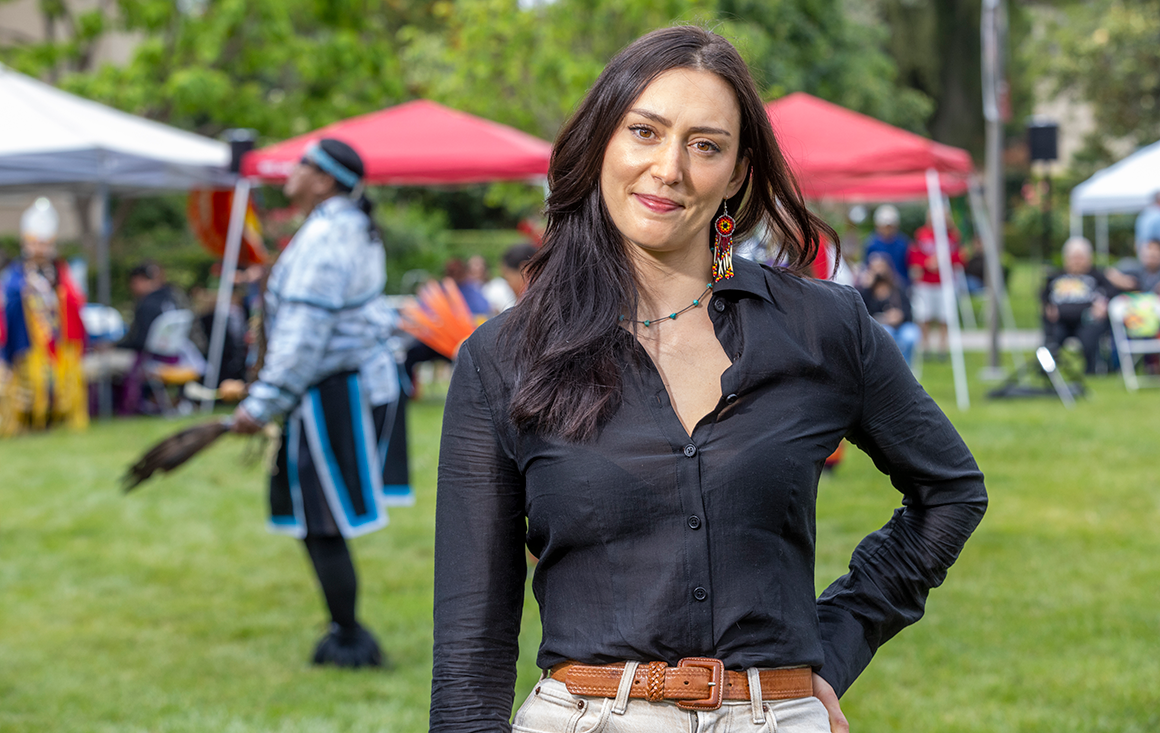
When I was little, my grandmother and I would go out and pick traditional medicine, like Arnica, Sage, and Sweetgrass. A member of the Blackfeet Nation in Montana, she taught me about the reciprocity between us and nature: when you take something from Earth, you leave an offering behind. Western medicine doesn’t recognize our ways of knowing as science, but Santa Clara University gave me an opportunity to help change that.
My journey there started with a crazy leap. I’d been studying at a big state school where I was having a hard time, and mentorship felt thin—especially for a first-generation student who didn’t know what doors to knock on. A friend was moving to California in a week and asked, “Do you want to come?” I thought: anywhere but here.
When I found Santa Clara, the small classes, the real-world impact, and the professors who genuinely cared—it was exactly what I was looking for. Back then, I was working close to 50 hours a week on top of a full course load. I felt underwater, but thankfully, my professors saw something in me that not many people did.
Professor Birgit Koopmann-Holm was the first mentor who took me under their wing and said, “You’re really good at research. You should think about a Ph.D.” Professor Stephen Carroll nominated me for fellowships I’d never heard of, coached me through rejection, and eventually pointed me toward the Knight-Hennessy Scholarship at Stanford. Professors Sonja Mackenzie and Michele Parker inspired me with the community impact of their research and dedication to their teaching. I still talk to them—they’re still my mentors. They were shepherds for my future in a way I’ll never forget.
Today I’m a Knight-Hennessy Scholar finishing my Ph.D. in epidemiology at Stanford, where I’m co-developing a food-as-medicine pilot program with the Indian Health Center of Santa Clara Valley (IHCSCV) for Indigenous adults living with diabetes.
Our program will deliver culturally and medically supportive groceries, traditional recipes and spices, and nutrition education. The need for this work is rooted in the history of colonization. Some of the upstream causes of chronic diseases rates go back to forced displacement of Indigenous peoples from their ancestral land, the deliberate dismantling of their traditional foodways, and commodity food programs that introduced processed foods to communities that had never known them.
The most important role I can play in this project is to listen to my partners at IHCSCV and show up with them. Some folks don’t have access to a kitchen, and our community partners suggested providing Crockpots to make the program as inclusive as possible. I’ve never seen Crockpots used within medical intervention before, but if the community tells you something is important, you have to make that a priority.
I think another important part of my job is showing up outside the research, too. I’ve been collaborating with IHCSCV for over a year, which is a long time in the world of graduate research. I attend their bingo nights, diabetes education and nutrition events, and volunteer at their monthly Produce Mobiles. I’m not just doing this because I want a successful research project; it’s because I care about the people I’m working with and value the amazing resources IHCSCV offers our local community.
I do this work because everyone should have a seat at the table to access resources and make their own decisions. Self-determination—that’s my North Star. I hope my community-centered research creates more space at the table for Indigenous ways of knowing, for organizations like the IHCSCV, and for people like my grandma and my mom. That lights a fire under me every day. I have a lot of gratitude for Santa Clara University and my mentors for encouraging me in this work.

Headquartered in the most innovative place on earth, Silicon Valley, Santa Clara University blends high-tech innovation with a social consciousness grounded in the Jesuit educational tradition. Broncos are driven to build a more humane, just, and sustainable world.