Friendship, Memories, and a Deeper Understanding of Community
There is something that happens when you walk into a room full of elementary students who are genuinely excited to see you. The stress of assignments, deadlines, and the demands of college life does not disappear, but it momentarily fades into the background. For a few hours, what matters most is being present.
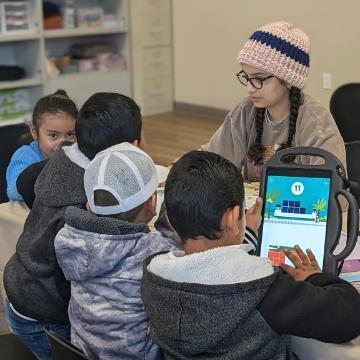
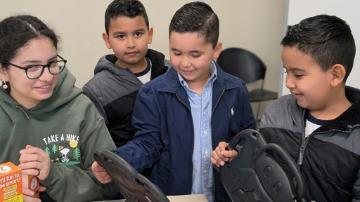
For Rocio Garcia and Beleny Quiroz, 2026 graduating seniors and tutors in SCU’s iPad Program “Abriendo Puertas,” that feeling has sustained them the past four years. The program partners Santa Clara University students with children in transitional kindergarten through second grade at a local elementary school, creating opportunities for academic support, mentorship, and relationship building.
What began as a volunteer commitment quickly became something much deeper. Through countless Saturday mornings, both students, as well as their other fellow tutors, discovered that community engagement is not simply about serving others. It is about building relationships, learning alongside one another, and allowing yourself to be transformed in the process.
Showing up, Week After Week
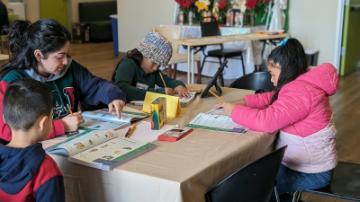
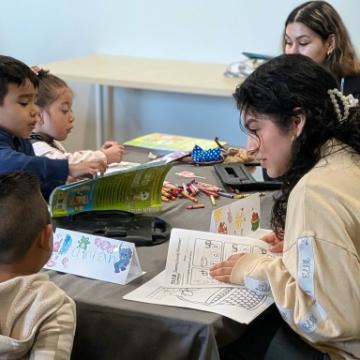
Every other Saturday, tutors gather with students for a ninety minute session filled with workbooks, educational games, and iPads. According to Rocio and Beleny, however, the most meaningful moments often happen outside the lesson plan.
“The workbooks that the students work on are like homework, and the students sometimes don’t want to do them,” Rocio says with a laugh. “So instead, we color, puzzle, and talk about their weekends.”
At first glance, those activities might seem simple, but they reflect something essential about the program. The goal is not just academic achievement. It is creating a space where children feel seen, heard, and valued.
For Beleny, the students themselves are what kept her coming back. “It’s a breath of fresh air every time, especially when life gets hectic,” she says. “I just love meeting the kids because it takes me away from all the other stuff that’s happening in my life. Just being able to talk to them about the wildest things and connecting with them in that way is really fun.” Beleny continued, “their conversations are often unpredictable, energetic, and filled with curiosity. Children speak with honesty and openness that invites connection, and for college students balancing demanding schedules, that presence can be surprisingly grounding.”
Rocio says the experience has helped her reconnect with a side of herself that often gets buried beneath the responsibilities of adulthood. “Kids react more when you match their energy, and they have a lot of energy,” she says. “I feel like sometimes we don’t get to interact with our playful side, so it’s good at my age to do that.”
Each session requires energy, patience, and intentionally. Yet for both students, the joy they receive in return makes every Saturday morning worthwhile.
Discovering What Community Really Means
Neither Rocio nor Beleny joined the program with a clear understanding of community-engaged learning. In fact, Beleny admits she did not think about it in those terms at all.
“When I joined the iPad program, I never really thought about it as community engagement,” she says. “I just thought it was a really cool opportunity. I had a totally different understanding, and I feel like I came in with nothing and just learning these past four years.”
Much of that learning happened through experience. As a first year student, Beleny found herself surrounded by graduate students pursuing teaching credentials. The experience was initially intimidating.
“When I first joined, I was a little intimidated because the people that were already a part of the program were graduates and I didn’t even know how to plan a lesson,” she says. “I was lucky that the graduates were kind enough to show me the ropes, how to lesson plan, be patient, and plan activities.”
Over time, Beleny began to understand that community is not built through grand gestures. It is formed through small, consistent acts of care.
Rocio came to understand community-engaged learning firsthand when, during one session, a student’s iPad stopped working. Before she had the chance to step in, another child had already offered help. “The kids understand each other and what it means to be part of a community,” she says. “That’s how I see the community engaged in learning.”
The moment was simple, but meaningful, demonstrating that the values being practiced in the room – collaboration, compassion, and mutual support – were being embraced by the children themselves.
Learning Through Challenges
While the program is filled with joyful moments, both students acknowledge that community engagement also requires patience, adaptability, and humility.
For Beleny, one of the biggest lessons was understanding that every student learns differently. “There are obviously some kids that are ahead of others,” she said. “I realized that really quickly when some students would already finish assignments that I hadn’t assigned yet. I wanted to make sure that I was slowing down so everyone could catch up, but also making the students think about each lesson.”
The experience taught her to let go of rigid plans and respond to the needs of the students in front of her.
For Rocio, growth has come through persistence. One student she works with is naturally quiet and prefers to work independently. “There is one student that I have tried to engage more with other students and other academic subjects,” she says. “He is super shy, but loves to do math in the workbook. I have been trying my best to get him to do more English and art, and I think it is slowly working.”
There is no quick solution. Progress happens gradually, through trust built over weeks, months, and years. For Rocio, success means continuing to show up, creating opportunities for connection, and celebrating small steps forward.
A Full Circle Experience
As graduation approaches, both students find themselves reflecting on how much these Saturday mornings have shaped them.
For Beleny, the experience feels deeply personal. Many of the families share backgrounds similar to her own. “I feel like being a part of this program is full circle,” she says, “because I see so much of myself in the kids. Most of the families are low income and immigrants. I can relate to that, and I am just so happy these kids get this opportunity to get the guidance they need to learn.”
What began as an opportunity to serve became a journey to recognize herself in others and contribute to a community that once supported students like her.
For Rocio, the lesson she carries forward is the importance of joy, presence, and meeting people where they are. The children remind her that connection does not require perfection. Sometimes it begins with a conversation about a favorite color, a completed puzzle, or a story about a weekend adventure.
Neither student could have predicted what the iPad program would mean to them when they first signed up. They arrived looking for a way to get involved. They leave with friendships, memories, and a deeper understanding of community. They showed up to support young adults. In the process, those students taught them lessons of their own.
“The kids like each other more than they like us,” Rocio jokes. Maybe so, but after four years together, it is clear the feeling goes both ways.