A business professor digs into how an NBA team led through values—and won

The San Antonio Spurs enter this year’s NBA playoffs as one of the league’s best: a small-market team now with the second-best record in the NBA at 58-18, built around generational talent Victor Wembanyama.
For Santa Clara University assistant professor of management Hooria Jazaieri, that success is no accident.
With five NBA titles, the Spurs have a reputation as a sports franchise that has consistently been willing to do things differently, on and off the court: hiring the NBA’s first female assistant coach in Becky Hammon, starting the first co-ed hype squad, and—in 2021—recruiting the first Chief Impact Officer in professional sports history, Dr. Kara Allen.
Allen served as the subject of a recent business case study written by Jazaieri and her colleagues: associate marketing professor and director of the new sports business program, Kumar Sarangee, and Nydia MacGregor, the associate dean of graduate business programs.
Their research asks a deceptively simple question: what happens when a professional sports franchise decides that showing up for its community is just as non-negotiable as winning games?
The case, which won the Dispute Resolution Research Center’s 2023 Pedagogy Competition and is now used in classrooms around the world, examines how Allen built a model of values-driven leadership inside Spurs Sports & Entertainment—one that treated community impact not as a charitable side project, but as a core business strategy.
Under Allen’s leadership, the Spurs invested in initiatives that went beyond typical corporate social responsibility. The Spurs aligned sponsorship deals with organizational values, piloted an in-stadium culinary residency program for minority-owned local restaurants, and showed up for its community through impact game nights and raising money for a grieving community 80 miles away in Uvalde. And that was just the start.
Jazaieri’s case examines how Allen developed these initiatives, what it cost, what it produced, and how it impacted the business. As one of Jazaieri’s students put it, the study demonstrated that ‘belonging’ wasn’t this soft, elusive thing. It’s actually something you can measure, track, and change over time.
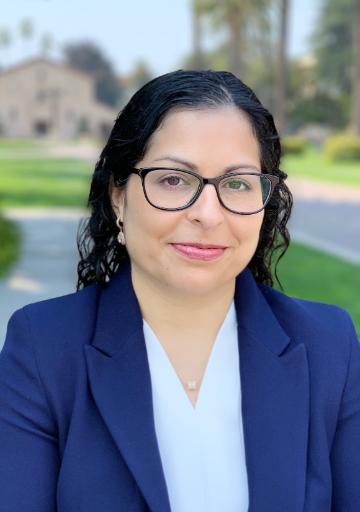
Assistant professor Hooria Jazaieri
“That’s why I think businesses are uniquely positioned to tackle what I think are some really wicked problems in the world,” Jazaieri explains. “This case demonstrates how a business can show up for the community in a profound way and be a force for social good.”
Jazaieri now teaches the case in Santa Clara’s MBA program and will bring it to the new MS in Sports Business program this summer. We caught up with her to talk playoffs, purpose, and why she thinks every fan should be asking more of their favorite team.
You’re a Golden State Warriors fan. How did a Warriors fan end up writing a case study about the Spurs?
It started with an alarm going off at 8:30 a.m. on a Saturday morning. Our business school was hosting an Earth Day Summit, and the headlining speaker was Dr. Kara Allen of the San Antonio Spurs. I was in bed with my sweet puppy, Wes, genuinely debating whether to get up and drive to campus. I’m glad I did—it changed everything for me.
During the interview about her work with the Spurs, Dr. Allen was asked what keeps her up at night. She said it was the 20-year life expectancy gap between residents of North San Antonio and South San Antonio. I was so shocked I had to fact-check it. Two decades across the same city. That statistic, and the work she described doing to address it, made me realize this was a story I had to tell. Closing that gap through what Allen called a commitment to healing, access, and belonging wasn’t just Allen’s passion. It was her job description.
How does Allen’s case contribute to scholarship and research around business leadership?
When you go through leadership case studies on Harvard’s website, there are very few that highlight women in leadership. And when you get to the intersection of women and sports leadership, there are maybe two cases.
I was designing a new MBA core course called Business and the Common Good, and I felt strongly that students needed to see what this kind of leadership actually looks like, not just in theory, but in practice, in a real organization, through a real person.
Some people might be skeptical of business being a force for social good. Why do you think business, and maybe sports franchises specifically, are uniquely positioned to drive that kind of change?
I think about it as a process of elimination. Government isn’t going to solve this alone. The scale of what we’re facing—poverty, inequality, public health—is too vast to put entirely on the shoulders of any one administration. Faith-based institutions do important work, but they have their own limitations. So who’s left?
Businesses—whether they want to be or not—are embedded in their local communities. Google is embedded in Mountain View. Apple is embedded in Cupertino. The Spurs are embedded in San Antonio. And you get to choose what that means.
You can take the tax breaks, draw from the local employment pool, and give nothing back. Or you can recognize that your community’s well-being and your organization’s well-being are actually the same thing.
Sports make that especially vivid, because a sports team’s relationship with its city is so visible and so emotional. The Spurs aren’t just a business in San Antonio. There’s a saying there that San Antonio has two religions: Catholicism and the Spurs. That kind of cultural weight is an enormous responsibility. But it’s also an enormous opportunity. If you can use it to actually move the needle on inequalities such as San Antonio’s 20-year life expectancy gap, why wouldn’t you?
For this case study, you didn’t just rely on interviews with Dr. Allen—you went to San Antonio multiple times. What did that fieldwork show you?
I really wanted to understand the degree to which this work is truly embedded in the organization, rather than just living in Kara. I didn’t want to put a case out there painting a picture I didn’t know was actually true.
So I talked to employees across the whole organization—finance, legal, marketing, game operations—and found those values quantifiably influencing business decisions. I also visited elementary schools in East San Antonio, where Spurs players were running camps with kids who would probably never get the chance to step inside the arena. Those players didn’t have to be there—it was opt-in. That told me everything I needed to know.
What surprised you most in the research process?
That the customer wasn’t always right. The Spurs weren’t just moving with public opinion but standing for something more. After every game night, they gather fan data. And time and time again, the scores for impact nights, whether it’s Pride Night or MLK Night, are lower. There’s real pushback, especially on social media. This is Texas.
But when I pushed one employee on it, he said: “If we’re not making people feel a little bit uncomfortable by welcoming everyone, we’re not doing our jobs.”
That stuck with me. It’s one thing to espouse values. It’s another to hold onto them when your own fans are telling you they don’t want it.
With the playoffs generating so much attention on the Spurs, is this a good moment for other franchises to look at what they built off the court?
Absolutely. The Spurs have always been ahead of the curve, from the NBA’s first woman assistant coach to the first Chief Impact Officer in professional sports. Other organizations are already starting to create similar roles. But you have to be willing to invest in the infrastructure, and it has to be non-negotiable—whether you’re winning or losing, whatever the fan sentiment, whatever’s happening in government. You can’t treat community impact as something that gets attention only when the championship column is empty.
What should fans be asking of their teams?
Getting as close as I did to the Spurs organization made me start asking harder questions about my own home team. Not whether they’re doing backpack drives or colored pencil donations—every organization does that—but whether they’re really showing up. Are they having difficult conversations? Are they addressing inequality that exists in their own backyard? I think that’s the standard the Spurs have set, and fans deserve to hold their teams to it.
As Santa Clara’s new MS in Sports Business program launches this summer, what do you hope students take from all of this?
I always say I’m developing high-performing leaders who have the skills and courage to care. Skills alone aren’t enough. And what this case shows students—what Kara Allen shows them—is that you don’t have to wait to be a CEO to show up differently. You can make a choice tomorrow, in whatever role you’re in, and it has a ripple effect. The world is a different place if we all just show up a little differently than we did the day before. That’s what I want them to leave with.

The Master of Science in Sports Business at the Leavey School of Business is a premier, industry-driven hybrid program designed to cultivate top-tier sports professionals. Offered by a top-ranked business school, this program blends business fundamentals with a specialized sports management education designed in partnership with the Bay Area’s many major athletic teams and organizations.
Learn more about Santa Clara’s MS in Sports Business program