A first-year Bronco sets his sights on an F1 racing career
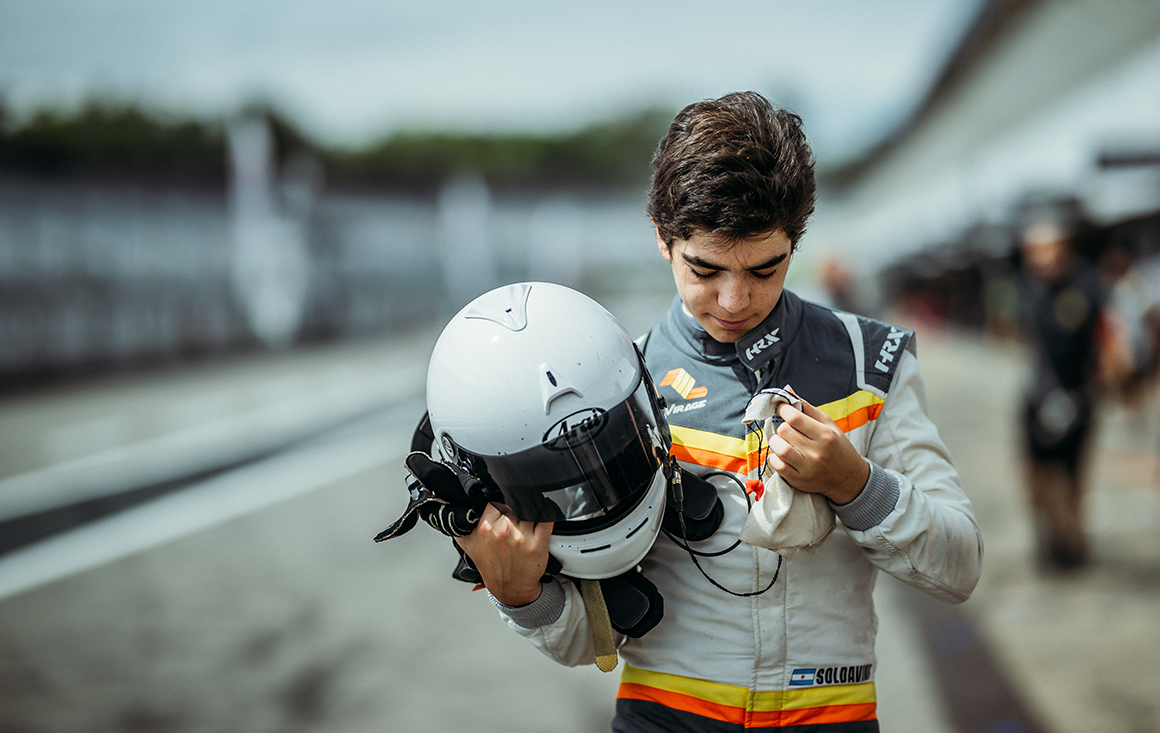
Like a lot of first-year students at Santa Clara University, Francisco Soldavini ’29 knows that college success is all about time management. His daily schedule balances his engineering classes, extracurricular clubs, social life, and staying in touch with family and friends back home in Argentina.
But, unlike other college students, he’s also training for Formula 2—the final stepping stone before Formula 1 racing.
Preparing to compete at the highest level is almost a full-time job in itself. Each day, he trains physically for an hour and a half, doing callisthenics in the mornings and switching to cardio—both running and tennis—in the afternoon. He also spends time in the campus gym’s sauna to help simulate the heat in the car.
“I also work to stay mentally sharp, and spend a couple of days each month driving on a racetrack, called ‘testing.’ Testing makes you more used to the car and track, and you learn about driving style as well,” Soldavini explains. “The ultimate goal is to be the fastest driver, but that comes with time and practice.”
Soldavini’s path is unique. As far as he knows, he’s the only driver at his competitive level pursuing a full-time college education. Most of his peers quit school entirely or enroll in programs designed for athletes that require minimal work.
“But I always liked school and could sit down and study when I needed to,” Soldavini says. “For as long as I can, I’d like to keep racing and school side by side. Between them, I think there are benefits that make you a better student and a better driver.”
Faster than fear
Soldavini’s dream started the first time he got behind the wheel of a rental go-kart at an elementary school friend’s birthday party at K1 Speed over a decade ago.
“I got in the car, and it felt super fast, like nothing I had ever experienced before,” he says. “I immediately thought, ‘I love this, I love this, I want to keep doing this.’”
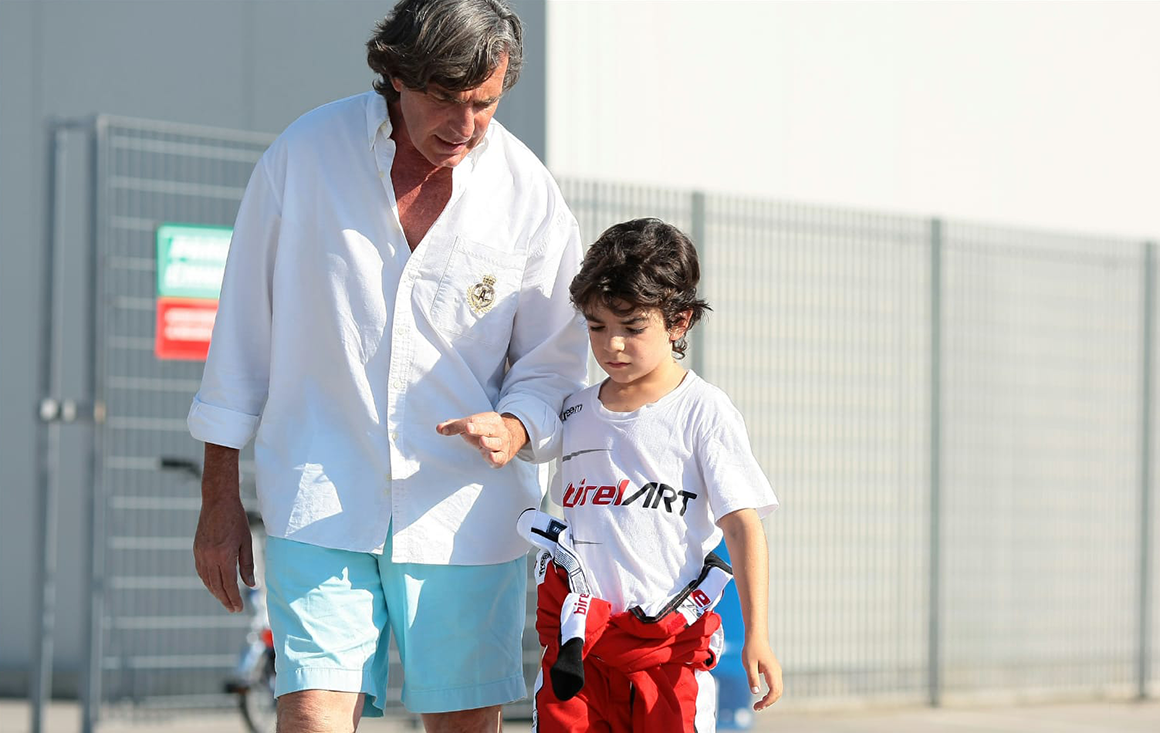
“My dad has always been my first inspiration,” say Soldavini. “He went through what I’m going through as a young athlete, and he’s always given me the proper support to persevere.”
He was just seven, but he told his dad then and there that he would be a professional driver. Neither knew what that journey would entail, but his father, a former competitive tennis player, knew the importance of having family support and was fully behind Soldavini’s dream.
That childhood idealism collided hard with fear as he began competing in go-kart racing. It wasn’t about engines exploding or crashes; it was the possibility of failure, of not being good enough.
As he made a name for himself in the Americas, the fear of falling short only grew when he joined Europe’s hyper-competitive karting scene, where margins were razor-thin and expectations high.
Eventually, Soldavini overcame this imposter syndrome by mirroring the self-confidence he admired in his peers and idols. He was particularly inspired by Lewis Hamilton’s story. As the first Black driver in F1, Hamilton worked his way up to the biggest leagues without money—his father serving as his mechanic—facing what Soldavini calls “probably the hardest gauntlet for any young driver ever.”
The lesson from Hamilton was clear: perseverance matters more than early success.
Turning on cruise control
There’s a certain amount of glamour in racecar driving, Soldavini concedes, like watching his friends racing on TV, or when he drove his first F2 car last year on the internationally renowned Mugello Circuit in Italy. But behind the flash, growing up and competing across three continents gave Soldavini something of substance too: perspective on just how wide the possibilities of the world are, and a comfort in that ambiguity.
“It made me see how the world works, in a sense,” he says calmly. “I learned that if Plan A doesn’t work out, there’s Plan B to Plan Z three times over.”
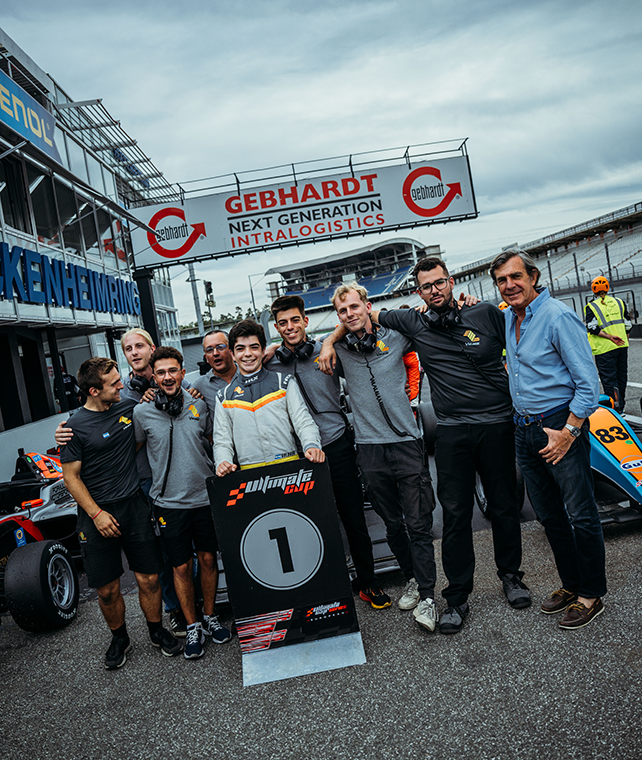
Soldavini celebrates a win with his pit crew and mechanics.
That flexibility is part of the reason he chose college. If racing didn’t pan out, he wanted the skills to pave a new road, perhaps still working with cars.
Santa Clara University stood out immediately because of its location in Silicon Valley and its strong Electrical and Computer Engineering program—a perfect fit for someone passionate about modern racing.
“People think that the most important major for the automotive industry is mechanical engineering, but I’d argue that nowadays, in my type of racing, everything is electronic,” he says. “The steering wheel is like the brain of the car. You can control everything from there.”
Through his classes and involvement with Bronco Racing, a student club where members build Formula SAE cars from scratch, he’s also picking up skills to communicate better with his mechanics on the track.
This year, Soldavini plans to compete in an unofficial F2 championship in Europe—six races using Formula 2-spec chassis. He’s also exploring IndyCar opportunities in the U.S., but one of his next big challenges is funding. So, with the help of friends in Santa Clara’s Leavey School of Business, he’s making pitch decks to attract investors to get to the next stage of his racing career.
“There’s a saying in Italian that says, ‘the sport does only good,’” says Soldavini. “I credit a lot of who I am—my competitive desire to perform and be great—to sport. Waking up and thinking about it every day forms you, little by little, in ways you can’t even imagine.”

Guided by the Jesuit tradition, the Department of Electrical and Computer Engineering strives to form engineers who contribute meaningfully to society and advance the common good. We provide students with a strong foundation in the fundamental principles of electricity and magnetism, equipping them with the concepts and tools needed to understand and shape the physical world.
Learn more about the Department of Electrical and Computer Engineering