Ram Bala: What does AI know about your business?
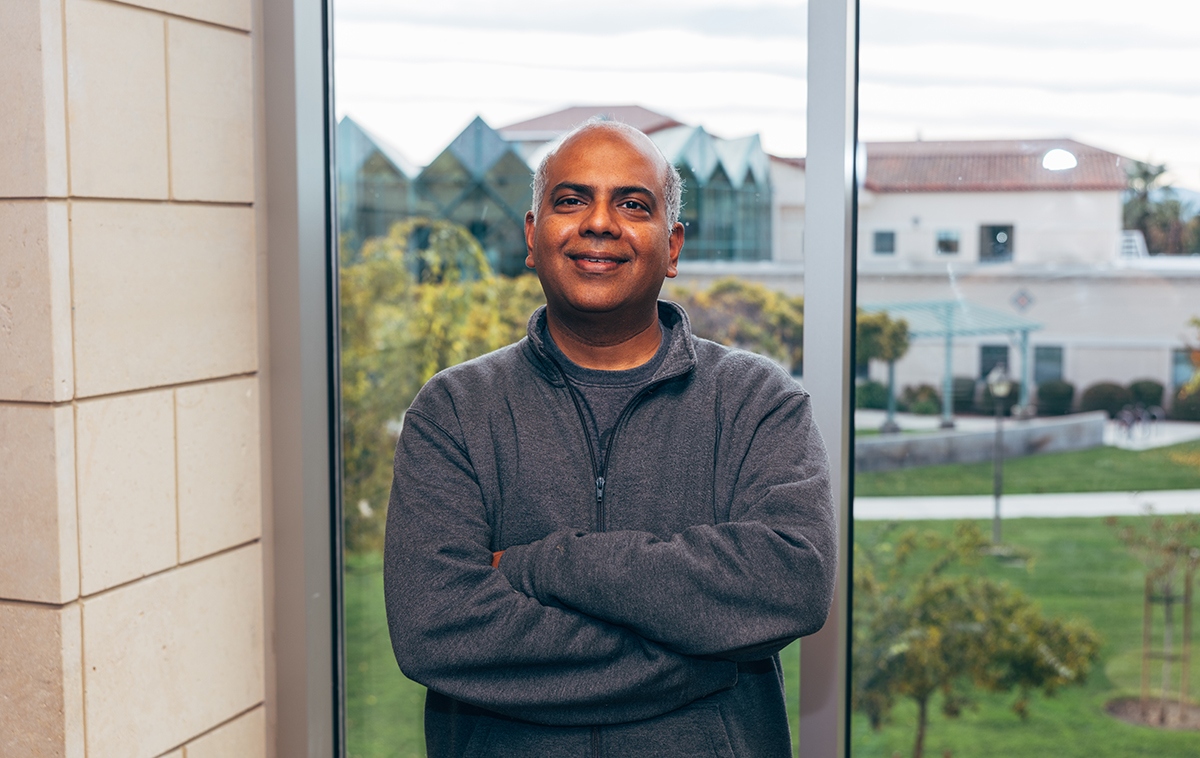
Ram Bala is an associate professor of AI and analytics who teaches executive MBA, master’s, and undergraduate courses on data analytics—one of the all-important building blocks for artificial intelligence applications in business.
Bala’s research and scholarly interests typically stem from his real-life experiences in business: as co-founder of Samvid, an AI startup focused on enterprise collaboration and discovery, and as a consultant to businesses on AI deployment.
Bala uses such real-world learning labs to inform his classes and to ensure his teaching produces not just skilled data analysts, but also the AI-savvy business strategists the business world increasingly demands. He recently co-wrote a book, “The AI-Centered Enterprise,” that is being well-received by CEOs and others for providing a practical framework for deciding how and where to incorporate AI into their businesses.
This series highlights how Santa Clara scholars connect their research to the Jesuit values of curiosity, reflection, and service to the common good.
What questions or challenges are at the heart of your current work?
We all are living in a world where we are completely inundated with information about AI, particularly topics such as how to make AI safe and how to make it aligned with human objectives and values.
My greatest challenge is to take it one step further: how do I align AI with the goals, values, and objectives of individual companies or organizations?
There are two aspects to that. One aspect is technological, because technology right out of the box, such as ChatGPT, doesn’t necessarily work. There needs to be some degree of personalization for it to actually help, either by industry, by functional area, by teams, or even by individuals.
The second part of it is the organizational challenges related to change management. I’m interested in both the technical and organizational challenges, partly because change management is an active area of research for me, but it’s also “learning by doing,” something I get to do at my company every day.
Why is this issue important for the world to address at this time?
Let’s take a broad view of why AI is important. It’s very easy to look at the short term and say, okay, there are going to be potential job losses. Maybe there will be, in the very, very short term. But I would say one of the biggest challenges we face as a society is that our demographics are actually moving in the wrong direction. We’re going to have more and more people who are older and retired than younger and working.
That means a massive shortage of people. We’re going to need tools and technologies that can actually do things autonomously. And this, by the way, is not just true with Western countries. Even countries like India, where the population is still in the growth part of the demographics, are projected to plateau in the next 20 years.
So the need for productivity is not going to go away, nor will the need for discovery, like finding the ultimate cure for cancer or developing high yield crop varieties.
Given all that, a top problem is going to be “how can I find the right information at the right time?” The data might be there, but it’s often located in an obscure document that you stored away in some folder somewhere. It’s typically also in the minds of workers, what we call "artisanal" knowledge. Without the ability to digitize and analyze such data, it might be lost forever. But today, just from somebody’s handwritten notes uploaded into an AI system, for example, you can ask “tell me what these notes are about” and “how could I do this better?” That was not feasible at all, even five years ago. But now it can be done.
If we could get there, I wouldn’t call it utopia, but we would be less frustrated about trying to locate data and connecting the dots, and instead focus on the real challenges of implementation.
Why have you chosen to dedicate your career to this research?
I got into using data and AI to solve business problems very early. My last year of undergrad was when the internet finally landed in India. It wasn’t ubiquitous, but I had access to computers at my university where I could code and build stuff. I was doing an internship for a lock manufacturing company, where factory workers were manually inspecting samples of the product, measuring the thickness of pins, the tolerance of which is very important for product quality. They would write the data on a piece of paper, and somebody would take a look at that and say, “OK,” and they were done. They wanted to be able to translate all of that data, do statistical analysis that would identify where the decline in quality originated. I happened to be the guy who understood math and data well enough, and I was willing to work with the computers they had, so I implemented software to track and analyze product quality. But I wasn’t done with just that. I gobbled up books on “smart machines” such as “expert systems” and included those ideas in my final report. One could say that the desire to impact the world of business through AI was born then.
In 1999, I came to UCLA to pursue a Ph.D. in operations research at the business school. I went for the Ph.D. program, not because I wanted to be a professor, but because I was interested in pushing the boundaries on the topics that interested me during my undergrad. After my Ph.D., I got a consulting job on the East Coast where we were doing some fairly sophisticated analytics for the pharmaceutical industry, which got me into appreciating the power of the data and how to implement what I was learning in practice. This reinforced my motivation toward data, AI and business problem solving even as I returned to academia.
How have your students impacted your research?
There are students who are not as technical—say in an executive MBA class where many students come in with a wealth of experience of how business actually works, and also some of the softer issues. Even if they are not big users of AI, they may present more quantitatively oriented problems that I did not necessarily imagine would actually happen. That’s because certain kinds of problems happen only in a certain environment, and unless you’re part of that environment, you don’t really understand it.
With undergraduates, who are much more likely to be using AI already, sometimes I have to work harder to explain to them why what I’m teaching matters in a business situation. And that back and forth with them, that Socratic process, is bi-directional, and that gives me opportunities and ways to think of problems differently.
Finally, there are my master’s students in the MSBA or MSIS programs, who help me directly by working with me on research projects, and some have interned for me at my company. In fact, my company right now employs three fantastic alumni from the MS in Business Analytics (MSBA) program.
What is a book in your field that you think everyone should read?
I’m going to recommend two books. If you want to really understand what AI is about, how it is influencing our world, I recommend “The Genius Makers” by Cade Metz. It will give you great insight into the history of AI, how deep learning was a backwater, and so many people were uninterested, even in the academic community. There’s a lot of behind-the-scenes and political drama. We think of AI as purely a technical problem, but actually, so much of scientific innovation is really about people and personalities and the power politics of how to get important research published, disseminated and incorporated in products. He captures that wonderfully. But where he stops is at the large language model revolution, which he doesn't unpack completely, given the timing of the book release.
If you want to get into the large language model revolution, the ChatGPTs of the world, I recommend “The Optimist: Sam Altman, OpenAI, The Race to Invent the Future” by Keach Hagey. There’s a lot about Sam Altman, his biography, but once he gets into the OpenAI part, and talks about how they actually came up with ChatGPT, it gets really, really interesting. It’s like they almost discovered this by accident, building stuff for games. It’s just amazing to me how scientific innovation actually works in practice.

Information Systems and Analytics (ISA) is an interdisciplinary department that considers how technology can facilitate business decisions to guide organizations to success. Our curriculum focuses on the intersection of areas like big data and business intelligence. It combines theory and strategy with hands-on experience.
Learn more about Information Systems and Analytics at Santa Clara