Chemistry research probes potential applications for rarely-studied compounds
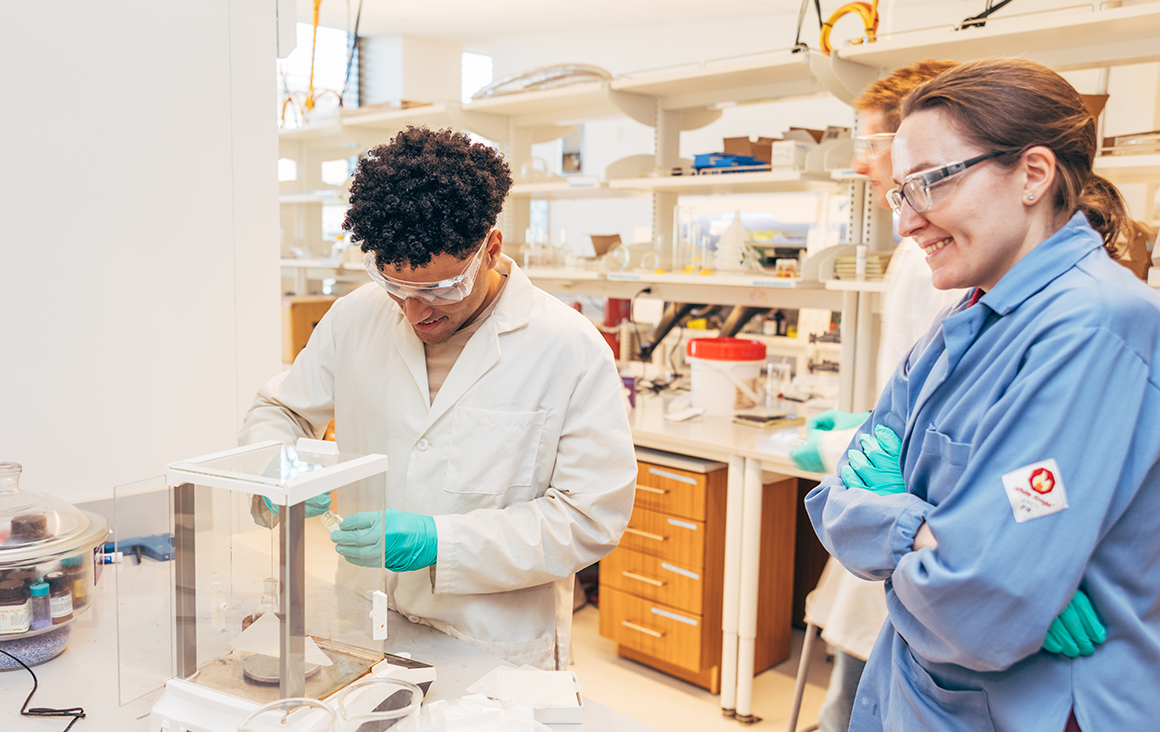
Inside Assistant Professor Meaghan Deegan’s inorganic chemistry lab at Santa Clara University, you’ll find students learning how to manipulate flasks within sealed gloveboxes or use specialized Schlenk glassware to protect air-sensitive target compounds from decomposition. It’s delicate, meticulous work, but the payoff is extraordinary.
“Any time my students make a new compound, I’m like, ‘Oh, great! You’re the first person who has ever made this,’” Deegan says. “It’s exciting, especially for students who have often never done anything like that before.”
In Deegan’s lab, the periodic table isn’t a finished story—it’s just the beginning. Her research pushes into uncharted territory, attempting to create and stabilize ring-shaped molecules that theory predicts might exist but haven’t been successfully isolated in a lab. These targets are unstable on their own, their electrons arranged in configurations that create molecular tension, like puzzle pieces forced together the wrong way.
“We think that if we bind these structures to those metals, we’ll be able to stabilize them,” explains Deegan. “If we can, this could alter fundamental chemistry processes by creating new, cost-effective, and sustainable applications across pharmaceuticals and other industries.”
After receiving her Ph.D. in chemistry from the California Institute of Technology, she joined Santa Clara University in 2022, and after just a few short years, her groundbreaking work is already earning national recognition. She recently received $90,000 in funding from the American Chemical Society (ACS) and was named a 2026 Cottrell Scholar—a prestigious award that recognizes early-career faculty who excel in both research and teaching.
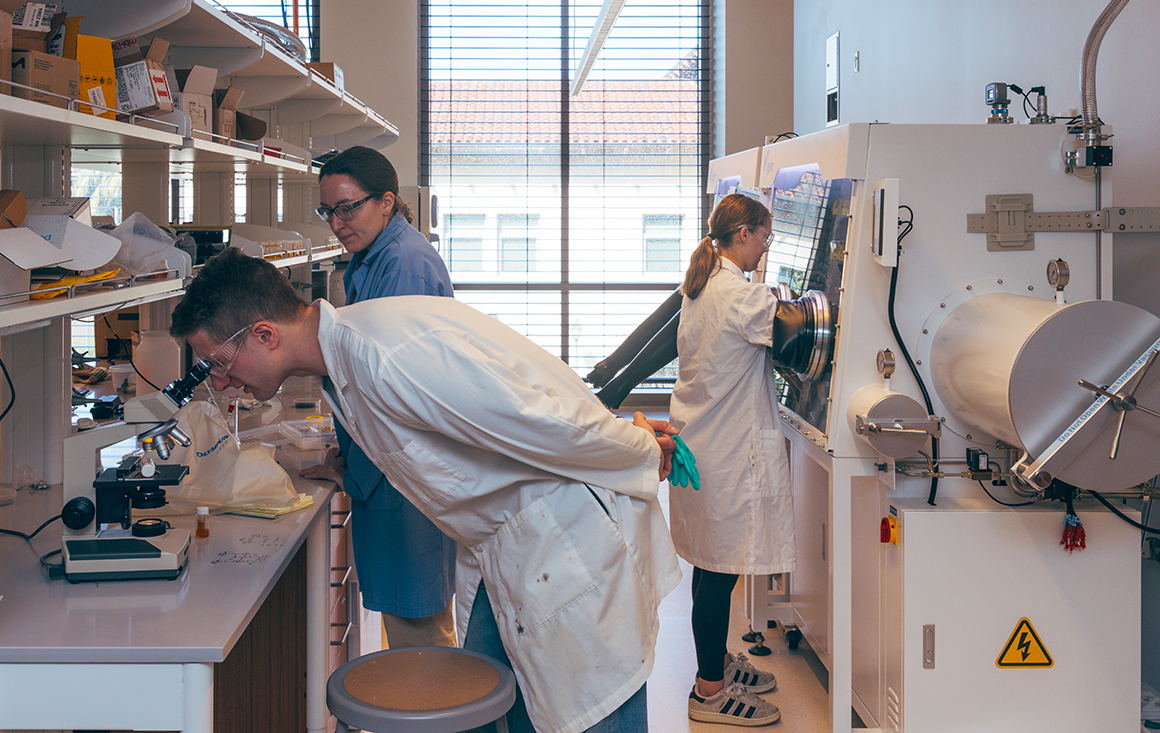
Deegan's lab in SCDI gives undergraduate students the chance to work with professional-grade equipment, like gloveboxes (far right).
The undiscovered chemistry
Examining the average chemistry textbook, one might get the sense that the subject is as much artistic as it is mathematical, with skeletal formulas depicting molecules in hexagons and double bonds—much like a snowflake, uniquely precise and beautiful.
That logical elegance just “clicked” for Deegan, who was able to appreciate the way molecular behavior, or reactivity, connected to the physical arrangements of electrons around molecular rings.
Today, her lab focuses on chemistry’s ugly ducklings: rings that would collapse immediately if left unprotected.
In chemistry, molecules can form ring structures where atoms connect in closed loops. Stable rings have electrons distributed evenly and bond angles that sit comfortably—they can be stored indefinitely (think of benzene, the classic hexagonal ring you might remember from chemistry class).
But the rings Deegan targets have electrons arranged in particularly unfavorable ways and in geometric shapes that create severe strain.
Her solution is elegant: use metals like rhodium as molecular anchors. Using oxygen atom transfer reagents—compounds that donate a single oxygen atom—the metal redistributes electrons, sharing some of its own while accepting electrons back from the ring in different orbitals.
“Essentially, we’re moving our electrons around a little bit to make it look less like that unstable structure and trick it into being stable,” Deegan explains.
Stabilizing these molecules would be like adding a new ingredient to the pantry, allowing chemists to explore new recipes for synthesizing materials, drugs, or other products.
The project is already underway thanks to a grant from the ACS, which has helped purchase a new solvent purification system—a piece of equipment that removes every trace of water and oxygen from solvents, streamlining work with these highly reactive compounds. But even with top-of-the-line instrumentation, like all great research, success isn’t guaranteed.
“Can we demonstrate that our approach is a way to stabilize these ring structures? The answer might be no, right? Which is why we’re doing the research; we want to figure out if we can.”
If it works, potential applications could revolutionize complex molecule synthesis. But if it doesn’t work, these experimental results will still contribute fundamental knowledge to organometallic chemistry.
“I think fundamental scientific research matters, and understanding more about basic science—even when the application tomorrow isn’t obvious—is still going to be important and useful,” she declares.
Catalyzing future chemists
Even if a project doesn’t yield the hoped-for results, Deegan is passionate about another guaranteed result of this funded research: undergraduate student access to meaningful lab experience.
“Having previously been at institutions that were very research-oriented, I wanted my job to also value my teaching contributions and allow me to actively work with my undergrad students in the lab, showing them what I know,” she says.
One student exemplifies this mentorship: Derik Seymour ’26. During Deegan’s first year at Santa Clara, Seymour joined her lab after taking her introductory chemistry course. Over four years, she’s watched him grow from a brand-new college student to a capable researcher headed to graduate school at UC Santa Barbara.
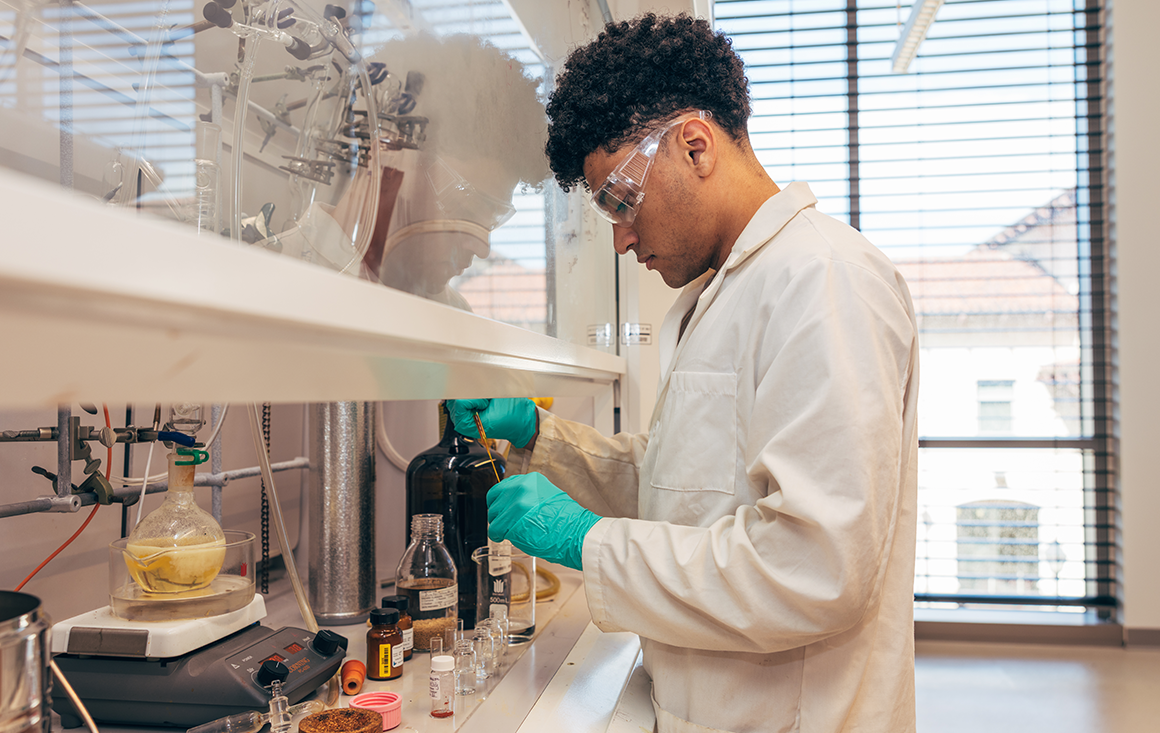
“Derik is the type of student emailing me in the middle of the night with questions like, ‘I had this idea, can we try this?’” Deegan remarks.
“I think Derik, maybe more than any of my other students, has always been very enthusiastic about driving his own projects versus following my lead. That’s changed the way I teach other students, and I think it will be rewarding for him in graduate school, where he'll be able to independently pursue his own ideas,” she says. “I really think he’ll flourish there.”
Deegan’s passion for student-driven teaching recently earned her a prestigious Cottrell Scholar Award—making her Santa Clara’s third faculty recipient after Amelia Fuller in 2010 and Grace Stokes in 2018. The award offers a $120,000 grant over three years to expand her discovery-based chemistry courses.
In her upper-division inorganic chemistry lab courses, she converted traditional "cookbook" experiments into project-based research where students propose and synthesize their own target compounds. Then, her first-year chemistry students will use compounds synthesized by upper-division students to study reactions in general chemistry—a generative cycle that gives all chemistry majors hands-on experience.
“Then I know that every single chemistry major will have graduated with at least this much research experience, which I think is really valuable in their first job, or in graduate school,” she adds. “Training undergraduates is, I think, one of the most impactful things we do at Santa Clara, and it’s why I’m so happy to be here.”

The complex interactions of atoms, molecules, and ions determine our shapes and sizes, our environment, and even how we feel on a given day. Our faculty and students endeavor to understand the world at the molecular level and apply this understanding to tackle problems in modern society.
Learn more about the Department of Chemistry and Biochemistry