Leon Panetta ’60, J.D. ’63 tells Santa Clara students ‘Leadership is about taking risks’
When Leon Panetta ’60, J.D. ’63 ran into former President George H.W. Bush after he left office, Bush reflected on one of the most consequential—and costly—decisions of his presidency. Facing a federal deficit barreling toward $600 billion, Bush had done the unthinkable for a Republican president: he raised taxes, breaking his famous “read my lips” campaign pledge to pass a bipartisan deficit reduction package. It probably cost him the election, Bush told Panetta.
Panetta’s response was simple: “You made the right decision. History is going to identify it as the right decision to make.”
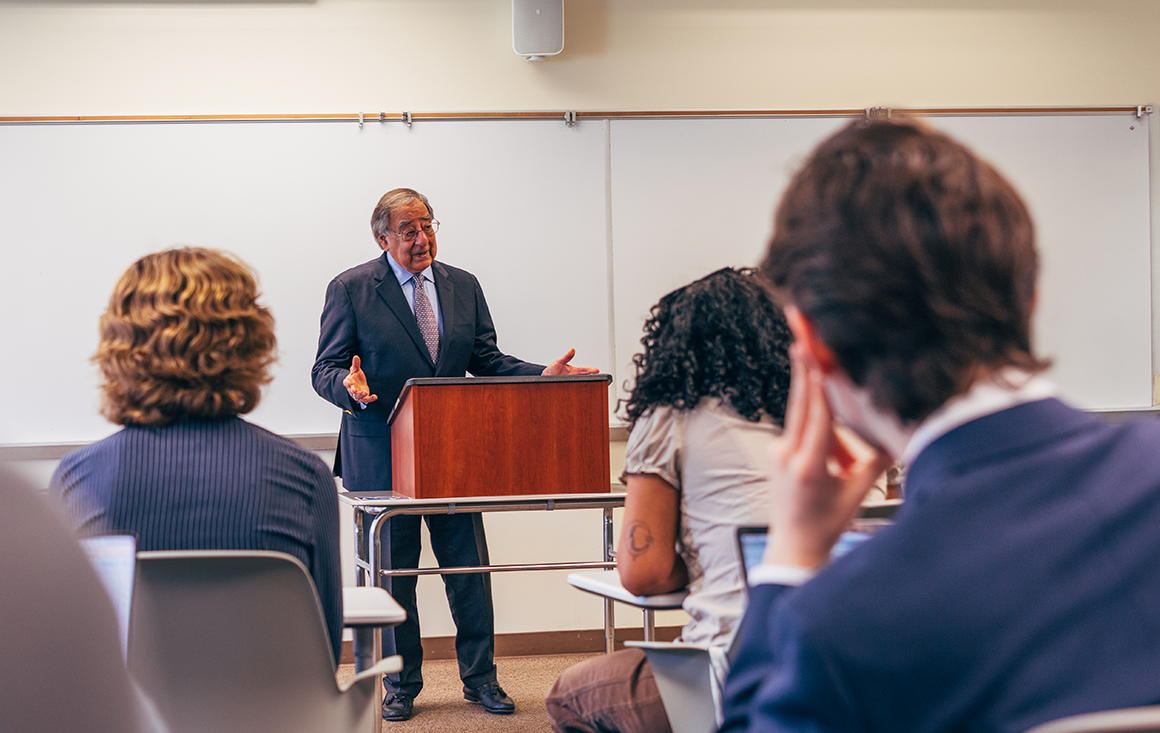
Sharing the anecdote during a visit to Professor Matthew Harrigan’s “Making Public Policy” class earlier this month, Panetta emphasized something essential about public service: governing isn't about self-preservation. It’s about doing what’s right for the country, even when the politics are hard.
It’s a conviction rooted in Santa Clara itself. A first-generation college student, Panetta credits his Jesuit education with deepening the values of service, conscience, and moral courage that would follow him across a four-decade career spanning Congress, the White House, and the Pentagon.
Panetta returned to campus as the featured guest for the Department of Political Science’s annual Eric Hanson Alumni Speaker Series at a moment of particular political urgency. After several candid conversations with students throughout the day, he joined Maya MacGuineas, president of the Bipartisan Committee for a Responsible Federal Budget, at the Mayer Theatre for a Fireside Chat on fiscal policy, foreign policy, and leadership.
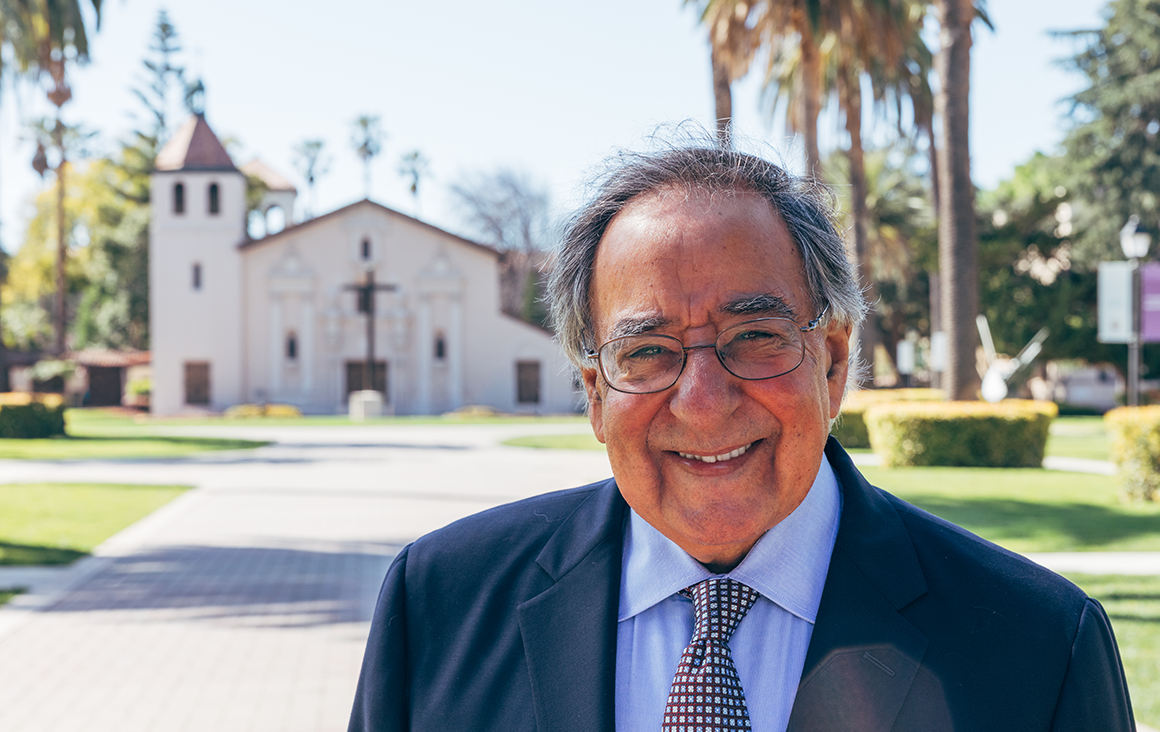
Speaking to a new generation of Broncos, Panetta said a Santa Clara education had helped him meet the challenges of his time, and he had every confidence it would do the same for them.
“You’re going to have to be a leader and take risks,” he said. “Whether in tech, policy, or elected office, the path forward is the same: set goals, build a team, and have the courage to do what’s right even when it costs you.”
Read on for more of Panetta’s remarks across his campus visit.
On the challenges facing the U.S.:
“I’m asked, as former Secretary of Defense, what is the biggest security threat we face? And they think I’m going to say China or Russia. But the biggest security threat we face is the dysfunction in Washington. If they can’t deal with the budget, if they can’t deal with immigration reform, if they can’t deal with health care, then the message we’re sending to the world is a message of weakness.”
On leadership:
“In a democracy, we govern either by leadership or by crisis. If leadership is there and willing to take the risks, you can avoid crisis. But if you don’t have that leadership, then we’re going to govern by crisis. And right now, the United States of America largely governs by crisis.”
On unifying American values:
“We hold these truths to be self-evident, that all are created equal—that’s what makes us Americans. We believe in values. We believe in the Constitution. We believe in the rule of law. We believe in telling the truth. That’s what makes us strong as a country. The reason we’re respected in the world is because of our values. We’ve got to get back to that.”
On civic duty:
“Each of you has a responsibility not to stand back and kind of watch how democracy comes to an end. You have a responsibility to be part of our democracy. You have a responsibility to make a difference.”
On his career journey:
“The most important thing I did was not plan a career where I would become CIA director and Secretary of Defense. What I did was my job. If you have a job, do the job, and be successful in doing the job—because if you do that, people will see that you are capable, dedicated, hardworking, and that will produce other opportunities for you.”
On honesty and integrity:
“If you’re honest, if you’re straightforward, and if you’re willing to tell the truth—it’s amazing what could happen. Truth is a rare commodity these days.”

The Department of Political Science introduces students to the analysis of political behavior, values, institutions, and governments. It also offers preparation for various graduate and professional studies and for careers in public service, education, and the private sector.