A team from Santa Clara University’s business school is working to use AI to uncover Nazi-looted art
During 1933–1945, the Nazi regime confiscated, coerced, or forced the sale of an estimated 650,000 artworks from Jewish families and institutions. While the majority have been accounted for, 80 years later, identifying and restoring the estimated 100,000 works that remain unrepatriated is a slow, labor-intensive task.
The problem is not a lack of information, but rather the vast dispersion of “provenance” data across thousands of museum websites, independent databases, national archives, digitized auction catalogs, and other databases. Each institution maintains its own system, in its own language, using its own vocabulary and database structures, or “schema.” Important clues are buried deep in millions of records, making it nearly impossible for any single researcher or museum to manually detect stolen art.
Now a team of researchers from Leavey School of Business at Santa Clara University is creating a program that can serve as an AI-powered provenance assistant, helping researchers access data across fragmented archives; interpret multiple languages; and surface artworks that may be at elevated risk of having been looted or sold under duress during the Nazi period.
The team of researchers—management professor Michael Santoro and information systems and analytics professors Haibing Lu and Michele Samorani—became interested in this work after Santoro learned that an acquaintance of his, U.S Court of International Trade Judge Timothy Reif, had used his law skills to track down art that had been stolen from his ancestors, the heirs of Viennese cabaret performer Fritz Grünbaum. His efforts resulted in art worth millions of dollars being restored, including at least 11 Egon Schiele artworks.
Separately, Santoro had also been looking into the human-rights aspects of efforts to repatriate art housed in American and European museums to Indigenous residents of many countries in South and Central America and Africa. He saw that those struggles might be aided by AI. He convened his frequent data-research partners Lu and Samorani, and the AI Provenance project was born.
To get started, they scraped the data on an estimated 30,000 stolen artworks known to have passed through the famed Jeu de Paume museum in France. The museum is famous for being seized by the Nazis and used as a repository for art looted from the region. Starting in 2010, the museum made its entire database accessible for researchers interested in repatriating stolen art.
From there, Lu built a system to make the messy, error-filled database easy to search in plain language, with AI interpreting a researcher’s question, translating it into a search, and improving on the search by seeking out related terms, different spellings, and translated versions of names. He received help from student research assistants Aryan Puranik M.S. ’26 and Reemika Subrata Das M.S. ’25.
After finding the results, the AI provides a response in clear language, showing why those records match the question.
“The AI tool makes it so that anyone can write a question in natural, human language, and it will automatically translate it to the code,” said Lu.
The resulting website, AI Provenance Assistant, can now act like an incredibly perceptive data docent, figuring out what users are seeking and plowing through mountains of otherwise indecipherable data to deliver answers.
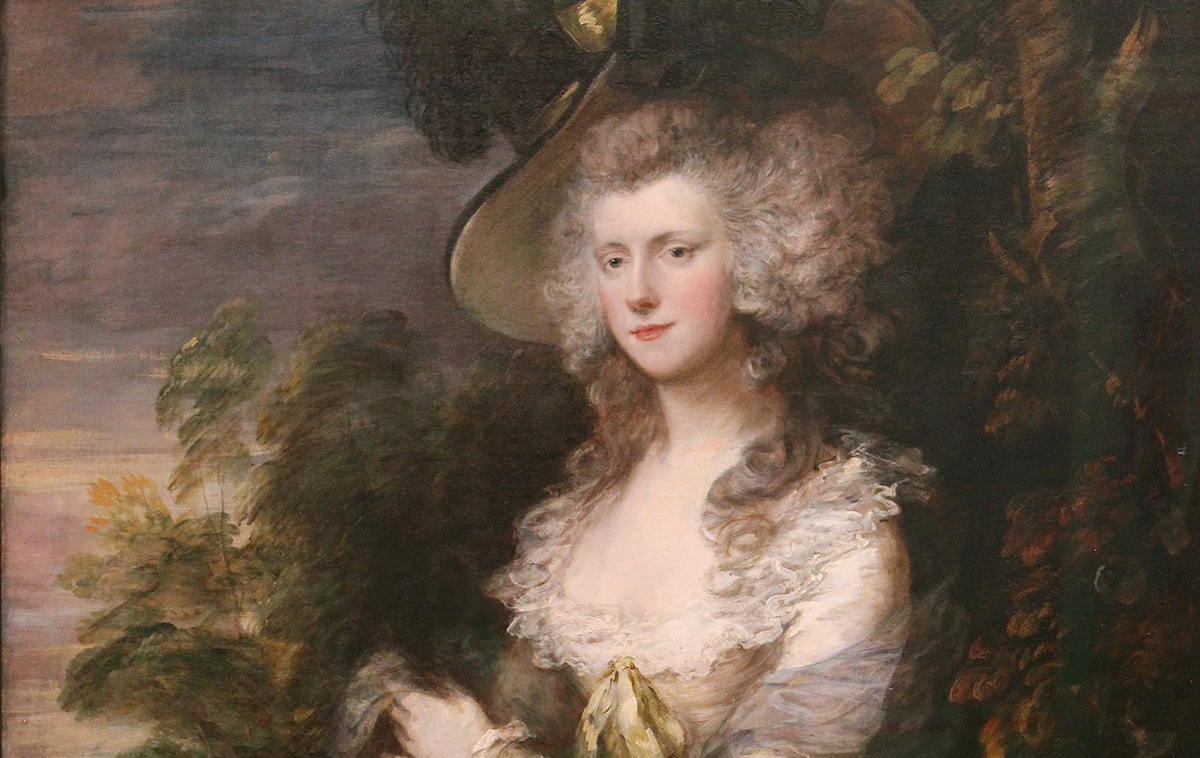
For example, a prompt asking “how many pieces of art were shipped to Nazi leaders?” returns a response that 208 pieces of art were recorded as going from the Jeu de Paume to Nazi leaders. Of those, 81 went to Adolf Hitler himself, according to the database, including the painting Portrait of Lady Hibbert, by Thomas Gainsborough (1727-1788).
Next Steps
The team envisions expanding the technology to more databases, providing the back-end coding and AI interface the way they have for the Jeu de Paume data. They also are looking to partner with specialists in the field of provenance research to learn new ways to structure searches, as well as how discoveries from one database can inform algorithms and searches in others.
“We want to come up with tools that help researchers identify high-risk works, to give them something to investigate,” said Lu. “In some sense, we cannot even envision who is going to use it,” he added, because the tool will become much more robust than is currently available.
Once the technology reaches a scalable operational level, the team hopes to write a paper for publication, and then create a foundation that would hire lawyers and raise money to make the search tool available to provenance researchers. Santoro has invited his former Harvard Kennedy School classmate Wendy Goldberg, an experienced tech and corporate strategist and communicator, to help with that phase.
“When I was at AOL, it was all about making the internet as easy to use as the telephone and the television,” Goldberg says. “This is making using AI for restitution and tracking art as easy to use as any other technology application. You don’t have to be a genius to find the provenance and track the trail of stolen art.”
Why Has it Taken So Long to Repatriate Art?
The obstacles to restoring the estimated 100,000 remaining unrepatriated stolen artworks are multifold.
- An alliance of museums that had been working together to share data about potentially looted artworks stopped doing so, ostensibly because they were creating their own databases. But in fact only a fraction did so and most no longer specially notate potentially looted artworks that “provenance researchers” could investigate.
- The lowest-hanging fruit of easily identified, high dollar amount, looted art has largely been discovered, and interest has been waning since its peak when the 1998 Washington Principles set international objectives for handling Nazi-confiscated art.
- More and more, the art that is left to be restituted to original owners is
- of lower dollar value
- harder to trace to original owners, whose heirs may be unaware
- scattered among private owners or
- lingering in museums awaiting restitution.
Knowing that AI is tailor-made to cut through difficult data problems, the team views this as a worthwhile “passion project” that could right decades-old wrongs. Says Samorani: “The value of this is to ultimately find the rightful owners of looted art.”

Fueled by the spirit of Silicon Valley innovation, all of our top-ranked programs at the Leavey School of Business provide rigorous study and high impact experiential learning, culminating in rock-solid business acumen. Plus the University’s Jesuit, Catholic tradition imbues all students with unwavering ethics and a commitment to social responsibility.