Ezinne Ofoegbu: What would it look like if colleges were designed to support students’ whole selves?
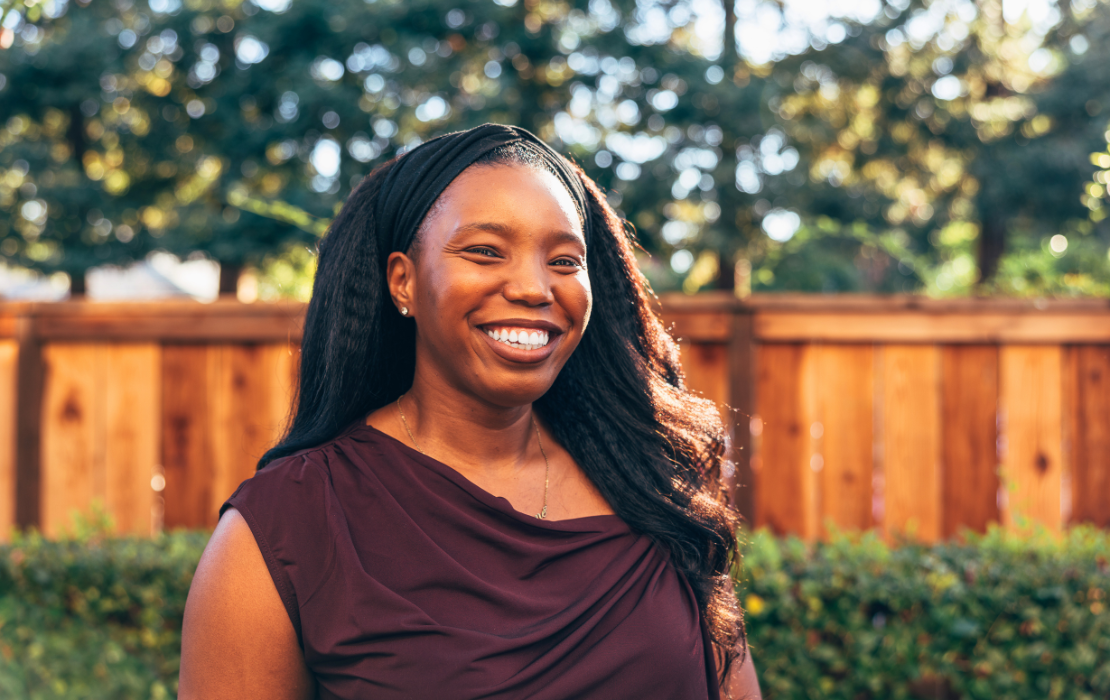
Ezinne D. Ofoegbu (pronounced eh-zen-eh oh-FEH-boo) is an assistant professor of educational leadership in the School of Education and Counseling Psychology at Santa Clara University. Her research and writing, published in outlets such as the “Journal of Diversity in Higher Education” and “The EDULedger,” blend rigorous scholarship with cultural critique, addressing topics ranging from community-building in college athletics to misogynoir and the double standards faced by Black women.
This interview series invites Santa Clara faculty members to reflect on the questions, motivations, and impact that guide their work as educators and researchers.
What questions or challenges are at the heart of your current work?
The biggest question at the heart of my work is how to create college environments that recognize the humanity and wholeness of all students. I focus on how Black women and Black immigrant-origin students experience higher education, and on how we can design spaces that support students intersectionally rather than address only parts of who they are.
Why is this issue important for the world to address at this time?
This issue is important, especially now, because, even as DEI work faces political and institutional pushback, our campuses and communities are becoming more diverse. We have to find creative, humanizing ways to support all students and ensure that every identity is valued. For me, that means listening to students about what they need to feel fully supported and designing spaces that honor their whole selves. And as legal scholar Kimberlé Crenshaw, who introduced the concept of intersectionality, reminds us, if we create systems that support those most marginalized, everyone benefits.
Why have you chosen to dedicate your career to this research?
I have chosen to dedicate my career to this research because I have both a personal and professional stake in the questions I ask. I began my career in college athletics, advising student-athletes, and even then, I was asking many of the same questions that drive my work today. It is frustrating and motivating that, almost a decade later, we are still confronting the same issues Black women athletes and professionals faced long ago. Those experiences, of being undervalued, questioned, or dismissed, are still part of the culture of higher education. I want to illuminate these realities because something has to change.
My research on Black women and Black students of immigrant origin is deeply personal. As the child of Nigerian immigrants, I know what it means to navigate multiple cultural identities and the tension between belonging and assimilation. These experiences shape my understanding of the world and the questions I pursue. Across all my work, I hope to show that there is no single Black student experience and no single way to be a Black woman in higher education. The goal is to create spaces that honor the fullness of who students are rather than asking them to silence parts of themselves to fit in.
How have your students impacted your research?
My students have deeply shaped my research by reminding me to approach my work with curiosity and humility. Many of them come to our classes with rich professional experiences outside higher education, and their questions and insights often push me to think differently about my own research, about who I study, how I ask questions, and what those questions mean. Advising dissertations has especially impacted me; it is humbling to guide students through the research process so soon after completing my own and to witness their growth from idea to completion.
Our students also hold us accountable. They choose to study at Santa Clara because they believe in our mission of being student-centered and justice-oriented, and that motivates me to make sure they are truly getting the most out of their experience. Their care, grace, and commitment continually remind me why this work matters and how much more we can do to support them.

Dr. Ofoegbu teaching a class of graduate students.
What is a book in your field that you think everyone should read?
A book I think everyone, especially educators, should read is “All About Love” by bell hooks. It reminds us of the importance of care, of honoring the humanity of others, and of leading with love in all that we do. That book really shaped how I think about supporting the whole person.
In my field, I have also been deeply influenced by texts grounded in Black Feminism and college athletics. “Tackling the Everyday” by Tracie Canada is an eye-opening ethnographic look at a Division I football team and what care looks like in those spaces. Another important book is “Say Her Name: Centering Black Feminism and Black Women in Sports” by Letisha Engracia Cardoso Brown, which centers Black Feminism and Black women in sports more broadly. And I’m currently reading “Body Factory: Exploiting University Athletes’ Healthcare for Profit in the Training Room” by Kaitlin Pericak. It explores athletic training and shows how care in sports medicine often prioritizes profit over the well-being of athletes. It’s fascinating and frustrating. These will push people to think more critically about what genuine, humanizing care really means in higher education and athletics.
Selected works and writing by Ezinne Ofoegbu
- “What Can I Do, What Can We Do?”: Exploring Black Women College Athletes’ Racial Justice Activism and Engagement During and After 2020
- “What Impact Do I Want My Work To Have?” Santa Clara University Explore Journal
- “Y’all Not Tired of Hating on Black Women? When Misogynoir Meets Double-Standards” The EDULedger

The Master's Degree in Educational Leadership program is designed to prepare top-notch leaders with the capacity to transform their organizations and to promote social justice and educational equity.