How an app rooted in social safety and belonging hopes to reduce depression among young people
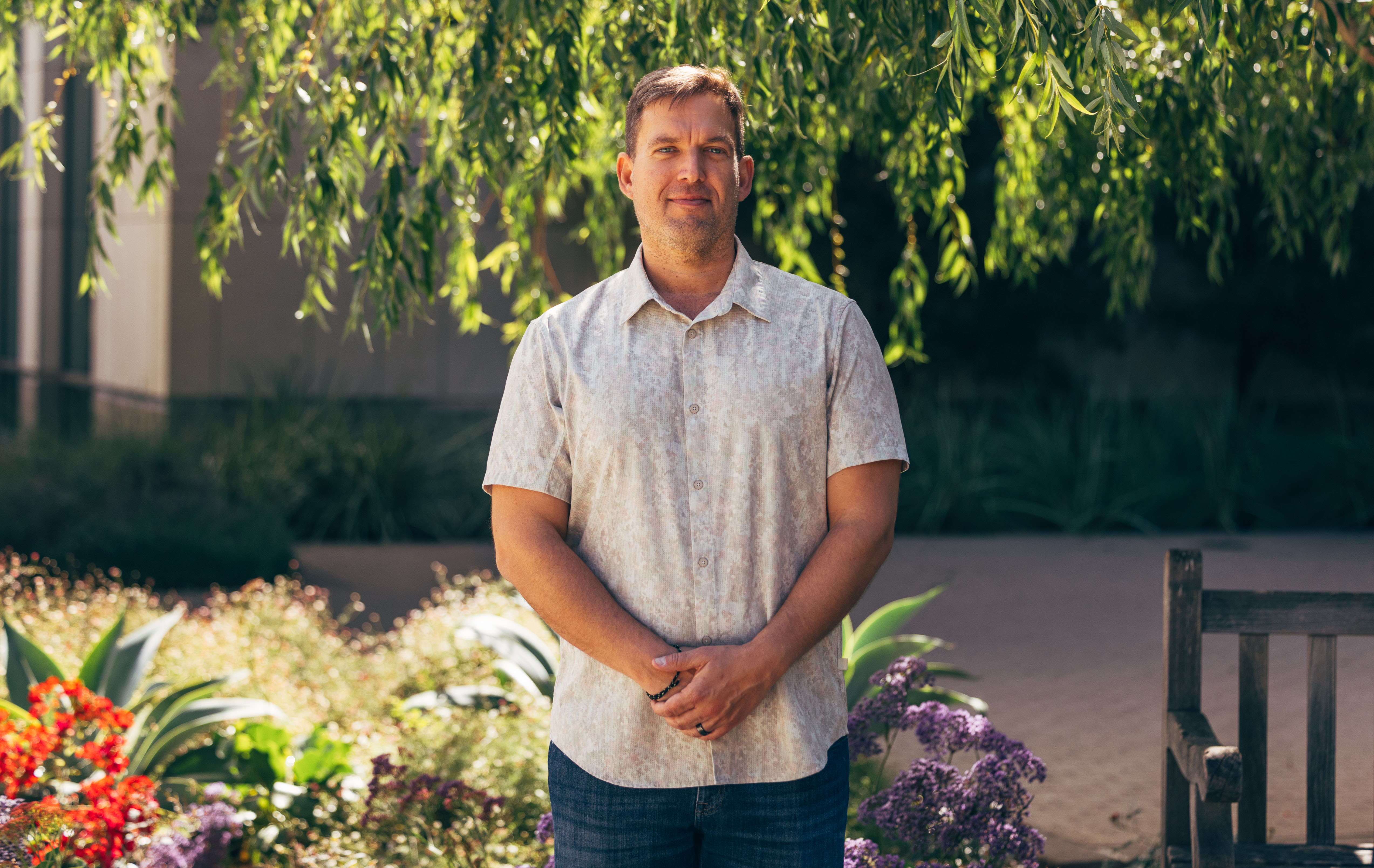
Greg Hajcak wants to make mental health care more accessible for young people experiencing depression. As a clinical psychologist, professor, and the Sheri Sobrato Endowed Chair of Child & Adolescent Mental Health at Santa Clara University, he has dedicated his career to understanding anxiety and depression, and finding ways to treat it at scale. Hajcak has published more than 350 peer-reviewed publications and received early career awards from both the American Psychological Association and the Association for Psychological Science. Hajcak is currently leading a multi-year project with the California Initiative to Advance Precision Medicine to develop and test accessible digital interventions so adolescents facing mental health challenges across the state can easily get the help they need.
What questions or challenges are at the heart of your current work?
As a clinical psychologist and professor, I’ve spent the last 20 years working to better understand the development and risk for anxiety and depression. The challenge I keep coming back to is how to address the mental healthcare gap in California. Upwards of half of youth who would like or need services don’t actually get them. So, there’s this mental health crisis, but then on top of that, there’s also a mental health care shortage and service delivery issue. There’s simply not enough providers to deliver care at the scale required. That speaks to the total inability of one-on-one traditional psychotherapy to meet the need that is out there. Scalable digital interventions are one way to close that gap.
How are you addressing this challenge?
I received a $3 million grant through the California Initiative for the Advancement of Precision Medicine to address depression amongst LGBTQ+ youth. I’m working with a team of leading mental health researchers to develop a fully scalable digital app focused on reducing and preventing depression. A key theory behind this work is that we are a social species that feels safe in community. The app is grounded in this idea of social safety, which raises questions about how people think about their own sense of safety, and how they can increase it by finding and participating in a community that values them. When a person feels accepted by those around them, the risk for depression decreases because they are able to find safety and belonging amongst others.
We’re comparing teenagers who use our app with those receiving peer support, which is another scalable intervention for youth mental health. Instead of seeing an older licensed clinician, in peer support, an adolescent usually works with someone closer in age who is certified and may share similar lived experiences. We’re also evaluating whether peer support, our app, or a combination of both can help reduce depression and related outcomes. There’s a lot of evidence showing that teenagers like peer support, but very little scientific data on whether it actually works.
We’re currently recruiting up to 800 youth across California to test the app and will be enrolling participants for at least two more years. The study is open to youth ages 14 to 19 with any elevated depression symptoms. While the intervention materials were designed by, with, and for LGBTQ+ youth, there’s nothing about the app that wouldn’t also benefit cisgendered straight adolescents.
One of my main goals with this work is scalability. Both the app and peer support model can be delivered remotely, requiring only internet access, which allows for much broader reach than traditional in-person care. At the conclusion of the study, we’ll follow up with participants and analyze the data to evaluate what works best for reducing depression. Ultimately, we hope to provide evidence that supports scalable interventions to prevent and reduce depression, and to better understand what works best for whom.
Why is this issue important for the world to address at this time?
Global mental health was really bad during and after the COVID pandemic; recent studies suggest that things might finally be moving in a better direction on average—or at least not continuing to get worse. Something like one in two people will struggle with depression at some point during their lives. And the best predictor of depression is a little depression. Someone with even somewhat elevated depressive symptoms is already at increased risk to experience more severe depression, so early intervention is important.
A clinical supervisor of mine once said that mental health issues are either like eating jalapeños or eating garlic. Some issues, like substance abuse, are like garlic: the problem is apparent in the same way the smell of garlic is—even if the person themselves doesn’t acknowledge it. Depression is more like the jalapeños version: the pain is largely internal. A person could be suffering immensely, but no one can tell. People experiencing depression can be good at managing their pain, and if they aren’t talking about how they’re feeling, you may not know they are depressed. I would hate for people to feel as though things have to get really bad before they seek help.
The good news is there are lots of great interventions for depression—medications, talk therapy, peer support, digital apps, and newer cutting-edge approaches like brain stimulation. There’s a large and growing number of science-based, empirically supported treatments, so there’s a lot of hope.
Why have you chosen to dedicate your career to this research?
Helping people with their mental health and reducing suffering have always been really important goals of mine. I was drawn to this field because I wanted to figure out how to leverage neuroscience to better understand, prevent, and treat mental health issues. But after doing that for 20 years, I wasn’t able to point to specific ways in which neuroscience had actually led to differences in how anxiety and depression are diagnosed or treated. At the end of the day, I think it’ll take industry to translate that research into the real world.
So, I started working on scalable interventions because I really wanted the work I did as both a researcher and psychologist to matter and make a more immediate impact. Scalable interventions aren’t going to be right for everybody, but if they’re right for 20% of the population who need help, that helps a large chunk of individuals.
And then there’s teaching Master’s-level aspiring clinicians in the School of Education and Counseling Psychology at Santa Clara. One of the most meaningful parts of my job is getting to use my research and clinical experience to teach the next generation of therapists. I see my academic life as a triangle that all works together: the research, the clinical work, and the teaching.
How have your students impacted your research?
The students at Santa Clara are incredible. I’m currently working with an undergraduate who came to me with an interest in a metacognitive therapy, an approach based on the idea that how we respond to our thoughts matters more than the content of the thoughts themselves. I had heard of it but never really looked into it. Because of his interest, I started learning more about metacognitive therapy, and now, we’re building digital content around it together. Our goal is to eventually test whether it’s helpful for people dealing with anxiety and depression.
What’s a book in your field that you think everyone should read?
Two come to mind. For anyone interested in depression, The Noonday Demon by Andrew Solomon is probably one of the best firsthand accounts of what it’s like to be depressed. Solomon is an incredible writer and journalist, so it goes beyond his own experience; he also looks at cultural and scientific research to shed light on the way depression impacts different people.
I’d also recommend Why Zebras Don’t Get Ulcers by Robert Sapolsky. It’s all about the uniquely human experience of stress and our capacity for worry. It gives readers in-depth knowledge about stress and how it affects our health and daily lives.

Our mission is to prepare outstanding therapists, educators, and advocates, grounded in the Jesuit values of a deep respect for all and a focus on social justice. Our mission is to develop professionals who will serve and positively transform schools, communities, and the greater society through their work.
Learn more about education and counseling psychology at Santa Clara