How some students are using a letterpress—not AI—to find their own voice
In Silicon Valley and beyond, we are immersed in a technology landscape saturated with digital tools that offer to write for us and give us ideas. For example, the Google Doc in which I am drafting this essay just offered, unprompted: “Write with Gemini.” (Not right now, but thanks.)
Deciding what to say first or next is not just brainstorming: it is writing and has been part of that process for centuries. As a literature and writing professor, I believe AI threatens this creative moment that is essential to writing craft. This threat makes letterpress printing at Santa Clara University especially meaningful to me now both in teaching and as a community practice.
In 2018, Bay Area printer Tom Davis donated a 1917 1,000-pound Chandler & Price platen press, and approximately 100 cases of type to Santa Clara, birthing our campus letterpress studio.
Building on that donation, a group of faculty passionate about the book arts—myself included—have collected four different teaching presses that give students the chance to print with models of the 19th-century platen press as well as a tabletop version of the 18th-century Common Press.
In addition to letterpress-specific classes where students write, print, and bind original projects, we also host community events—interdisciplinary learning opportunities that integrate art history, literature, book history, technical and creative writing, and even mechanical engineering (how do these presses work?).
Through letterpress composition—or writing with wood and metal type on a giant iron press—students practice advanced rhetorical skills, critical thinking and analysis, and the patience needed for extremely detail-oriented, hands-on work.
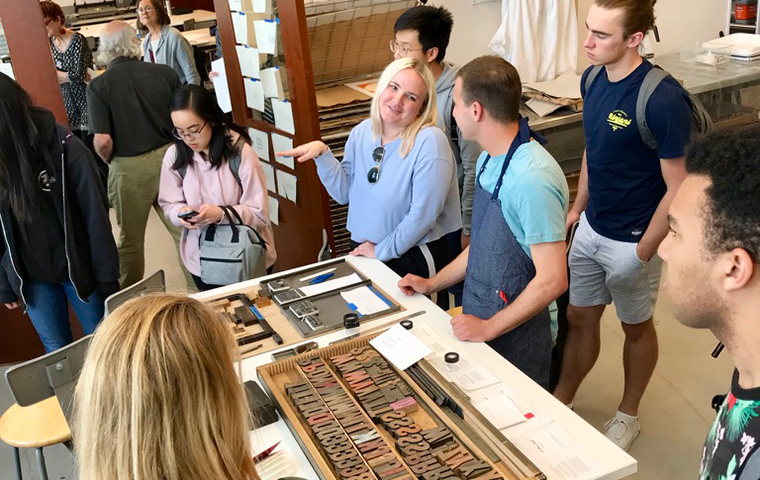
And, in this specific cultural moment defined by AI and social media, students working with letterpress also become more attuned to their own authentic voices and ideas separate from digital influences. I believe the letterpress helps us practice writing who we are and cultivating a voice that is unique to us, that celebrates our differences through the art of printing.
During the encounter between the writer and the blank page, when we pause because we don’t yet know what to write, there is actually an encounter with the self. This moment of not-knowing is an occasion to be curious and to search within ourselves for the answer. Using AI or other digital tools to write for us fills in the blank page faster, with data that we might not know off-hand, but it’s missing what only the writer can deliver: their ideas and their voice.
For this reason, I associate letterpress with the Jesuit concept of cura personalis, or care for the whole person.
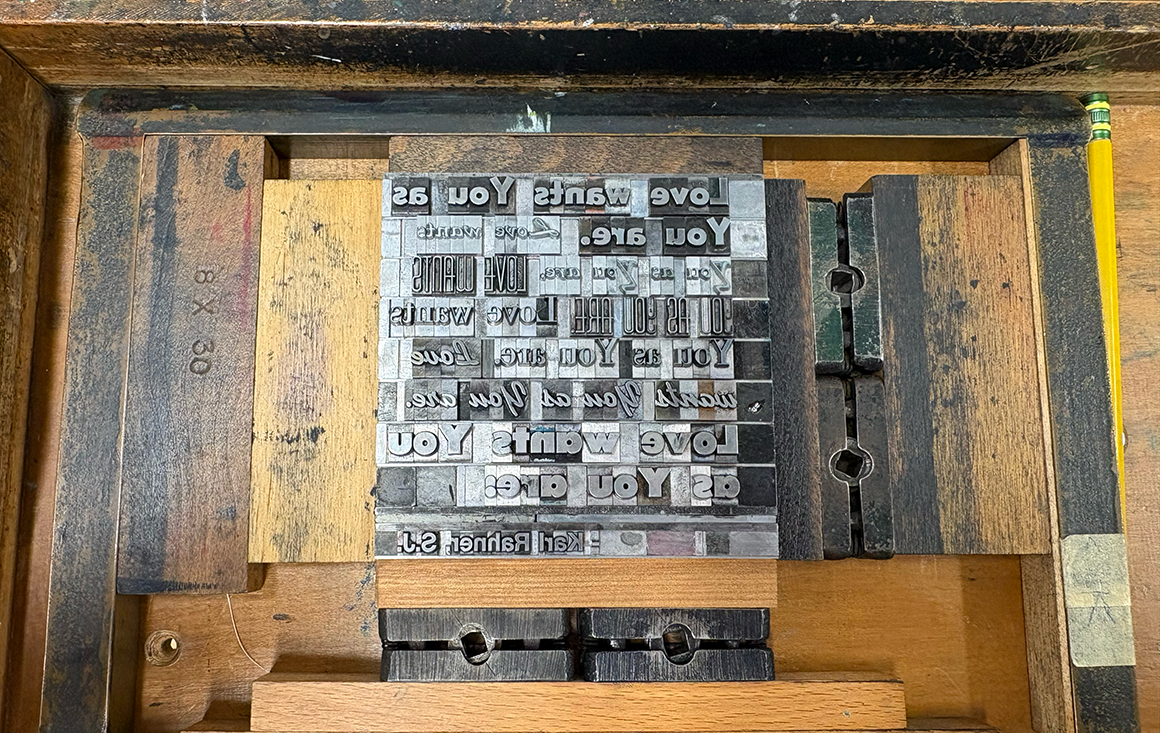
Writing for the letterpress gives the writer more of these “blank page” moments of encounter and choice than writing in a word processor because nothing is pre-programmed. A writer chooses not only their ideas and words, but the typeface and point size, each individual letter, the little metal spaces between words, the wood blocks (called furniture) that nest the type form, the size and alignment of the page, the type of paper, the opacity of the ink, and even the press. Every choice impacts the print.
The ability to self-publish with letterpress printing is the ultimate form of freedom of speech, allowing the author to elide interventions a publisher might make that change a work’s style and meaning. When a printer reflects on all of the choices that led to their letterpress print, they discover that the defaults of digital media have become ingrained in our writing habits at the cost of our own problem-solving skills and range of modalities for self-expression.
In fact, letterpress delivers a crucial lesson from centuries of pre-digital print history: as the new “Age of AI” unfolds, remember that the struggle to figure out what to say and how to say it is an opportunity to differentiate yourself and your voice from others, as well as from all the AI responses that sound the same.
While the letterpress printing process emphasizes self-reflection, it is not a solitary practice.
Everything we do in the studio is collaborative because we need each other to print safely; to solve problems; to develop our ideas; and to push our work in directions we might not be brave enough, or patient enough, to go on our own. Together, we learn to slow down and figure out what we care about, what we sound like, and how we differ from each other through our shared use of language, writing, and art.
I like to joke with students on the first day of my class, “Letterpress Composition: Writing with Heavy Metal,” that the press does not connect to Wi-Fi or Bluetooth, but we can, and should, connect to each other. By the end of the course, many students describe the letterpress studio as a mental health haven where they can untether from the web, social media, and now, AI. In the letterpress studio, we can rediscover each other.

The Department of English is the center for reading and writing at Santa Clara University. You’ll go beyond the page, learning from experience through community-based coursework, internships, and independent research. We will nurture your development as a whole person, not just as a student, and encourage you to contribute to a more compassionate and equitable society.