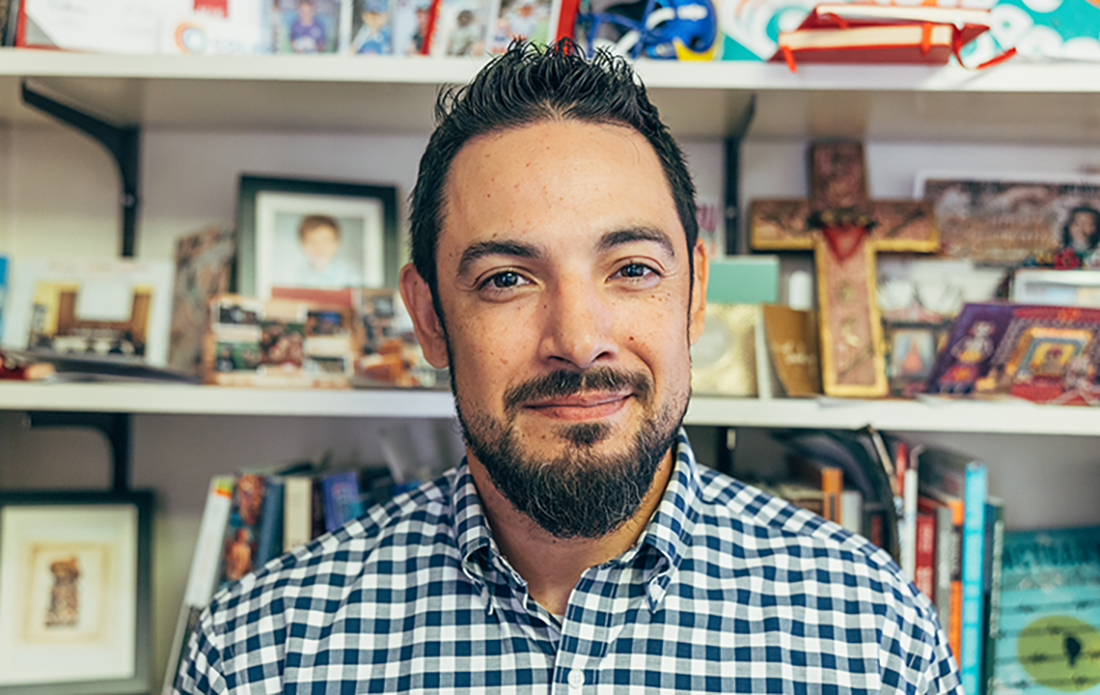
James Glaser Looks Under the Hood of ‘Everyday Democracy’

James Glaser, Santa Clara’s executive vice president and provost, has spent most of his career studying electoral politics and political behavior. In a trio of acclaimed books, he analyzed post-1960s Southern politics to show how history, place, and race relations shape everyday politics and inequality. Now, with the release of “Everyday Democracy: Liberals, Conservatives, and Their Routine Political Lives,” he has turned his attention to contemporary political polarization and the potential for mitigating it by understanding everyday habits and ways of thinking.
“It used to be that people thought of our system as encouraging moderation because of our electoral rules. We’re a first-past-the-post presidential system, which refers to how we elect presidents, senators, and representatives in states and districts. These elections operate with plurality rules and are generally between two parties,” Glaser says. “But over time, things have changed. The forces of contemporary life are driving the parties further apart and elites further apart. And as elites have been driven further apart, so have rank-and-file voters. That’s where we are. It’s an unfortunate state of affairs.”
Glaser’s previous work on southern politics helped inform the study of polarization because some of this transformation can be understood through shifting party politics in the Southern states. He underscores that the South has gone from being a one-party region, where Democrats overwhelmingly dominated, to a two-party region, where Republicans heavily outnumber Democrats. “A sorting process has occurred,” he explains. “It used to be that there were conservative Democrats, many of them from the South, and liberal Republicans, some of them from the North, that created a sort of buffer zone. We’ve lost those people who glued the system together and sat in the middle, and that has contributed to the polarization in our society.”
Glaser spent nine years researching and writing the book together with Tufts political science Professor Jeffrey Berry, whom he considers a mentor, and Deborah Schildkraut, their former student, now also a Tufts political science professor. The book, says Glaser, developed organically as the three focused on why liberals and conservatives think differently about politics. Their book argues that the health of American democracy is shaped less by dramatic elections and more by the small, recurring choices people make in daily life.
Drawing on surveys of Americans from the last 20-plus years, the authors define “everyday democracy” as the attitudes and behaviors people display in routine interactions—such as whether and how they talk with political opponents, tolerate compromise by politicians, or participate in community activities and charitable giving. They find that neither liberals nor conservatives dominate in what they call “democratic habits of the heart,” a positive sign for reducing partisan tensions. In most domains, liberals are more “democratic” in their orientation than conservatives, but this is not true in all of them, and the book aims to offer an understanding of the contours of thinking about various aspects of politics.
Glaser believes the rift between liberals and conservatives, and the accompanying stalemate and vitriol, is exhausting and unpleasant for many Americans. “It’s dominating our lives in ways that it didn’t used to,” he says. He could see a political candidate, new party, or subset of a party come along that “presents themselves as healers—to address problems in a different, more civil, and more respectful tone. You’re already starting to see some of that in this political environment.”
He also thinks universities can play a role in helping to heal the polarized country. “We can role model how it can be done, show that we can disagree in a way that’s respectful and civil—that doesn’t call people names and doesn’t impugn the motives of the other side,” he says.
Glaser believes Jesuit institutions, in particular, are places where civil discourse can thrive. He points to the Jesuit value of presupposition, the idea of assuming good intentions in others, interpreting words charitably, and listening deeply before judging. “This Ignatian principle is so appropriate to our time. It calls for us to assume the best intentions in whomever you are engaging,” Glaser says. “My experience at Santa Clara has reinforced this notion that how we engage each other on an everyday basis has bigger political and societal implications.”