What if we could predict problems in space before they happen?
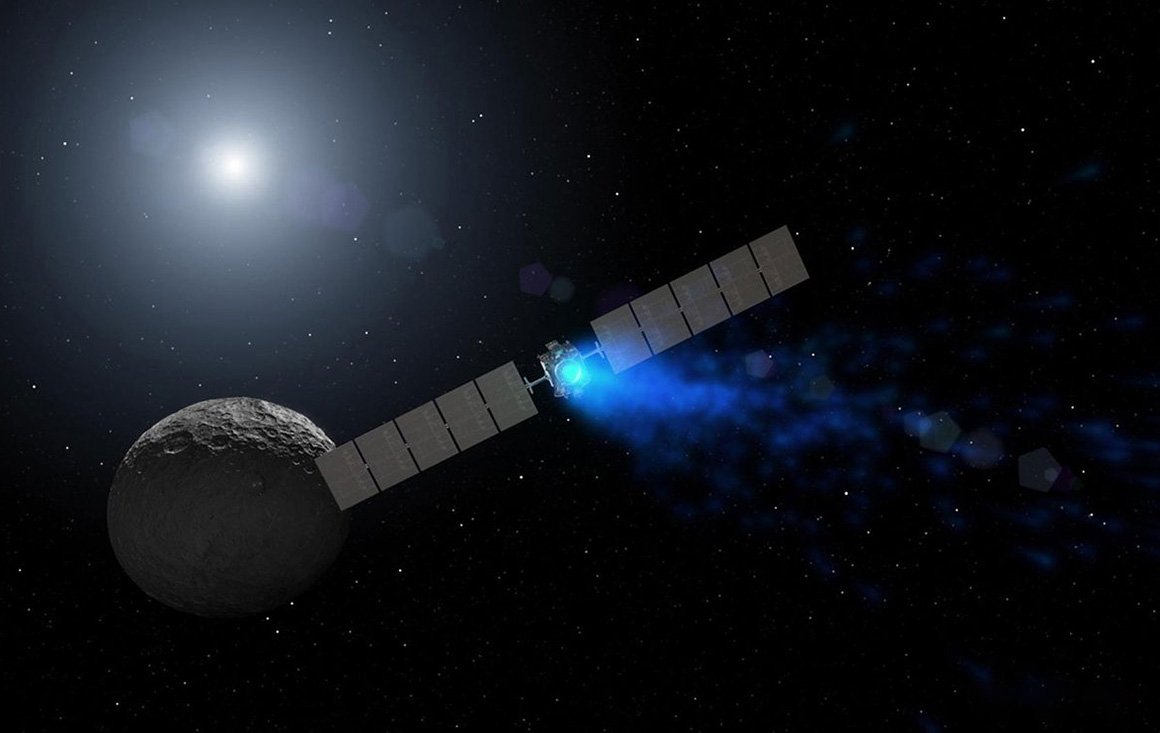
Spacecraft rely on spinning reaction wheels to control their orientation—essentially pointing them in the right direction while orbiting the Earth or traveling through space. If a reaction wheel degrades or fails, it puts an entire mission at risk. Spacecraft may burn up in Earth’s atmosphere or float into a growing heap of space trash. Mohammad Ayoubi, an associate professor in the Department of Mechanical Engineering and director of Santa Clara’s Aerospace Engineering Program, has helped develop a method that can detect problems in these wheels early and estimate how much useful life remains.
Reaction wheels are mechanical devices with rotating parts, so they can gradually wear and develop problems. “Over time and due to the harsh environment [of space], the wheels can fail. And when they fail, the spacecraft can partially or fully lose its ability to control its altitude,” Ayoubi says, “and turns that huge and massive and expensive piece of art into junk.”
The importance of reliable reaction wheels cannot be overstated. See: The Kepler space telescope had to end its primary Earth-sized planet-hunting mission when two of its reaction wheels failed. Also, the Dawn spacecraft, designed to orbit two extraterrestrial bodies in the main asteroid belt between Mars and Jupiter. Dawn experienced a series of reaction wheel failures that forced engineers on the ground to adapt the mission. Detecting degradation before a complete failure would be so valuable for extending a mission’s useful life.
Ayoubi and his collaborator developed an efficient algorithm designed to run onboard a spacecraft and detect even the subtle changes in the behavior of a reaction wheel, such as those changes associated with internal friction and motor torque. “We use machine learning techniques to obtain the governing equations of the spacecraft’s reaction wheels, then compare them with those of a healthy wheel to determine whether something is wrong,” Ayoubi says.
Professor Mohammad Ayoubi.
Detecting a problem is only the first step. “Once an issue is flagged, the next question is how much time do we have before we lose control of the spacecraft?” Ayoubi says. Researchers track changes over time and use them to estimate the wheel’s remaining useful life.
Spacecraft are not easily repaired once in orbit. “It’s not like a car you can just take to the shop,” Ayoubi says. But predicting a problem that’s not easily solvable still holds value. “It gives more time to the engineers on the ground to still get something out of the mission.”
Plus, this is a step toward the larger goal of making spacecraft more autonomous. If a craft can detect a developing problem on its own, future systems could use that information to decide how to respond—for example, by changing how they operate, adjusting mission priorities, or relying on redundant hardware. This capability would be especially important on missions far from Earth with significant communication delays. “Millions or billions of miles away, these decisions need to be made on board quickly,” Ayoubi says. It would be impractical to wait for engineers on the ground to analyze every problem and send corrective commands back.
The research was published in June in the AIAA’s Journal of Aerospace Information Systems using synthetic data generated from a reaction wheel model rather than data from an actual spacecraft since companies are generally not apt to release detailed information on failures.
Even so, the method provides a framework that can be tested and developed further by researchers and engineers in the field. Why not make it proprietary? “My goal has always been to identify real problems in industry and develop practical solutions that can ultimately make a difference,” he says. “That’s my job as an engineer.”

The master’s program in aerospace engineering at Santa Clara University is a two-year program for students who want to pursue a career in the aerospace industry, government, or Ph.D. program. Through this program, faculty and students are granted access to and often collaborate with local aerospace companies and government agencies.
Learn more about Aerospace Engineering at Santa Clara University.