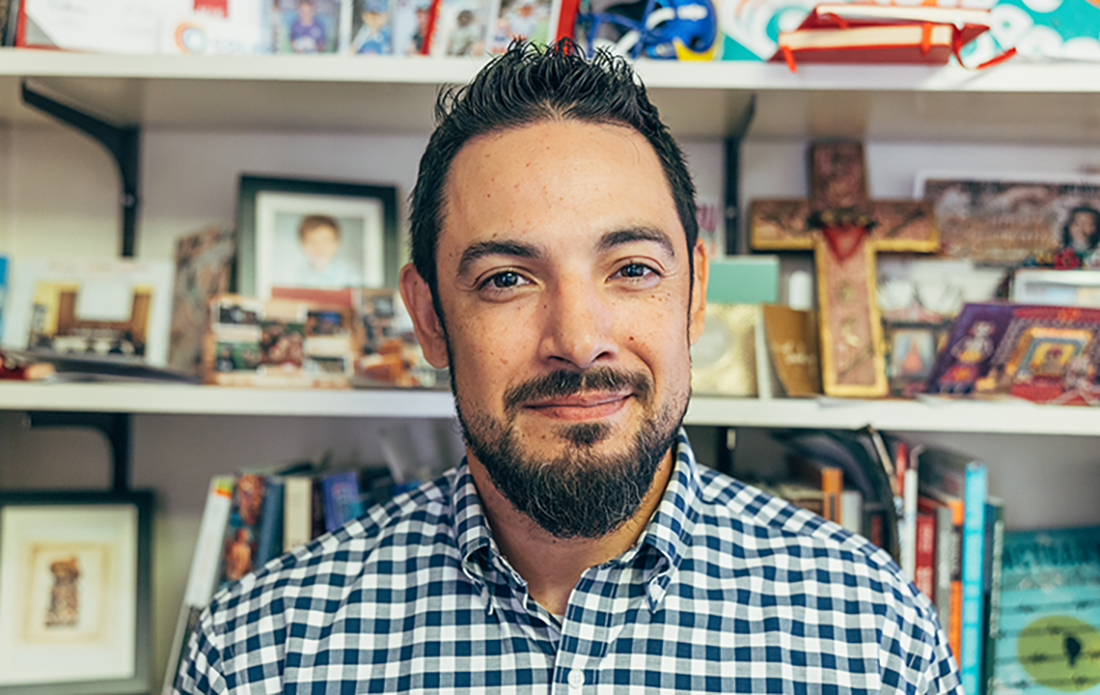
Evan Fine ’25 made award-winning short films with two five-watt light bulbs and one creative vision
Evan Fine ’25 made it his mission to explore every corner of Santa Clara University. Whether he was playing violin for the orchestra, helping plan the annual Powwow, or walking to a lecture in Kenna Hall, he always kept his eyes open for hidden spots that most students never noticed.
“I loved exploring and studying in as many different places as possible,” says Fine, who double-majored in music and political science. “I’d find all these crazy places—the stairwell in Bergin Hall or a random room in Varsi Hall—and get this creative itch and think, this would be a great place for a movie.”
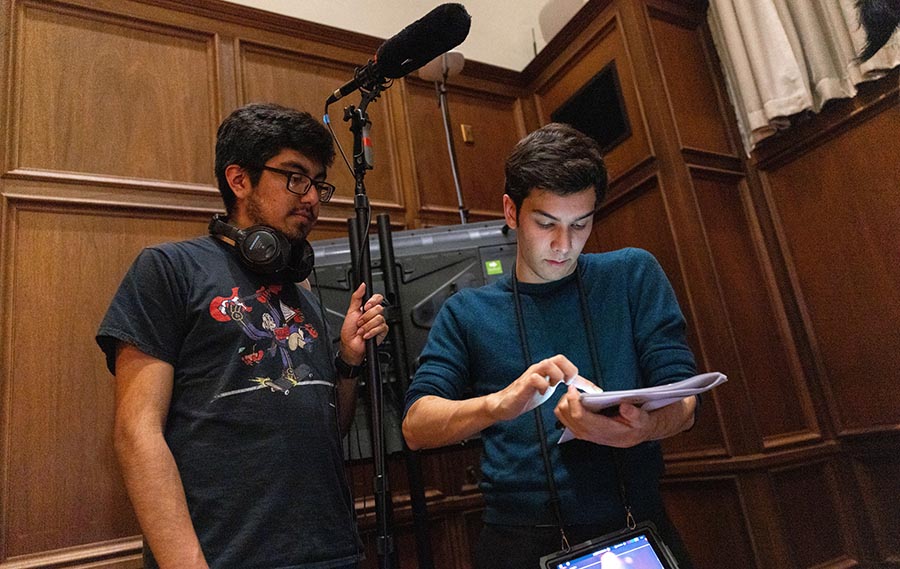
A few years later, those same spaces became the backdrop for his short films, Unknown User and The Death of Jim McGraw, both created alongside fellow students who worked in front of the camera and behind the scenes. With no filmmaking experience or formal training, Fine learned by doing, developing his skills through hands-on experience.
Fine’s first project, Unknown User, a sci-fi horror film about a scientist who builds a computer to communicate with herself in an alternate world, screened at 14 film festivals worldwide, reaching more than 5,000 people and earning awards in San Francisco, Beverly Hills, Ireland, and Scotland—all on a budget of about $230.
“To even be thought of alongside people who do this for a living was humbling,” says Fine, who served as director, writer, cinematographer, editor, color grader, and soundtrack composer across both films while completing his studies at Santa Clara. “A lot of those skills came through trial and error. I can’t think of another place where I could have engaged all of the distinct, yet integral parts of my personality.”
This fall, Fine will attend Stanford Law, where he plans to study space law while continuing to pursue filmmaking and music. We talked to him about his journey from violinist and political science student to award-winning filmmaker, how Santa Clara supported his path, and what he’s looking forward to next.
You grew up in the Bay Area and chose to stay for college. What drew you to Santa Clara University?
I first learned about Santa Clara University when I was in high school. The interdisciplinary nature of a Santa Clara education appealed to me the most. I really don’t like narrowing myself down to one thing—as you might be able to see with me randomly picking up filmmaking—but I figured Santa Clara would be a great place for me to create and try a lot of different things across disciplines.
Outside of the classroom, student government and mock trial taught me what it’s like to speak publicly, present an argument, and rebut a case. Performing in the orchestra taught me how to be a performer and showman. And filmmaking taught me logistics. How often is it that someone who’s a political science and music major gets to direct their own film? I think that’s something you’ll only see at Santa Clara.
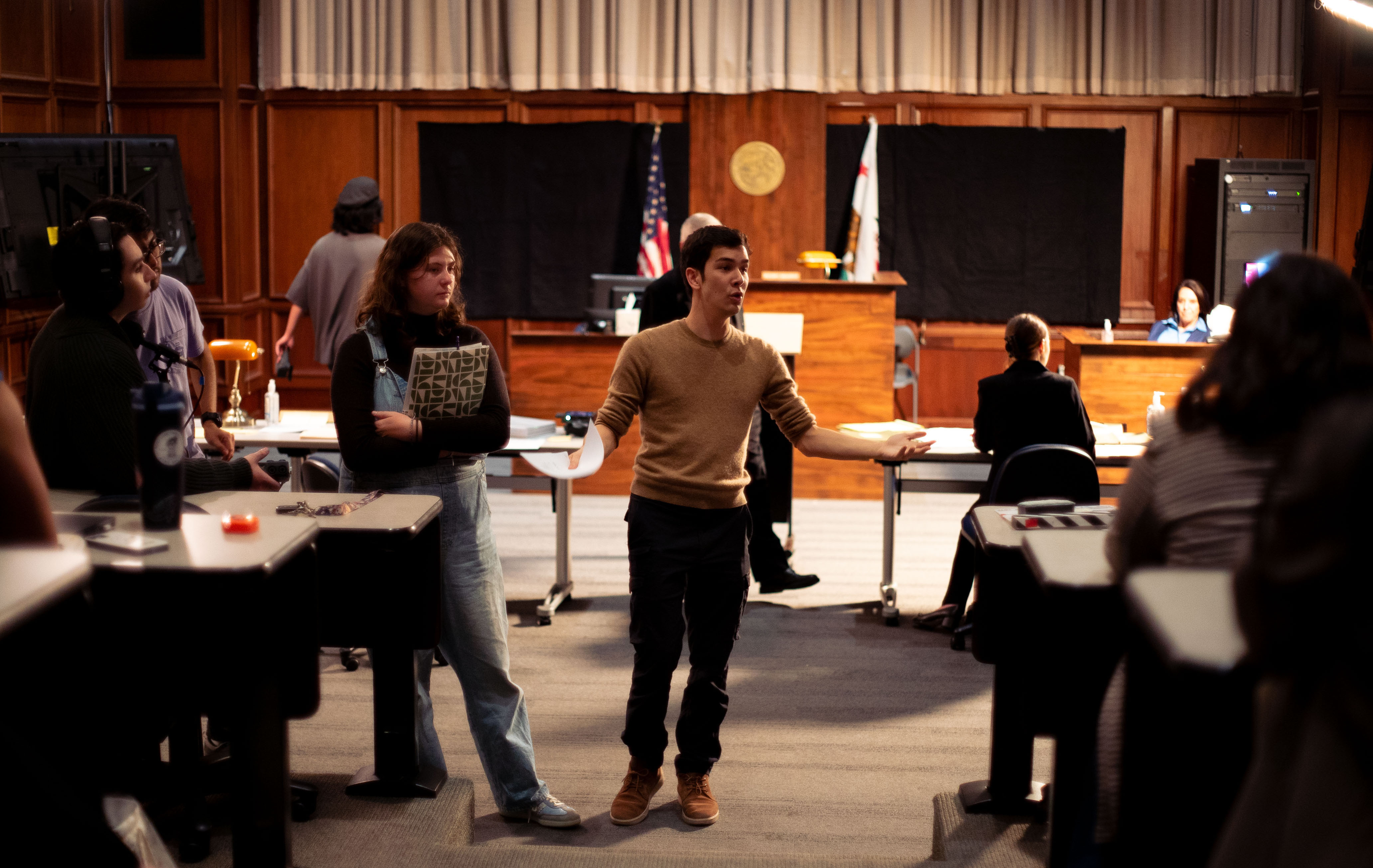
Some scenes from The Death of Jim McGraw were filmed in Bergin Hall's former moot courtroom.
What made you take the leap into filmmaking with no formal training or experience? How did Santa Clara support you?
I think I just watched way too many movies and thought, perhaps foolishly, I can do that too. The first show I ever watched as a kid was Star Trek: The Original Series. I grew up on that stuff. In fact, Unknown User was very much inspired by Star Trek. When I wrote the script, I was researching quantum mechanics and alternate realities, so the film became an exercise of exploring what happens if we reach out to another world and we don't like what answers us.
I was a total newcomer to the film branch at Santa Clara’s communications department when I reached out to assistant teaching professor Michele Sieglitz and asked, “How do I make a film? Because I kind of want to do that.” She taught me everything she knew about the process, believed in my vision, and supported me every step of the way. She is the reason this film was done, at least on the faculty side, and has been absolutely invaluable in making it real. I was also very lucky to have a great team of students take a chance on me.
After your first film’s successful run on the festival circuit, you founded the production group, Five Watt Lights. Where did the name come from, and what do you hope to build?
It’s actually a really funny story. We were doing lighting tests for our film, and we consulted professionals who kept telling us we would need 500- or 1,200-watt lights for our scenes. Those lights cost thousands of dollars, and we’re broke college students and alumni. We didn’t have that kind of budget. One day, we tried a very simple setup with two inexpensive, tiny, portable 5-watt lights. The lighting was perfect for what we were doing. Our lighting designer, who had worked in the film industry for years, even told us he never thought it could look that good.
That’s when I thought: Five Watt Lights is the perfect name for us. We are a small, unassuming group, but we make things that look way better than they have any right to. We want to be recognized not because we’re the scrappy underdogs, but because someone can blindly look at our films and love them based on the merit of our work.
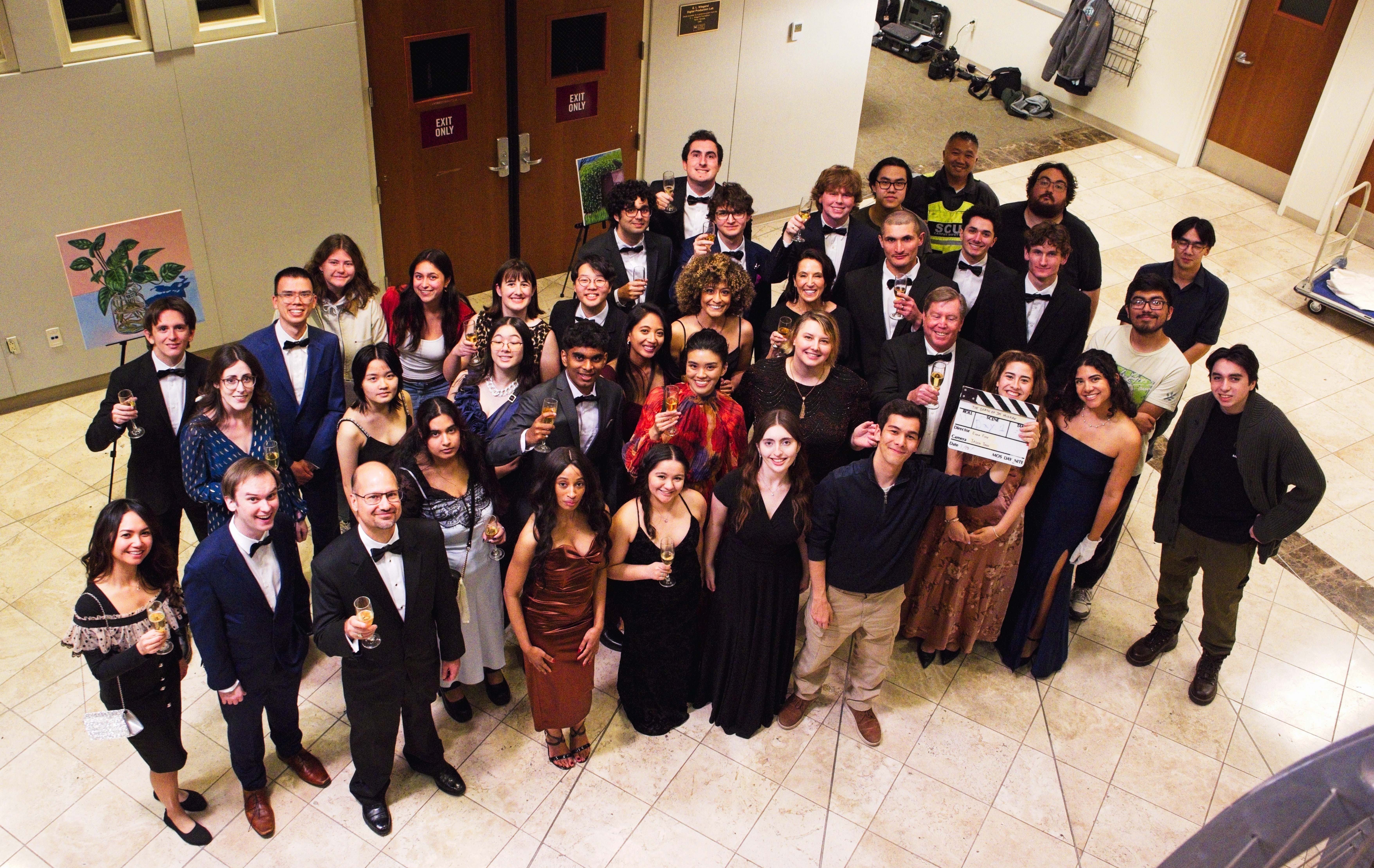
Your second film, The Death of Jim McGraw, is a courtroom thriller that brought together more than 130 students, alumni, faculty, and community members. What inspired the film?
The Death of Jim McGraw is my swan song and homage to my time in mock trial. A lot of courtroom or murder mystery films deal with one question: who did it? I wanted to give a fresh take on that genre, so this film is about how we prove who did it. For me, that’s the big question at the heart of every legal issue and the most interesting part of being a lawyer. It’s not just what the truth is, but how you actually prove that truth. You can have the same case with two different judges, two different juries, and get two entirely different outcomes. You can have a courtroom where everyone thinks “he did that,” but that’s not enough. I wanted to explore this idea in The Death of Jim McGraw.
Starting another film was a huge undertaking, but working with people who had a hunger to create and be part of something was really cool. I'm just glad I was able to give them an outlet to do it. We used Backstage.com, a local casting network for amateur actors, to find our cast. The actor who plays the judge is actually a Santa Clara alumnus from the class of 1982, and the lead actress flew in from New York and paid her own way to be part of this film. That is a testament to how much people believed in the project.
You composed 10 minutes of original music for The Death of Jim McGraw, which was recorded by the Santa Clara University Orchestra. What was that experience like?
The soundtrack was the most demanding part of this whole process for me. I spent at least 70 hours learning how to write a score for orchestra because, as a violinist, I don’t think much about composing. Thankfully, I got to work with Santa Clara’s orchestra director Anthony Rivera again. I’d worked alongside him for three years as his concertmaster, and he helped me through the entire process. I think the extent of student filmmaking is usually that you shoot over the course of a couple of days, edit, find some stock music, and make a good final product. But, I’m a musician. Music is such a core part of this film, so I couldn’t leave it up to stock music.
We premiered the film at Santa Clara this spring. To see it on the big screen in the same place we recorded the score and where I’d spent four years performing violin in recitals and competitions was incredibly rewarding. More than 80 people from our cast and crew brought their friends and families to watch. They’d point to the screen and say, “I remember when we shot that.” It was an immense triumph for our ambitions to pay off at this scale.
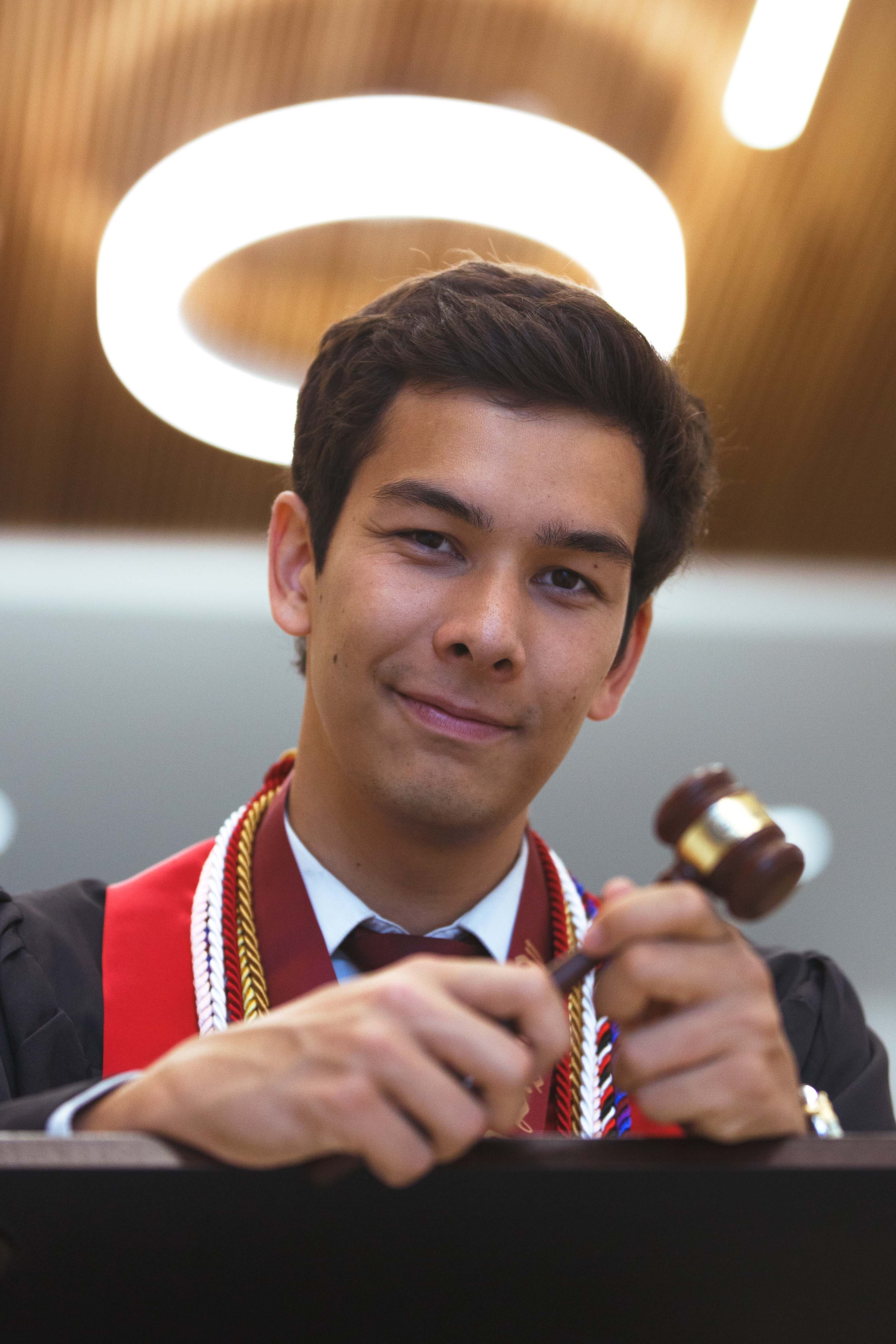
Fine plans to continue pursuing filmmaking and music while studying space law at Stanford.
You’re headed to Stanford Law this fall and hope to pursue a career in space law and the human colonization of the Moon and Mars. What sparked that interest?
Law is an interesting field where you get to harness public speaking for the benefit of others. During a mock trial round, a judge once told me that law is a language you translate for your clients, and that really stuck with me. The vocation of law is a way to help people be seen and understood. Outer space law takes that and adds this really cool frontier aspect. We’re simultaneously giving voice to people who need that translation, while laying the groundwork for a future in space commercialization.
And I think every generation needs a frontier. Ours is space, and it is waiting for us to claim it. It’s like the line from The Truman Show when young Truman tells his teacher he wants to be an explorer, to which she simpers, “there’s nothing left to explore.” As humans, we've seen the Earth, we’re starting to see the ocean, and I think space is the logical next step in expanding humanity.
Unfortunately, I am terrible at math, so I will never be a rocket scientist, but I see myself contributing to this frontier in any way I can. I want to be a part of that future while doing something meaningful, like law.
Santa Clara University gave you the space to be a violinist, filmmaker, student, and now future lawyer. Looking back, what do you think ties all of those experiences together?
Creation is the thread that binds me. My mantra is “creation is effort, apathy is destruction.” To me, it means that if you want to make something, you have to work for it. Nothing will just appear. And if you simply don't care, things will die. I love to create, and in whatever form that manifests, hopefully I’ll leave some kind of impact.

The department introduces students to the analysis of political behavior, values, institutions, and governments. It also offers preparation for various graduate and professional studies and for careers in public service, education, and the private sector.