Research 15
Beyond Detection: David Anastasiu's Vision for Proactive AI Safety
With a $600,000 NSF CAREER award, Santa Clara University researchers are training AI to see accidents before they happen.
Imagine a bustling intersection near a school. A car is approaching just as a pedestrian, distracted by their phone, steps off the curb. In a conventional world, a nearby surveillance camera might record the collision for an insurance report.
In David Anastasiu's vision of the future, the camera does more than watch. It anticipates.
Seconds before the impact, the AI system identifies the dangerous trajectory, triggers a flashing warning at the crosswalk, and sends an immediate alert to the vehicle's dashboard. The driver brakes, the pedestrian looks up, and a tragedy is prevented.
This shift from reactive recording to proactive prevention is the heart of new research at Santa Clara University. David Anastasiu, Associate Professor in the Computer Science and Engineering Department and Director of the WAVE High Performance Computing (HPC) Center, is leading an effort to redefine how artificial intelligence interacts with the physical world.
A Paradigm Shift: Anticipation vs. Detection
For years, the standard in AI video analysis has been Video Anomaly Detection (VAD) — the ability for a system to recognize that an abnormal event has already occurred. While technically impressive, VAD has one fundamental limitation: it requires the event to happen before the system can respond.
Anastasiu is advancing a new approach called Video Anomaly Anticipation (VAA).
"For too long, AI in video analysis has focused on detecting anomalies after they happen. With this nearly $600,000 grant, we are aiming to shift the paradigm from detection to anticipation."
By training models to analyze live data and predict what might go wrong seconds in advance, the goal is to create enough lead time for people or automated systems to step in and prevent harm.
The NSF CAREER Award
The National Science Foundation CAREER Award recently recognized this vision with nearly $600,000 in funding. This highly competitive grant supports early-career faculty who demonstrate strong potential in both research and education.
Over the next five years, the funding will support the development of real-time AI models capable of anticipating accidents in smart city environments — transforming everyday infrastructure like traffic cameras into proactive safety systems.
Why Explainable AI Matters
If an AI system triggers a vehicle's emergency brakes or changes a traffic signal, it cannot operate as a black box.
This is where Explainable AI becomes essential.
"Prediction alone isn't enough. To build trust, these systems must also be explainable."
Rather than issuing a vague alert, the system is designed to communicate clearly why it flagged a risk — highlighting a vehicle's trajectory or identifying unusual movement patterns that suggest potential danger. That transparency is what makes these systems viable in real-world, safety-critical settings.
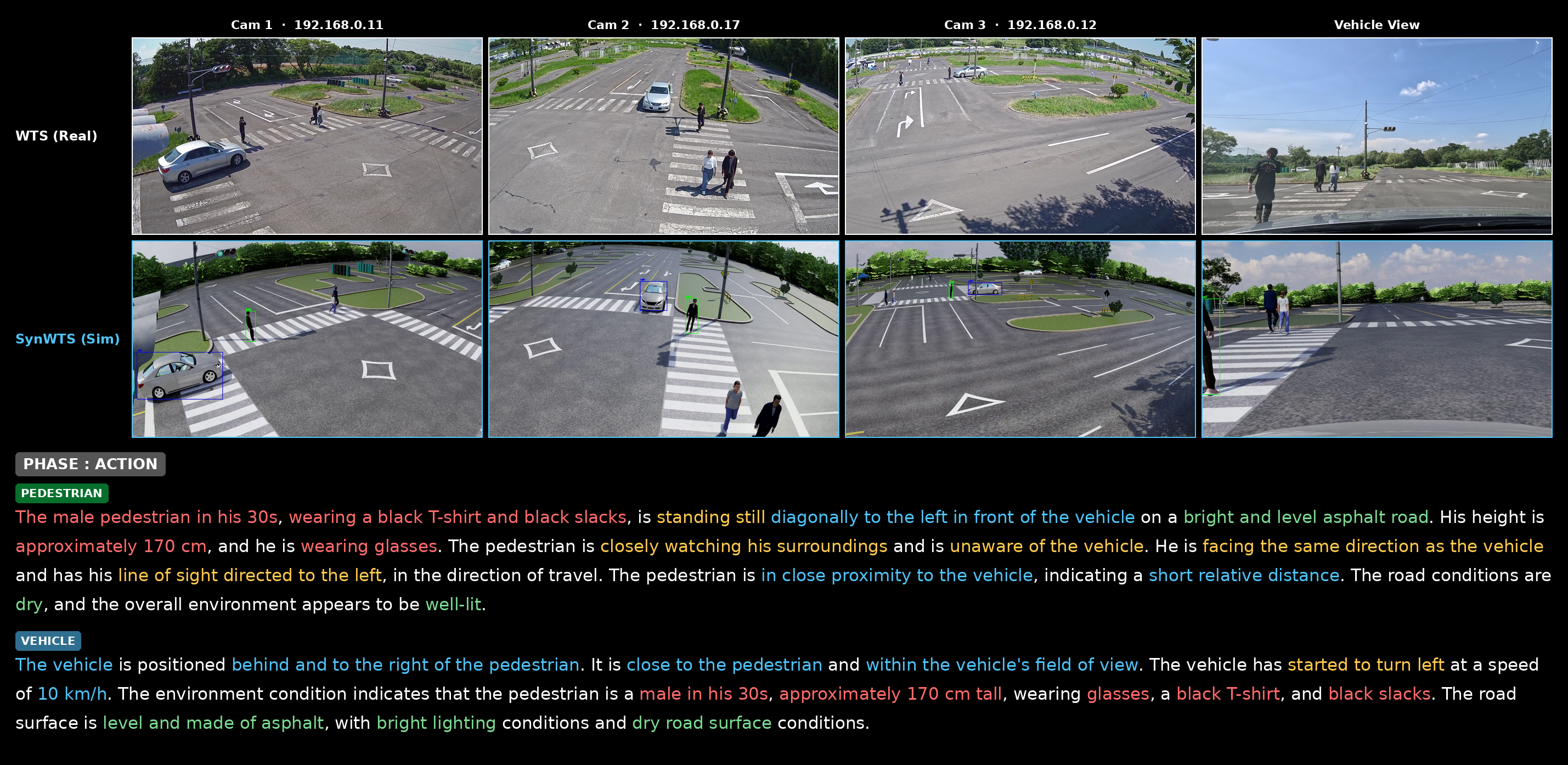 Figure 1: Comparison of real-world WTS camera feeds and synthetic SynWTS simulations. The AI system identifies key entities (green bounds for pedestrians, blue for vehicles) and generates real-time, descriptive text explaining pedestrian actions and vehicle trajectories.
Digital Twins and Global Partnerships
One of the biggest challenges in this research is data. Real accidents are rare, and near-accidents are even harder to capture on camera.
To address this, the team is working with NVIDIA Metropolis to develop digital twins — highly realistic virtual environments that simulate real-world conditions. Using NVIDIA Isaac Sim, researchers can generate hundreds of near-miss scenarios that would be impossible, or unsafe, to recreate in reality. Six RTX A6000 GPUs, provided by the NVIDIA Metropolis team, power this simulation work in the lab environment.
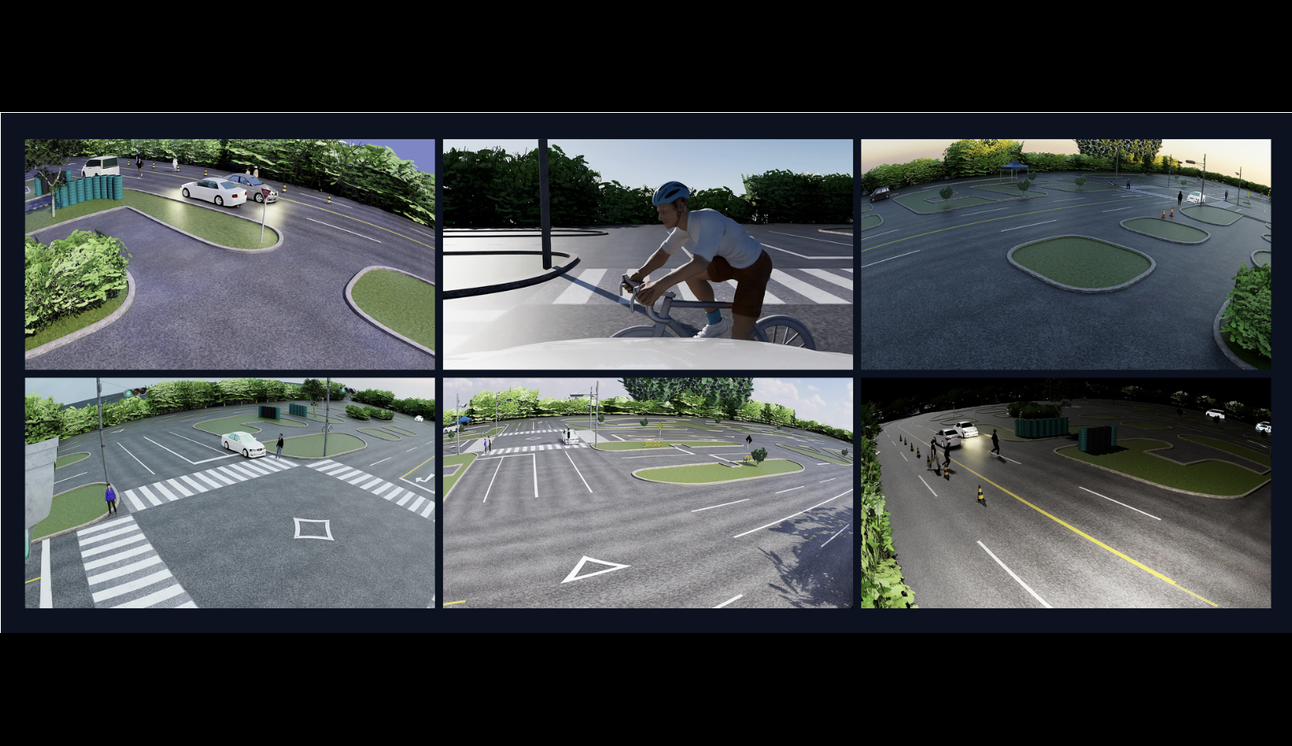 Figure 2: Simulated traffic environments generated in NVIDIA Isaac Sim, showcasing varied street layouts, lighting conditions, cyclists, and pedestrians used to train AI models safely.
The project also includes collaboration with Woven by Toyota, which provides access to data from Woven City, a 175-acre smart city under construction in Japan. This serves as a real-world testing ground where models can be evaluated in dynamic, constantly changing conditions — bridging the gap between simulation and deployment.
From the Lab to Large-Scale Training
Once synthetic scenarios are generated using the RTX A6000s, the real computational work begins. Training the deep learning models that underpin VAA requires a level of processing power that no standard lab setup can provide.
That infrastructure lives in the WAVE HPC cluster, supported by hardware donations from Supermicro and NVIDIA:
- One 8-way NVIDIA A100 GPU server
- Two NVIDIA GH200 nodes
These systems are used to train and fine-tune the large-scale models responsible for prediction, anticipation, and scene understanding — tasks that demand massive GPU memory, multi-node parallelism, and sustained computational throughput.
"WAVE allows us to do the work that we need to do… we wouldn't be able to create the kind of models that we're trying to create for this project without it."
The servers themselves reflect the scale of the challenge. A single high-end GPU node can require multiple 2000-watt power supplies and 220-volt outlets, producing significant heat and noise in the process. The WAVE data center is the only environment on campus built to handle it.
"These servers are very high power… they would not run in the office. You need specialized power, specialized cooling."
Student Researchers at the Forefront
This work is driven not only by faculty leadership but by a team of student researchers working directly within these pipelines. Ridham Kachhadiya and Dhanishtha Patil recently earned second place in the global AI City Challenge for developing models that describe traffic incidents — contributing directly to the explainability component of the project.
For Kachhadiya, working at this scale has been central to the research experience. On a typical day, student researchers use WAVE to:
- Preprocess large video datasets
- Run inference across thousands of traffic-scene frames
- Fine-tune vision-language models across multiple GPUs
- Submit long-running training jobs through Slurm using srun and sbatch
"As student researchers, WAVE gives us access to computational resources that go far beyond personal workstations. With high-end GPUs such as NVIDIA A100s and GH200 nodes, large memory capacity, and support for multi-GPU and multi-node training, we can fine-tune large language and vision-language models at a scale that would otherwise be difficult or infeasible."
The skills developed through this workflow — distributed training, GPU resource allocation, job scheduling, large-scale experiment management — closely mirror what students will encounter in industry and research environments after graduation.
"These workflows are difficult to reproduce on personal machines, where limited GPU memory, slower compute, and lack of multi-GPU support often become bottlenecks."
Beyond this project, WAVE supports a broader ecosystem of innovation at Santa Clara University, including Catalyst Faculty Projects, the Emerging Research student cohort, and coursework in AI, machine learning, and molecular modeling.
The Road Ahead
The ultimate goal of this research is to create a safer and more transparent future — systems that can anticipate risk, explain their reasoning, and respond fast enough to prevent harm before it occurs.
By moving beyond documentation and toward active protection, Anastasiu and his team are developing technology that does more than observe the world.
It helps protect it.
Read the full paper: Explainable AI for Real-Time Video Anomaly Anticipation
Written by Ella Griffin, HPC Marketing Specialist (April 2026)
High-performance computing resources supporting this work were made possible through hardware donations from NVIDIA and Supermicro, which help power the WAVE High Performance Computing Center at Santa Clara University.