Stories
Human Rights and Cultural Memory
Reflections from the Chile Immersion | Summer 2025
- Mateo Coulson '28
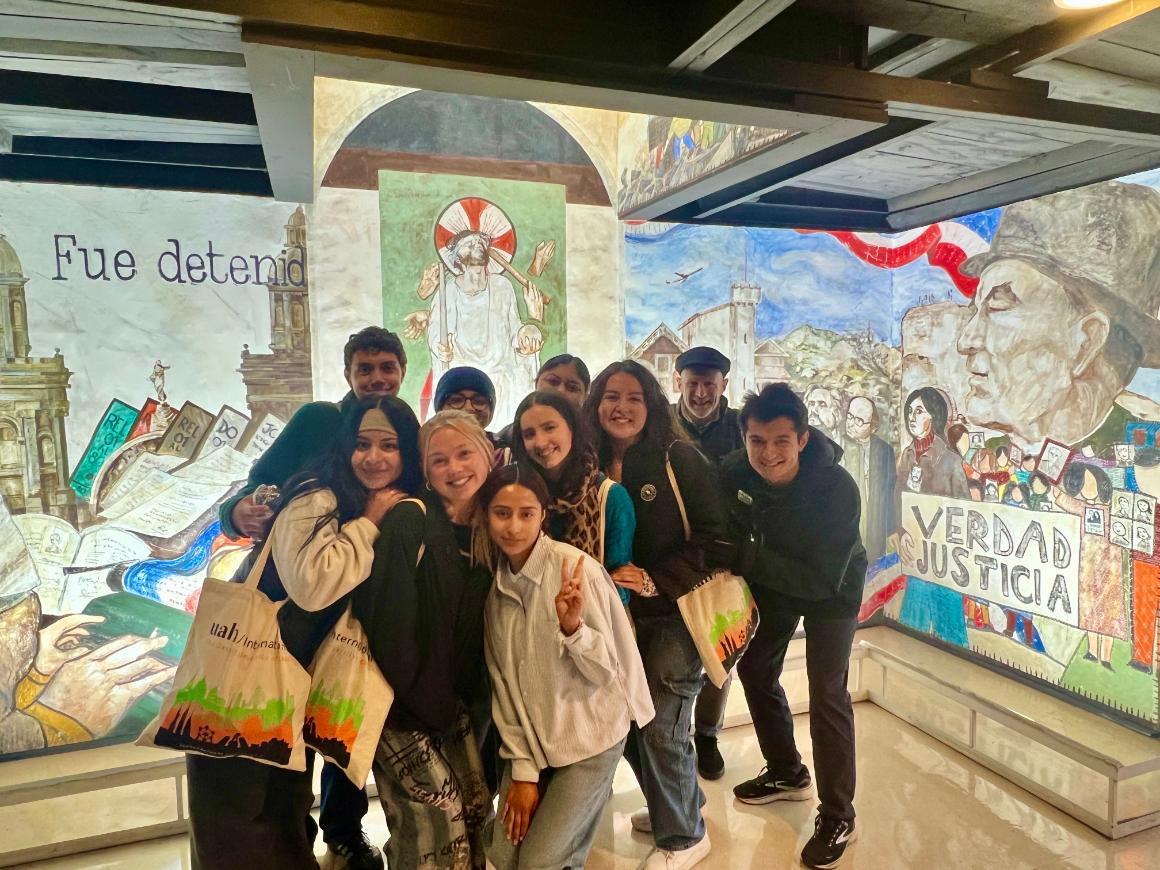
I applied to this immersion in April because I was intrigued by the opportunity to travel to another part of the world to learn about the history, politics, and culture of another country and region, all while practicing my Spanish, and building friendship and relationships with my SCU colleagues. In the end, the immersion ended up meeting all of my hopes, goals, expectations… and even more! After traveling to Santiago, Chile on an immersion trip with Santa Clara University, my experience has left me a more spiritual, intellectual, and social-justice-driven person as a result of our visits to many historical sites, the relationships we made, and, what was probably my favorite day, our visit to the Chilean Jesuit residence.
During our trip to Chile, my immersion trip group and I visited many key Chilean cities, historical sites, and museums. To name a few, we visited the La Moneda Palace, the Chilean National Museum of Fine Arts, the Museum of Memory & Human Rights, the National Stadium, and Gran Torre Costanera (the tallest building in South America)! Visiting the La Moneda Palace definitely stayed with me. It felt very jarring to be in the presence of a site that was the location of the violent coup on September 11th, 1973 that was the start of a new era for Chile filled with fear, crime, and human rights violations. It reminded me of how weird I felt after visiting the US Capitol in 2022, one year after the violent insurrection on January 6th, 2021.
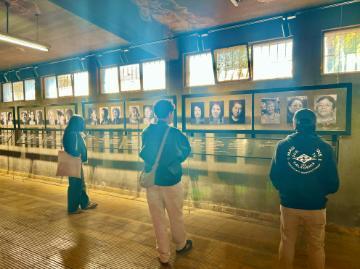
The visit that affected me the most emotionally was our group’s visit to the national stadium, since it was used as a detention center, with reports that over 40,000 people were detained in the facility in 1773. After we left the complex, I had many mixed and confused feelings; I felt shock, despair, and gratitude that my country has been spared these crimes in my lifetime, and inspired, driven, and motivated to always do what I can to preserve the human rights and dignity of others in my life. As a result of these mixed feelings, I offered up a prayer to God during our departure and prayed for closure for the families affected by the coup, for gratitude for those spared, and for hope for a future that does not repeat these crimes.
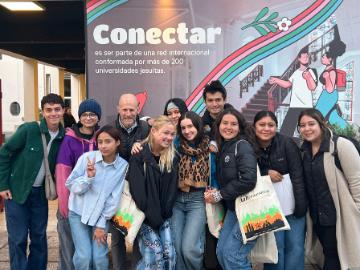
The conversations and relationships my immersion group had with local activists, professors, and students at the Jesuit University Alberto Hurtado were also impactful. Specifically, the classes we attended at the University were especially effective at making me reflect on the causes and social consequences of political violence past and present. For example, we took many classes that helped me dive into the history, culture, and social history of Chile. As a result, I can now confidently say I have a broad understanding of Chilean literature, history, and music. In fact, regarding the music, I came away from the trip with a new favorite piece of music, “La Partida,” which was an acoustic guitar piece. The song contains no lyrics and was written by a communist human rights activist, Victor Jara. In fact, one class I did not expect to enjoy was one in which the professor described “ethnomusicology.” Although I initially thought it was a niche and perhaps even boring concept, I could not help but fall in love with and appreciate the study, as it was an interdisciplinary field that catered to my intellectual interests through its exploration of music, science, cultures, and social studies.
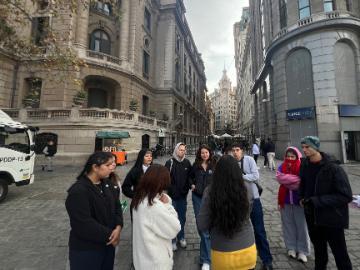
I really enjoyed getting to meet so many wonderful and kind people, especially at the University. In particular, I especially loved lunchtime, as it offered me an opportunity to go and sit with many different students at the school, with whom I chatted (in Spanish!) about everyday topics such as movies, tv shows, music, and visiting the United States. I share all of this because I want to emphasize how much the immersion’s strong community and cultural exchange components with students helped me practice my social skills and language skills to the point where I actually became comfortable in the foreign setting and felt excited to go out and eat, meet and talk with new people. One of the Ignatian Center leaders told me that one of the things that makes the SCU immersion trips so special is that they offer us an opportunity to participate in experiential learning by becoming one with our community, and after having the opportunity to become one with my community through interacting with students and professors, I can confidently say that I agree. Being able to talk with them one-on-one about their experiences, perspectives, and education, I truly felt like no boundary separated us, like I was one of them and got to hear an unfiltered perspective of Chilean identity, and as a result I cannot highlight enough the importance of experiential learning opportunities.
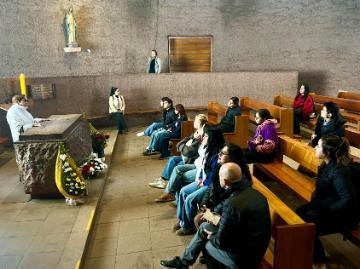
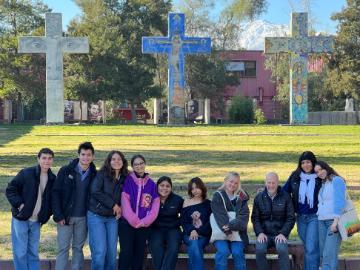
My immersion group made a visit to the Jesuit residence in Chile, which was very impactful for me on a religious, spiritual, and emotional level. During our trip to the Jesuit residence, I had a long meditative session, where I prayed the rosary, played with the dogs at the residence, and admired the nature surrounding me and the housing. During my rosary, I again prayed for Chile – for its government, country, and culture, as well as for a continued safe trip for me and my immersion group. Later that day, I also had mass with most of my immersion group, and Fr. Carnes, a Jesuit priest from SCU who joined us on our trip. This particular mass was one of my favorite’s in a while, as it was entirely in Spanish and had a very interactive homily, as it asked for me and my immersion colleagues to share what we pray for. This experience helped me feel closer to God, and has in part contributed to my continued self-reflection concerning the priesthood in recent months.
My interactions with my group’s colleagues underscored one of the values of the trip, that being the value of the individual, which was apparent by the care and attention the immersion leaders put into each one of us by getting to know us, asking us questions, and talking to us. This love conveyed by the immersion leaders helped me feel safe and welcomed the entire time on my immersion. It was a very constructive experience for me, as it highlighted for me how similar the experiences one can have in another country compared to one person’s home. Because of these shared experiences, I can definitely say that a strong community formed between me, my immersion classmates, and the leaders. It was not just the visits and explorations of Chilean identity that brought us closer together, but the reflections and group social activities we did together. By asking questions, sharing our thoughts, and being ourselves, we were better able to appreciate the characteristics that defined each of us, and I believe that’s why I truly felt I was able to get to know and become friends with everyone.
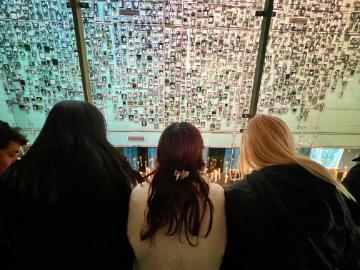
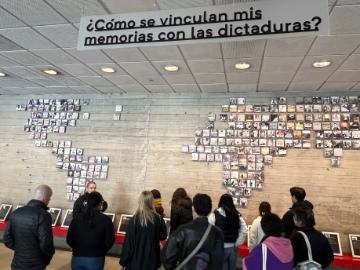
This immersion trip examining Chile's journey from dictatorship to democracy was very impactful for me. The goal of this experience was to explore human rights from both a historical and contemporary perspective, and I believe that after visiting this site and the classes we engaged in we achieved that goal and more. I learned that if I ever want to search for truth, justice, memory, reparation, and guarantees of non-repetition, then it is incumbent upon me to always take advantage of any resources I have. Learning about the perspectives of others will help me better understand history and what defines the cultures of others. This immersion trip has taught me to always do what I can to learn about human rights – past and present – making sure not just to focus on my own country, but others as well. More specifically, this immersion has helped me better understand my vocation to be a public servant. Whether it be as a future immersion leader, future politician, or even a future parent, this immersion taught me to always look to cultural memory to help understand the present. It also taught me that leadership should always prioritize the service and wellbeing of others, always making sure to understand and care for one’s individual value, but never at the expense of their dignity and human rights.