Stories
Laughing, Listening, and Learning to Stay
Reflections from the Los Angeles Immersion
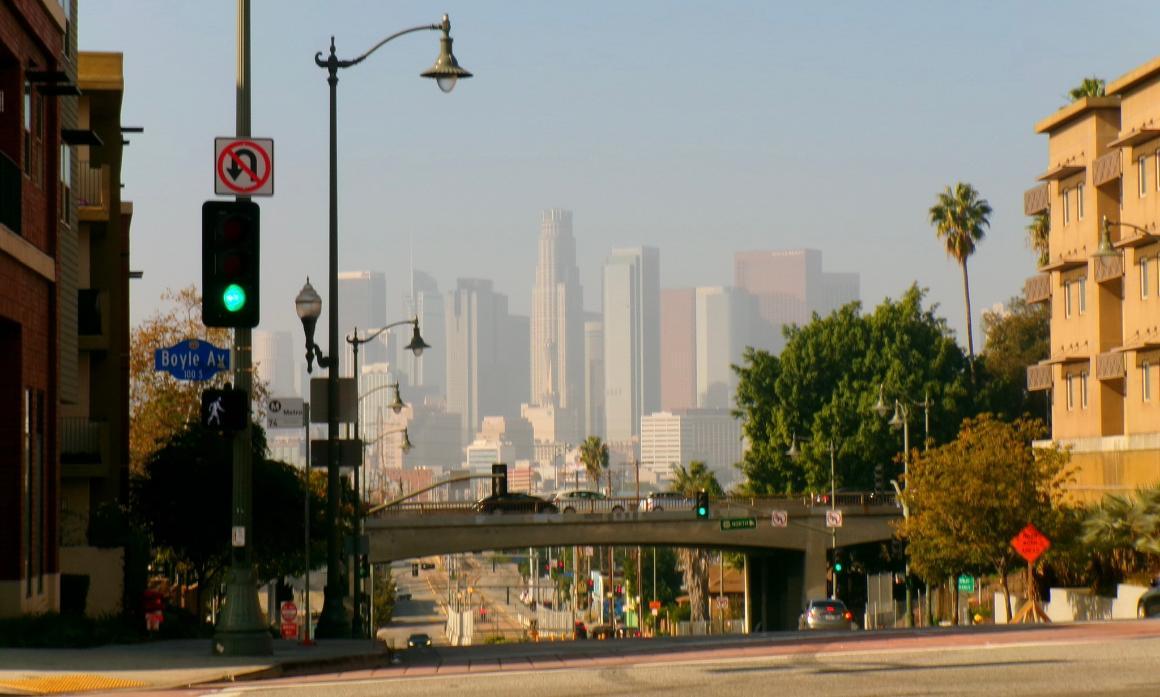
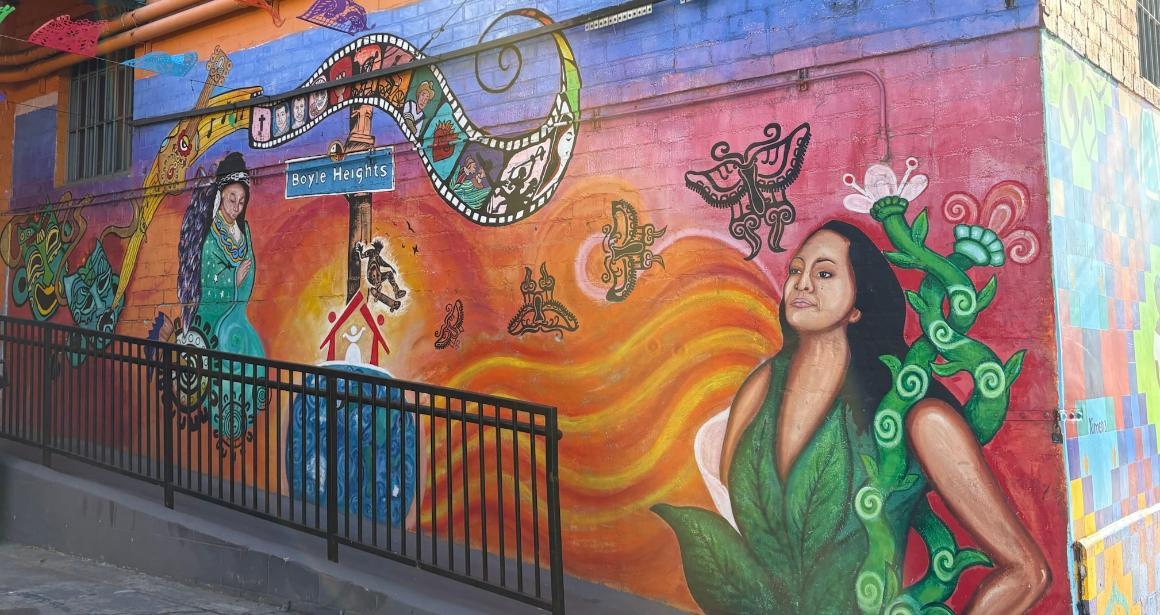
I didn’t realize how much I needed to laugh until I found myself doing it constantly on the drive to Los Angeles. It was the kind of laughter that softens you and makes you feel lighter. Somewhere along the way, the car ride felt shorter than it should have, not because of the distance, but because of the people I was with. I realized that I hadn’t laughed like that in a long time, and before we even arrived in Boyle Heights, I already felt myself opening up and making room for whatever this experience was going to ask for me.
The 2025 Winter Immersion I participated in was based in Los Angeles, specifically Boyle Heights. A historically Latinx neighborhood in East Los Angeles, Boyle Heights is shaped by generations of resilience, struggle, and collective care. It’s a community that has endured systematic injustice, displacement, and violence while continuing to show up for one another with consistency and love. Community here is not something abstract or aspirational; it is something lived daily through presence, recognition, and responsibility. It means knowing names, honoring stories, and refusing to let anyone fade into invisibility.
As we settled into the neighborhood and into the rhythm of the immersion, I began to notice how intentionally people from the community moved through their world; greeting one another by name, lingering in conversation, and making space for connection even in passing moments. It became clear that in Boyle Heights, community is sustained not through grand gestures, but through the repeated choice to see one another, learn their stories, and engage in the daily routines of the neighborhood.
Attending Mass at Dolores Mission became one of the moments that stayed with me most deeply, in part because it challenged so much of what I thought I knew about faith and worship. Growing up, I had attended Mass many times and it often felt sterile and serious, as though reverence required distance. This Mass felt entirely different. It felt warm and open, more like gathering with extended family for dinner than entering a formal religious space.
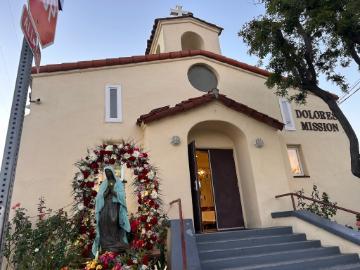
As I sat with that contrast, I wasn’t alone in noticing how faith can take many forms. Sophia Irinco ‘26 reflected, “I realized that Catholicism takes many forms. The faith I experienced growing up looked different from both my peers’ experiences and what I encountered at Dolores Mission. In LA, I saw a community united by the same beliefs, expressing their faith through radical support and solidarity.”
Hearing her put into words what I was feeling helped me understand that faith here was not about performance or uniformity, but about relationships and how people show up for one another with care, humor, and presence.
At the same time, I became increasingly aware of these feelings of discomfort beginning to surface, particularly as Catholicism remained present throughout nearly every aspect of the immersion. During Las Posadas, a vibrant community celebration reenacting Mary and Joseph’s journey to Bethlehem, I found myself feeling especially conflicted. Surrounded by people who were deeply rooted in their faith and clearly moved by the ritual, I noticed a quiet sense of guilt rising within me, as I wasn’t experiencing the same emotional connection and didn’t know how to reconcile that difference. 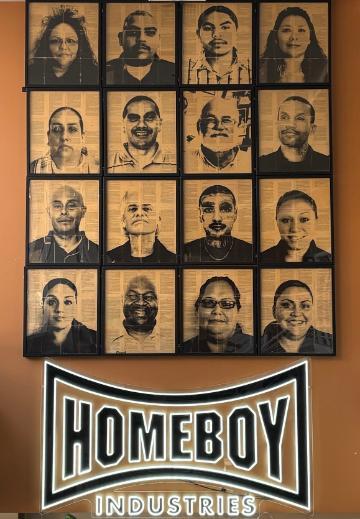
Sanaa Ahmed ‘26 articulated this tension with honesty and clarity, reflecting that “we were talking about the mission of the Catholic Worker as it relates to the Gospel, and these were not the same as my beliefs as a Muslim. I struggled with grasping the differences, but realized that I was not taking into account the many similarities we all have as human beings.” Discomfort does not necessarily signal disengagement or failure; sometimes it is simply the beginning of deeper listening, a reminder that shared humanity can exist even when the belief system differs.
The invitation to listen rather than retreat became clearer during our time with the Los Angeles Catholic Worker, a community rooted in hospitality, simplicity, and solidarity, whose members choose to open their hearts to those who are unhoused or marginalized and live alongside their neighbors in community rather than serve from a distance. Sharing breakfast with them and learning about their mission initially felt overwhelming, especially for those of us who do not strongly identify as religious, yet the space they created allowed for honesty, vulnerability, and reflection without judgement.
Rather than receiving answers, we were invited into reflection through conversations with Greg, a member of the Los Angeles Catholic Worker and David Decosse, a professor at Santa Clara University, who helped us slow down and name what was honestly stirring us. They encouraged us to release the pressure to feel a certain way or to perform empathy in response to what we were witnessing, and instead pay attention to what was actually present; the laughter, the discomfort, the guilt, and the uncertainty many of us carried. For some of us, that guilt came from finding joy while surrounded by hardship; for others, it emerged from not fully connecting with the faith-centered aspects of the immersion. Through that shared reflection, I began to understand that the immersion was not asking us to arrive with the “right” emotions, but to practice presence so that we can remain attentive to ourselves, others, and the community we are encountering. 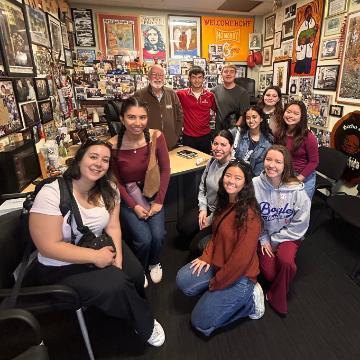
This understanding followed us to Homeboy Industries, where compassion took on tangible, lived form. Founded by Fr. Greg Boyle, SJ, Homeboy Industries provides accompaniment for people impacted by incarceration and gang involvement by offering housing, education, employment, and mental health support rooted in dignity rather than judgement. Listening to our tour guide as he shared his story of growing up without stability and of his ongoing journey toward healing was heavy and humbling. As his emotions surfaced freely, it reminded us that healing is rarely quiet or complete, but deeply human, unfinished, and rooted in the bravery it takes to speak pain aloud.
He reminded us to “always make sure to check in with your loved ones and friends, because you never know what they are going through.” His words remained with me long after we left, quietly reshaping how I understand what it means to care. In Boyle Heights, listening was not passive or incidental, it was love made visible through presence, patience, and the choice to remain.
Throughout the immersion, many of us wrestled with the tension between joy and grief, struggling to understand how laughter and connection could exist alongside such visible hardship. Katie Ngyuen ‘29 captured this complexity when she shared, “I didn’t expect to feel so heavy about feeling joy, like a little guilt,” a sentiment that resonated deeply with me. Boyle Heights taught me that joy is not denial of suffering, but a form of resistance, a reminder of why community matters in the first place.
This lesson surfaced again while volunteering at the Hippie Kitchen with the Catholic Workers, where tasks ranged from chopping vegetables and plating food to serving water and handing out Christmas cards. The most meaningful moments come through conversation; talking with people about the food they loved, sharing stories, and participating in a brief meditation together. Those moments quietly dismantled assumptions and reminded me that people are not defined by circumstance, but by their desire to be seen, heard, and respected. 
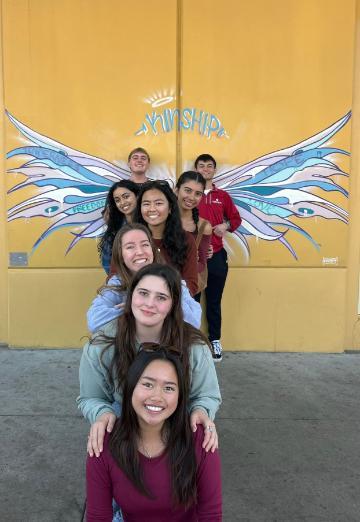
The immersion group itself became a community rooted in vulnerability and joy, shaped by late-night conversations, reflection circles, card games, loudly singing Christmas songs, and the simple act of choosing to show up for one another. Alicia Nelson ‘26 reflected that gathering together made her feel “really emotional and available to process just how much of an impact these communities had on me,” while James Byrum ‘26 shared that a conversation at the Catholic Worker house helped ground him during a season of uncertainty, reminding him how presence alone can be enough.
As we returned home, I carried with me a deeper understanding of what community truly means and what this immersion was quietly teaching us all along. Mateo Coulson ‘28 reflected that he is taking away “a strong sense of hope, optimism, and motivation” to serve marginalized communities with compassion and advocacy. Simone Smith ‘28 named a truth we encountered repeatedly in Boyle Heights, sharing that “without directly saying it, the community taught me that love for everyone is going to get us a lot further than only loving those that fall within our circle, or those who look like us. And it is truly the people that make a difference.”
Boyle Heights did not ask me to feel at ease or certain, it asked me to remain attentive, especially to the moments that brought joy, to the places that stirred discomfort, and to the questions that resisted easy answers. Through Ignatian reflection, I learned that transformation begins when we take these interior movements seriously, allowing them to shape how we listen and how we love. Community, I know, is not built through resolution or agreement, but with the choice to stay with one another, with discomfort, and with hope; trusting that presence itself can become a source of change.