Stories
The Imaginarium: A Leading Hub for Student Innovation in Virtual Reality
What began as a creative lab has become a pioneering Virtual Reality research center, where students design groundbreaking projects and have the opportunity to showcase their work on the international stage.
By Kate Vander Vort ’27
When the Imaginarium launched five years ago, no one could have predicted how profoundly it would shape students' experiences at Santa Clara University. What began as a simple multimedia lab quickly evolved into one of the most advanced Virtual Reality labs in the country, where diverse teams of students regularly collaborate to conceptualize, design, and launch innovative projects.
At the heart of this transformation is lab director and Assistant Professor of Communication, David C. Jeong, whose expertise in media psychology has shaped the Imaginarium into more than just a research facility—it has become a safe, inclusive, and dynamic space where students feel empowered to explore, innovate, and push the boundaries of VR technology. Jeong’s focus on fostering a culture of positivity and collaboration has turned the Imaginarium into a hub for both technological advancement and personal growth, allowing students to thrive academically while developing critical skills in teamwork, communication, and research.
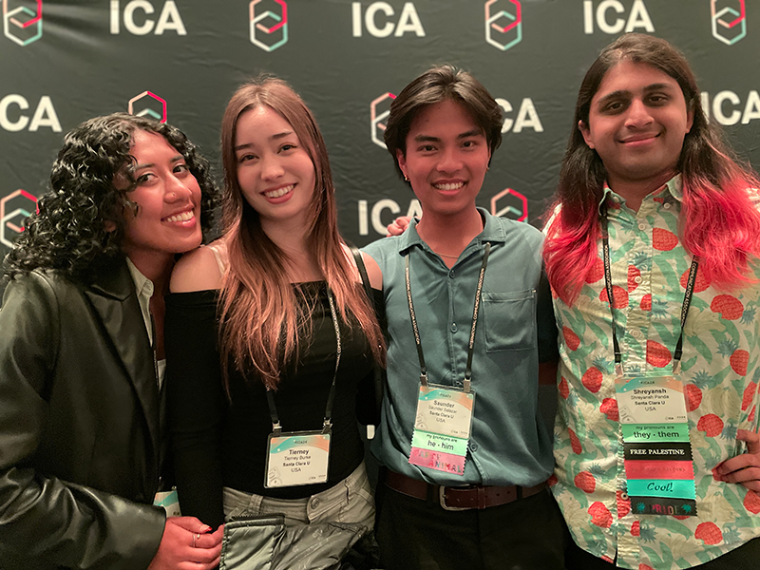
Last summer, the lab’s groundbreaking work received international recognition at the International Communications Association Conference in Australia’s Gold Coast, further solidifying its reputation as a leader in Virtual Reality research and student-driven innovation. While the conference typically features graduate students, academics, and Ph.D. students, thirteen SCU undergraduate students were invited to travel alongside Jeong to present papers written and researched within the Imaginarium.
"Every student that went was part of research, and they were co-authors on papers and presentations," Jeong shared. "We actually had five students present their work as first-authors, which is an incredible achievement given the competitiveness of this conference."
The conference, which boasts a highly selective acceptance rate, saw eight papers from the Imaginarium accepted for presentation. "This conference is not a common one for undergraduates to attend," Jeong explained. "Preparing them to be at the level of Ph.D. faculty and postdocs while also convincing the academic and university community that their work is meaningful and not just an undergraduate project, can be challenging." Despite that, one of the papers, co-authored by ten students, won a prestigious top paper award.
The award-winning paper focused on a body positivity yoga game where participants created avatars that reflected their self-image, helping the team explore the impact of virtual bodies on real-world self-esteem. "The team that designed the body positivity yoga game is one of our biggest teams in the lab, with over 20 students studying body dysmorphia and body positivity," Jeong said. "How do you design your avatar? Do you make it accurate or different from your real representation? That was one of the big research questions."
The students who attended the conference received positive feedback about their work and were able to build upon their public speaking, global engagement, and research skills. "Each session at the conference had anywhere from four to eight presentations, mostly from faculty and Ph.D. students," Jeong described. "And then there were our Santa Clara undergraduate students, stepping up to present their work alongside them. Watching them take ownership of their research in that setting was a proud moment." In fact, Jeong will get to witness it again later this year. Seven more papers with 20 student authors between them were accepted to present at the same conference in June, this time in Denver, Colorado.
Beyond providing a space for students to engage in research, faculty are incorporating the Imaginarium into their coursework, bridging theory and practice through hands-on learning. Classes such as Introduction to Two-Dimensional Animation in the Art and Art History Department, the Molecular Modeling Biology lab, and the Communication Department’s VR Design course utilize the lab’s cutting-edge technology, enabling students across disciplines to engage in immersive, experiential learning. Integrating the Imaginarium into courses such as these allows students to gain real-world skills while contributing to ongoing research and innovation in the interactive media space.
Looking ahead, Jeong has a clear vision for the Imaginarium’s future: he seeks to establish a dedicated academic program in interactive media and virtual reality studies. While students currently engage with the lab through various courses and research opportunities, there is no formal academic track that fully integrates these experiences into the curriculum. "Right now, we have over 50 students regularly involved in the Imaginarium, working across multiple research teams," Jeong noted. "But unless they are communication majors, there's very little I can do for them in terms of academic credit." Because of that, Jeong is actively working on developing a minor, which would not only enable more students to engage with the Imaginarium than the current format allows, but would provide an academic framework for them to plan, develop, and bring VR projects to life while earning academic credit.
Through his leadership, Jeong has transformed the Imaginarium into more than just a tech lab; it has become a community. His focus on creating a balance between academic rigor and a safe space where students feel cared for has set the Imaginarium apart. "A student once described it as a 'third space' — a place between home and school where they feel comfortable, challenged, and supported," Jeong said. "That sense of belonging, coupled with the academic rigor of what we do here, is what makes the Imaginarium special."