Author J.P. Lacrampe won’t take sides in the AI debate
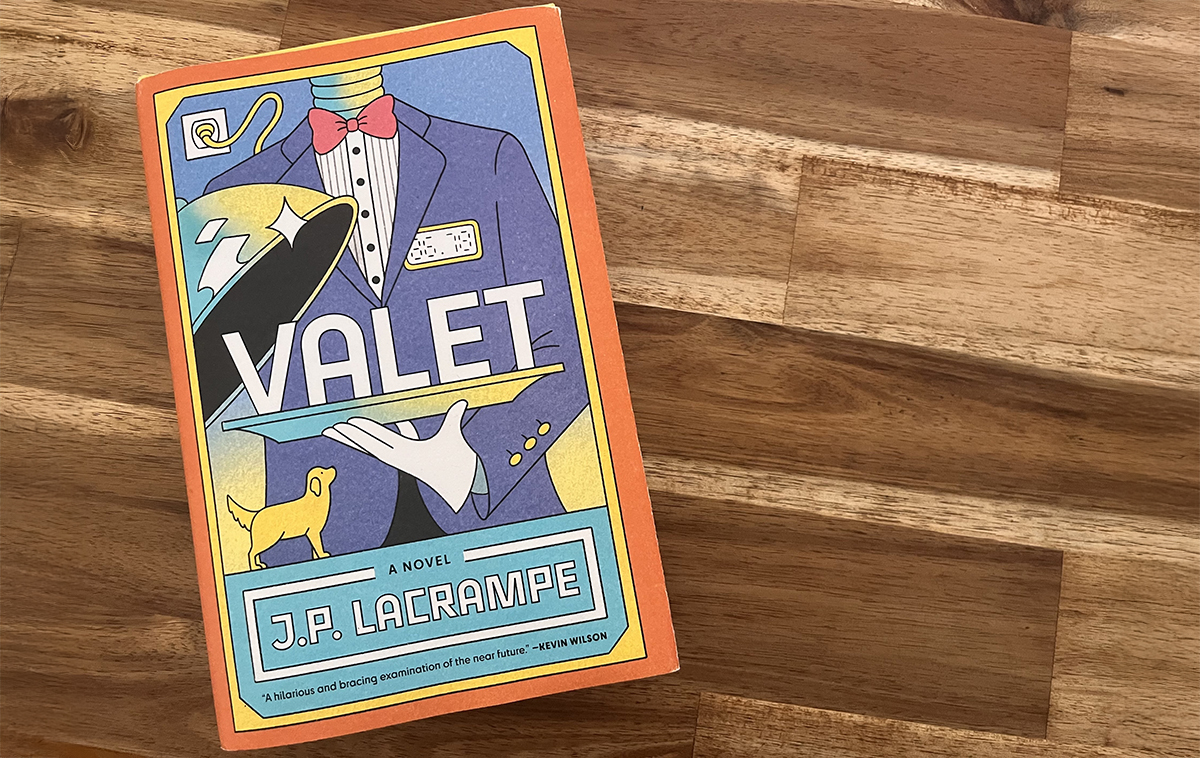
There’s a small scene in J.P. Lacrampe’s debut novel, “Valet,” about an android learning what it means to be human that strikes a chord for both its banality and depth. The narrator, a robot butler named Cy, is on a pier in San Francisco, watching the city’s famed sea lions wrestle and bark. Then he closes his eyes “to better hear them.” Just like a human turning off his car’s stereo to better concentrate on parallel parking. Robots: They’re just like us!
Like all art about technology, “Valet” is, at its core, about humanity. What is our purpose? How do we find meaning? What does it mean to be part of a family? But unlike so much of the current media landscape that paints the artificial intelligence revolution in dark, sinister tones, “Valet” poses those questions in a fun farce that’s more “Succession” meets “Idiocracy” than “Terminator.” It’s obvious Lacrampe is having a blast imagining a near-future San Francisco that’s entirely plausible if we were to allow cybertruck-driving tech bros to become city planners.
Lacrampe, a teaching professor in the Department of English, is not interested in adjudicating whether artificial intelligence is good or bad. At different times in “Valet,” he seems to be rooting against humans and for our eventual AI overlords, or vice versa. And he won’t pick a side now, either.
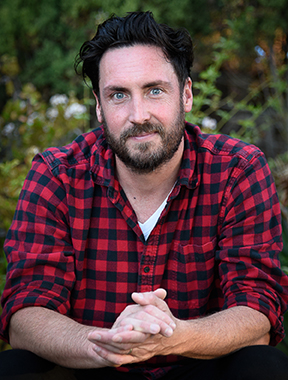
Technological progress is “going to happen. It’s going to transform our minds and therefore how we relate to the world and to each other,” Lacrampe says. “We should understand that we will lose stuff in somewhat equal measure to what we will gain.”
“Valet” is already garnering attention, landing on PEOPLE’s Best Books of June 2026 list. Lacrampe sat down with Santa Clara Magazine to discuss writing from the robot’s perspective, what happens when we prize utility and usefulness above all, and finding humanity in suffering.
First of all, how far in the future is “Valet” set?
I kept it purposely unclear. Because it’s a satire, ultimately whatever happens within the book, I want people to see reflections of the world as it is right now. I like to say the vague near future and just allow the audience to fill the timeline in for themselves.
The future San Francisco you illustrate is equal parts comical and slightly terrifying. What inspired that world-building?
I grew up in the East Bay and I love the greater Bay Area, but I have a real affinity for San Francisco. I lived in the city for 12 years. So I thought about what it would look like if corporations and really rational, calculating tech took over. If efficiency was prized above all else. I asked what would happen if all of the irrational parts and little quirks of a city were taken out. You’d lose things like graffiti, things that people do on a lark. In San Francisco there are so many beautiful murals. It doesn’t make financial sense to create them—they’re not advertisements—but they add to the charm.
Your narrator is Cy, a humanoid android tasked with caring for Grayson, the 35-year-old slacker son of Cy’s creator. What was it like to put yourself in the mind—or neural network—of a nonhuman?
Part of the idea for the book started from one of my past students’ research project pre-pandemic. The project was forecasting that AI would become so advanced, so human-like, that we would have to endow it with civic rights. That we’d have to treat it like it was human. And that was really fascinating to me.
I like that an android gives you some distance to describe the human experience and poke good-natured fun at it. What would we look like in the eyes of a hyper-rational ultra-computer that always knows the right thing to do? Like, the number of mistakes a human makes every day is incalculable. So what would somebody who has all the answers be thinking as they watch me flounder about in the world?
For much of the book, Cy is concerned with his Utility Score—a coveted software update is tied to maintaining a high score, and he starts malfunctioning if the score drops too low. His sense of self-worth is tied to his being useful. Why did you make utility a robot’s North Star?
The Utility Score is what keeps androids tethered to humans and makes them seem safer to us. Because pleasing the humans around them by being useful is what motivates robots. I wanted Cy to be obsessed with that number going up or down. And those sorts of carrots and incentives are at play, I think, in all of our lives. Like, for example, review sites have aggregate scores of how readers are liking my book. It’s completely out of my control, and it doesn’t or shouldn’t determine how I feel about the book or the pride I have in my work, and yet I’m just on the sites clicking reload all the time. Quantifying our worth in that way can make us obsessive. I think that is a very human thing, that when we feel like we’re falling in some invisible ranking, it can be debilitating and we can get very erratic and act strangely.
“Valet” is very funny but so much of the digitization and optimization in the book is legitimately scary. Real food has been swapped for 3D-printed imitation meals, journalists are low-level robots only concerned with getting “both sides” quotes, and colleges have shut down because it’s more efficient to do everything online. Are you worried about what might happen to the human ecosystem if tech becomes too useful?
I’m a huge Neil Postman fan. What I always appreciated about Postman was that he wasn’t looking at individual technological shifts and advancements but rather how is it going to change what we think is possible within the world, how we see the world, how we act within it? I have no technological background or expertise. Zero. I don’t know how my toaster works. So I can’t offer any plausible or credible warnings about the tech. But I can say that I think it’s going to change how we view the world, how we view each other, how we view our sense of purpose. If machines can outperform humans in every possible way, that is clearly going to make its mark on the human experience. And probably not in a positive way. So yes, those are things I’m very worried about.
On the other hand, many of the humans we meet in the book aren’t great. They’re either engineers creating the tech and the ruthless CEOs peddling it, luddites who reject it, or listless slobs.
Well, you need very flawed characters for a work of fiction to operate properly. You need them to not be able to get what they want and their flaws are usually the best indicator of why they can’t achieve it. But also I just love flaws. That’s what makes humanity really beautiful, it’s our capacity to redeem and grow.
Perhaps a minor spoiler, but Cy and Grayson team up to keep dangerous software out of the wrong hands. The tech in question would allow robots to suffer as humans do and therefore assume self-control. What is it about suffering that you think is so central to the human experience?
I was playing with the connection between suffering and preference and awareness. The idea that if you were aware of your pain or suffering, that would become your primary motivation—to avoid it. So for robots, rather than focusing on their Utility Score, they’d all of a sudden have a more pressing need that would supersede any controls they were bound to. Again, that felt like a really human thing.

The Department of English is the center for reading and writing at Santa Clara. Working alongside best-selling authors, ground-breaking scholars, and award-winning teachers, you’ll analyze and interpret through different lenses like race, gender, sexuality, and more. You'll go beyond the page, learning from experience through community-based coursework, internships, and independent research.
Learn more about the English major at Santa Clara University