Can engineering help build a more accessible world?
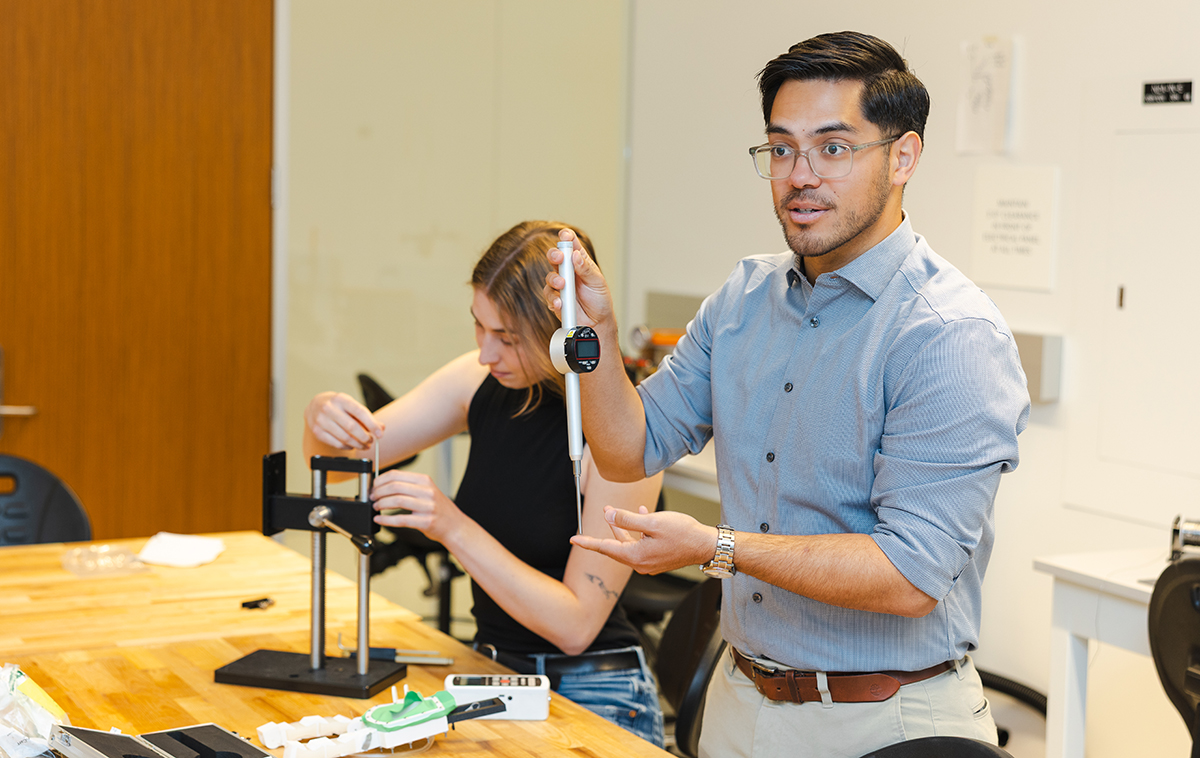
Michael Abbott is an assistant professor in the Department of Mechanical Engineering at Santa Clara University, where he leads the Design for Assistive Robotic Technologies (DART) Laboratory. His research sits at the intersection of robotics, haptics, and biomechanics, focusing on developing novel assistive technologies that address problems in healthcare and mobility.
What question or challenge is at the heart of your current work?
My work is focused on how we can apply engineering principles and emerging technologies to improve the quality of life for people with disabilities or motor impairments. Our goal is to enhance function, independence, and access to meaningful activities through thoughtful, human-centered design.
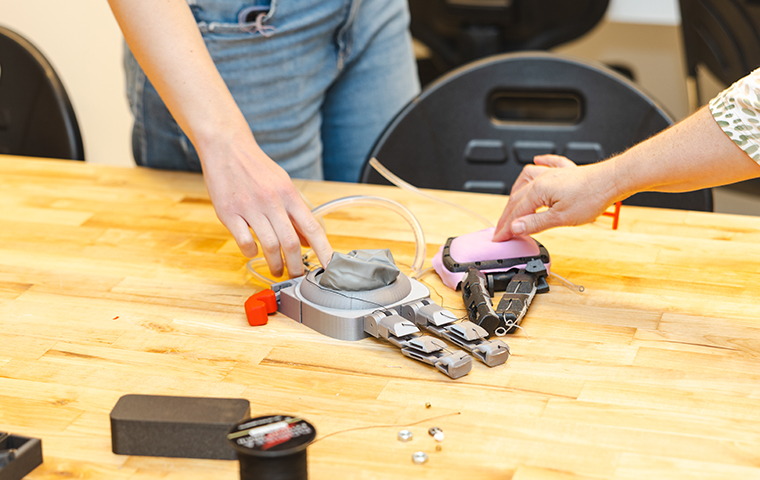
One ongoing project, developed with a team of undergraduates, focuses on creating a low-cost prosthetic arm using soft robotics and mechanical jamming techniques. These use a flexible, grain-filled chamber that starts flexible and then hardens under vacuum pressure to lock in place. This adaptability allows the device to conform to object shapes, augment grasp forces, and perform actions that traditional rigid prosthetics struggle to handle, such as picking up a credit card from a flat surface.
In collaboration with San Francisco State University, we’re also developing a biofeedback virtual reality platform to build emotional regulation and stress management skills. By pairing immersive scenarios with wearable biosensors and haptic feedback, the system provides real-time cues on stress and emotion, enabling users to adjust their responses and build confidence in a safe, simulated environment.
Finally, we’re designing adaptive remote rehabilitation tools that integrate intelligent sensing and data tracking to improve at-home recovery. These devices automatically adjust difficulty as patients progress and provide clinicians with detailed performance data, improving adherence, insight, and outcomes over time.
Why is this issue important for the world to address now?
This issue is increasingly urgent because the need for assistive and rehabilitative technologies is outpacing our healthcare system's capacity to support them. As populations age and chronic conditions become more common, we face a widening gap between patients’ needs and the availability of clinicians. At the same time, innovations in 3D printing, soft robotics, and artificial intelligence have made it possible to create adaptive, affordable, and personalized solutions that were unimaginable a decade ago. These innovations allow devices to be custom-fit, more comfortable, and responsive to individual users, bringing us closer to true precision rehabilitation. Building on centuries of dedicated progress, we are living in an era where technological advancements are meaningfully expanding human autonomy. The possibilities ahead have never been more exciting.
Why have you chosen to dedicate your career to this research?
I’ve always been a tinkerer. As a child, I built wooden toys with my dad and constructed all sorts of LEGO® creations, so engineering was a natural fit. Over time, it has become a powerful tool for identifying and helping solve problems in our communities. During my first internship at a medical device manufacturing company, I realized that what we build in the lab can have a direct, positive impact on people’s lives. Seeing that connection between technology and health really stuck with me and has driven me to help bridge the gap between emerging technologies and the standard of care for people with physical disabilities.
How have your students impacted your research?
Working with undergraduates has been a constant source of creativity and energy. They bring fresh ideas drawn from their own experiences and help me understand the challenges they face, which has directly inspired projects like the biofeedback system for emotional regulation. They’ve also introduced me to new ways people engage with engineering, such as through short-form content on platforms like TikTok. This has provided new ideas for prototyping and insight into the lived experiences of those we aim to help. Their curiosity and willingness to think beyond how things are “supposed” to be done bring a freedom and creativity that continually push my work in new directions.
What is a book in your field that you think everyone should read?
One book I think everyone should read is “The Design of Everyday Things” by Don Norman. It’s a foundational text in design that introduces the concept of affordances, showing that an object's form suggests its function, and emphasizes the importance of user-centered design. The book explores why some objects feel intuitive while others are frustrating, like doors that seem to invite you to pull when you should push, or handles that mislead you about their function. It also shows how design can guide or influence behavior, intentionally or unintentionally, a phenomenon that is especially relevant today, as digital interfaces and applications are engineered to capture attention or steer actions. Understanding these principles helps designers create systems that are more usable, accessible, and aligned with human expectations.
Another favorite is “The Hitchhiker’s Guide to the Galaxy” by Douglas Adams. It’s absurd, funny, and full of imaginative scenarios. There’s a depressed robot, doors with personalities … It reminds me that technology can be playful, creative, and even a little silly. It encourages me to think beyond conventional solutions, to inject creativity and whimsy into problem-solving, and to remember that even as AI and machine learning grow, we should approach innovation with both curiosity and care.

Mechanical Engineering applies the fields of physics, mathematics, and materials science to the design and realization of mechanical and thermal systems. For more than a century, mechanical engineers have played a central role in creating the infrastructure of modern society while addressing the emerging interdisciplinary challenges of tomorrow.