‘I wanted systemic transformation.’ Santa Clara University’s director of bioethics is on a quest to put care back into health care.
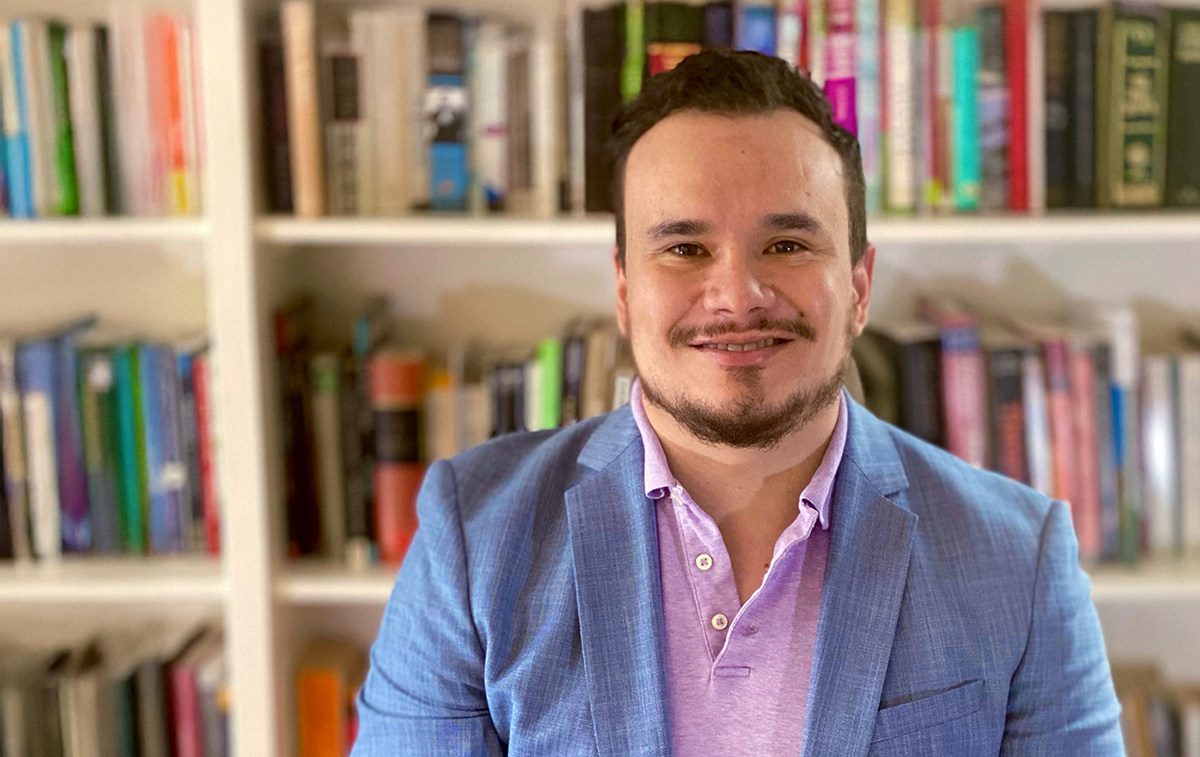
Guadalupe Hayes-Mota died for a short time when he was 12 years old. He’d been taken to the local hospital in his home state of Zacatecas in central Mexico with severe abdominal pain. The rural hospital did not have the necessary medication to address Hayes-Mota’s severe hemophilia, a rare clotting disorder in which even small injuries can lead to life-threatening internal bleeding. But his appendix had burst and the doctor made a split-second decision to go through with emergency surgery despite being ill-equipped to deal with his hemophilia and hope for the best.
Hayes-Mota’s heart stopped beating on that operating table but the doctors were ultimately able to revive him. He was transported to another hospital in a city eight hours away that had access to the required drugs—a medicine known as Factor VIII that contains blood coagulation protein to prevent bleeding in people with hemophilia. After more surgeries and six months spent recovering in a hospital bed, Hayes-Mota’s parents decided to immigrate to the United States in search of better care for their son.
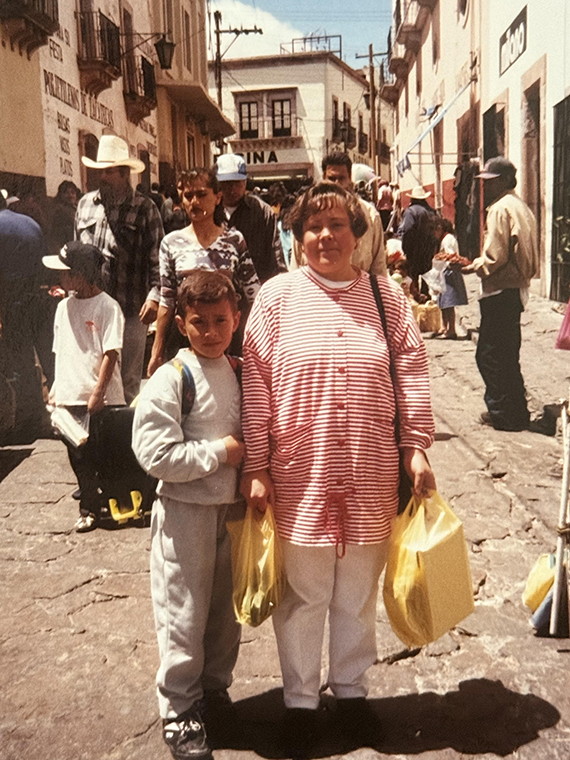
Guadalupe Hayes-Mota and his mother Martina Mota in the streets of Zacatecas.
Looking back today, Hayes-Mota views this as the starting point to his career in bioethics.
He went from an isolated childhood spent indoors and in fear of getting hurt to an adolescence navigating a foreign medical system in a foreign country. It was a difficult several years, Hayes-Mota says, but all of it shaped his mission to make health care work for more humans. “From those experiences, I have deep insight into immigrant and rural health care, what it means to be in vulnerable positions and not have access to necessary services,” he says. “It established my own personal ethics, about how I see health care and what I think health care should be.”
As the new director of bioethics at Santa Clara University’s Markkula Center for Applied Ethics, Hayes-Mota says he’s in a unique position to help others, from students to big companies, shape their own ethical frameworks around a health care system that so often falls short in its promise to actually care. As director of the bioethics program, he leads the Health Care Ethics Internship program and advances work at the intersection of artificial intelligence, biotechnology, and health equity through teaching, public speaking, writing, and consulting.
“Working here felt like a calling to me,” he says. Santa Clara’s “Jesuit mission and focus on social justice spoke to me.”
Growth and growing up
At 13, Hayes-Mota moved with his parents and older sister to Phelan, an unincorporated, predominantly white community in California’s Mojave Desert where an uncle helped his father find work. “It was difficult, a culture shock,” Hayes-Mota says of arriving in a town that reflected its harsh, unwelcoming surroundings. No one in his family spoke English. “We were fish out of water and experienced a lot of discrimination. But we were just focused on surviving.”
Head-down, one foot in front of the other, not ever directly addressing the trauma. That’s how Hayes-Mota describes the way his family soldiered through their first year adapting to a new home. “We weren’t thinking about thriving, just how to make it to the next day,” he says. “I think I’m just now unpacking what we went through, 20 years later. I don’t know if [my parents] ever will. But they’re really strong people.”
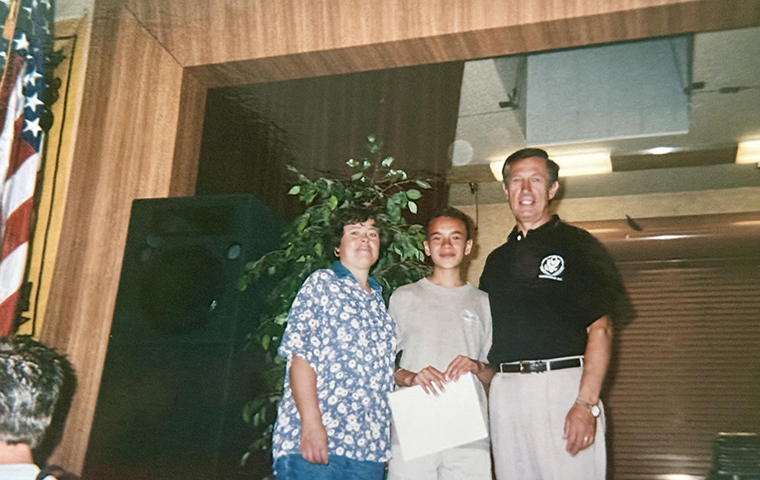
Eighth grader Guadalupe Hayes-Mota (middle) receiving the Student of the Year award at Mesa Middle School (Phelan, CA) in 2000.
From their new home in the United States, Hayes-Mota’s parents located a hematologist an hour and a half away—much closer than the several-hour trip required in Mexico—where he could get critical, consistent access to the medicine necessary to treat his hemophilia. “That changed my life completely. My risk of bleeding out from a minor injury decreased by a lot,” he says. “Not completely, of course. It’s always on the backburner. To this day, I still have to be careful.”
In high school, Hayes-Mota says he focused on “getting out of Phelan.” College wasn’t something most of his peers were interested in, nor did his parents—who had a fifth-grade education—know how to help him navigate the application process. A few dedicated teachers encouraged him to take outside advanced placement courses and apply for scholarships. His senior year, he won a full-ride Gates Foundation scholarship to the school of his choice. He chose the Massachusetts Institute of Technology (MIT). “I visited and it felt like coming home,” he recalls.
“I thought I’d study science or engineering. Maybe go to medical school,” Hayes-Mota says. “I think I wanted to give back to the world somehow. Subconsciously, I was wondering, ‘Why am I alive?’ Coming back from the dead at 12 meant ‘I should be someone.’”
Though Hayes-Mota was accepted to medical school after college, he ultimately decided not to go, figuring he’d focus instead on the administrative side of health care, running clinics and hospitals. He worked for a spell in administration at UCLA Health, which at the time was one of the most extensive free health care systems in the United States, serving the poor, or undocumented, or immigrant communities. “I saw a lot of my own community there,” Hayes-Mota says. Then, he worked for the RAND Corporation, a non-profit think tank focused on improving policy for public welfare, during the implementation of the Affordable Care Act.
“I realized I didn’t want to work in the delivery of care for individual patients,” Hayes-Mota says. “I wanted systemic transformation.”
Getting ethical
Yearning to facilitate change on a wider level, Hayes-Mota went back to MIT to earn two master’s degrees—in business administration and in artificial intelligence engineering systems. (He also earned a third master’s, in public administration, from Harvard.) He went on to hold executive roles in supply chain management at pharma companies like Biogen, Amgen, and GSK, overseeing complex operations that delivered life-saving medicines to patients around the globe. As someone who knows first-hand how important it is to have continuous access to crucial drugs, Hayes-Mota found a lot of meaning in this work. “I loved it. It was a combination of producing a tangible product that patients need and it made a global impact,” he says. “I was making sure patients got medicine they couldn’t get before.”
But in this work, Hayes-Mota saw a “huge problem” in the communication between different location points in supply chain networks, or lack thereof. “They weren’t connected well, they weren’t working together, so what ended up happening is drug stock would run out and patients would go without needed medicine,” he says. So he developed technology that connected all points on a supply chain—from suppliers to manufacturers to distribution centers to transportation hubs—in order to “flow well.”
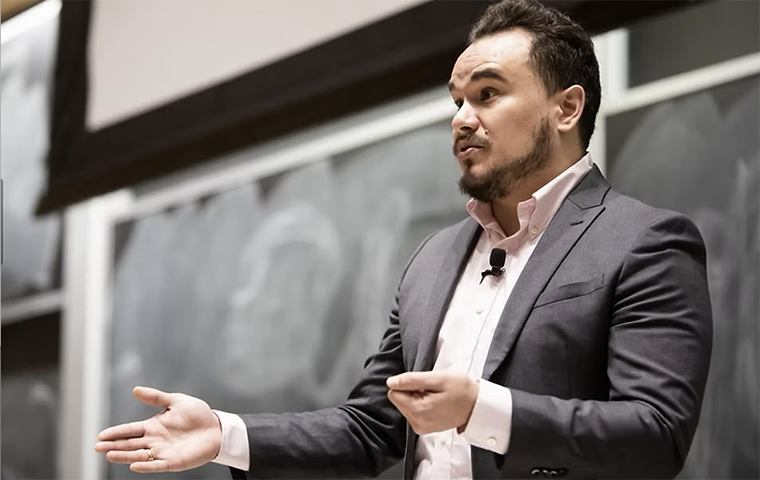
Guadalupe Hayes-Mota served as a lecturer in biopharmaceutical ethics at MIT.
In 2019, he founded Healr Solutions, an AI-powered company aimed at optimizing global drug distribution and manufacturing. It used blockchain to capture real-time data across the pharmaceutical supply chain, connecting what medicines were available with where they were needed. As CEO, he led the company to scale across 43 countries before it was acquired by investors in mid 2024. Around the same time, Hayes-Mota served as a lecturer in biopharmaceutical ethics at MIT where he taught students how to navigate the ethical complexities of drug development and access.
After selling Healr, Hayes-Mota’s husband, Nicholas Hayes-Mota, accepted an assistant professor job in religious studies at Santa Clara. The couple moved to Silicon Valley and Hayes-Mota debated starting another tech company. After all, he’d just relocated to the epicenter of innovation. Instead, he decided to continue focusing on the ethics.
As director of bioethics at Santa Clara, Hayes-Mota helps students through teaching and mentorship as they explore careers and ethics in biotech and health care. His job is also external facing, helping health care and technology companies—through consulting, keynote presentations, media appearances, and publishing articles—to ask themselves the hard ethical questions and develop frameworks to answer them.
“I’ve lived and breathed health care at so many different levels—I saw needs as a patient, a policymaker, a business professional, and also as a technologist,” Hayes-Mota says. “Not everyone has the ability to see the big picture because they haven’t had to look through all those different lenses. But I have.”
The AI of it all
Hayes-Mota is most interested in identifying and developing ethical frameworks around incorporating artificial intelligence into health care—an industry he sees as “human-centered yet ironically disconnected.”
“Often, ethics stay with the practitioner, the doctor,” he says. An individual doctor may show great care for individual patients. But that’s a small net, cast on a case-by-case basis. Ethics do not usually extend past the exam room. “Not with insurance, not systems, not tech, or policy.”
AI could assist with that. “We talk a lot about the perils of AI, but it’s already done amazing things,” he says, such as earlier breast cancer diagnoses and increased access to care in rural areas.
Hayes-Mota contends that AI is, on the whole, a boon to a flailing healthcare system because he is confident it won’t replace the need for competent, caring doctors. “There are important things the doctor does that AI can’t, such as empathy, understanding, and listening,” he says. “Those components of humanity that cannot be replicated by AI and cannot be substituted.”
What’s cause for concern is when tech companies attempt to supersede this human touch with AI, such as chatbots offering “help” to users struggling with mental health issues. These bots can introduce biases, lack effectiveness, affirm harmful or misguided thinking, and contribute to harmful stigma. This is why, Hayes-Mota says, “there have to be some ethical guardrails and structures and principles developed in order to address these kinds of issues.”
Hayes-Mota developed what he calls the CARES Framework for companies developing AI health care tools to do so ethically and responsibly. It outlines principles such as clinical accuracy, responsibility, human oversight, and social accountability. “We have to have actual humans be responsible at the end of the day. A human has to intervene in situations [such as asking chatbots for serious mental health help] and act as a guardrail,” he says. “Companies have to acknowledge the limitations of their technologies.”
Santa Clara feels like the right place for Hayes-Mota to assist in leading responsible AI development. “Specifically, when thinking about health care and technology, I do feel like Santa Clara can be described almost as the soul of Silicon Valley. We’re grounded in these very strong values of social justice and people for others, which positions us to really think about the ethics of it all and how we design and create tech that is actually beneficial for society,” he says. “It felt like a calling for me to be here, to help develop the next generation of ethical leaders.”

The mission of the Markkula Center for Applied Ethics is to empower people and organizations to make better decisions for a more caring world. Our comprehensive approach engages our community through materials offered on our website and customized events with organizations.