It’s about understanding where the pieces connect
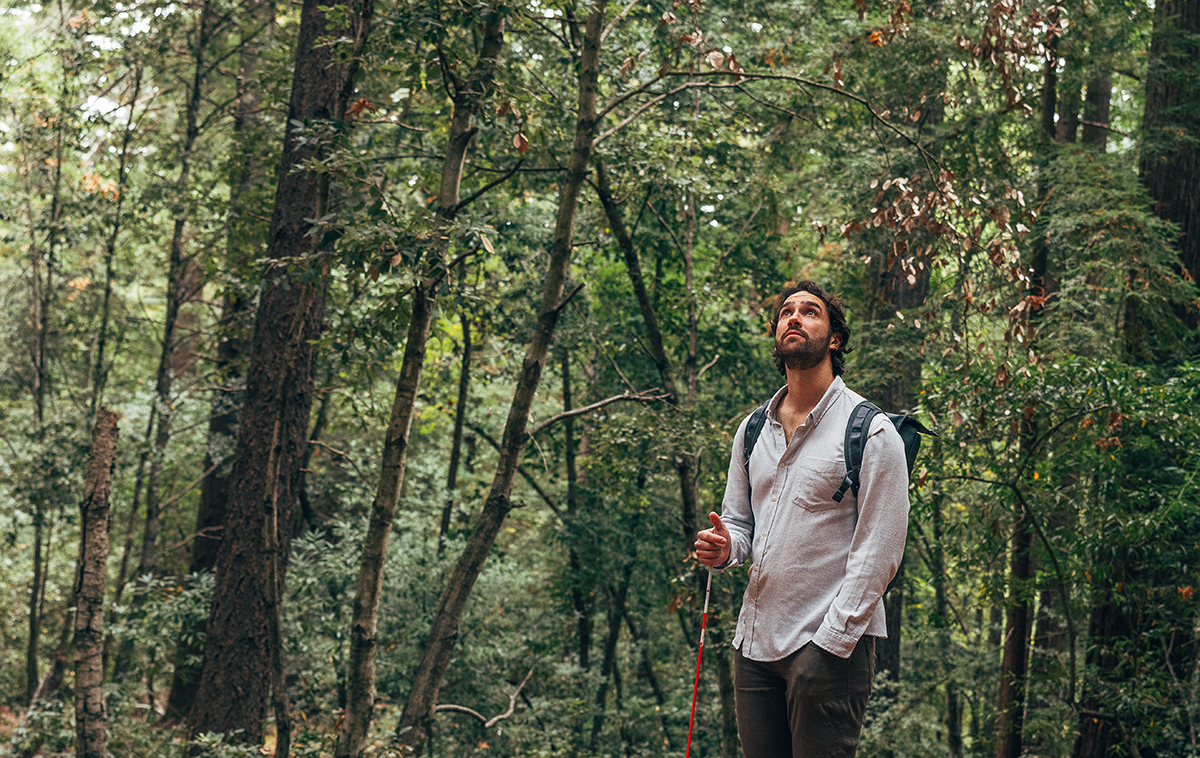
Santa Clara helped me find my purpose. It helped me find a path from college to a Rhodes Scholarship at Oxford to the work that I’m doing now as a wildlife hazard remote sensing researcher at UC Berkeley.
I was lucky very early on at Santa Clara in that I connected with the honors program and Leilani Miller. California’s wildfire crisis is complicated. At Santa Clara, I learned how to make scientific models and use data to solve big challenges. But I also learned how to ask better questions and to talk to firefighters, land managers, scientists, and neighbors to find where my skills can help.
In high school, I knew I was interested in the environment—I grew up in the Santa Cruz Mountains surrounded by redwoods—but I didn’t really know what that meant for my life. Santa Clara took this vague notion and helped me figure out what my talents were. The faculty helped me get small internal grants and then chart a path. They gave me goals to shoot for, which led to a Fulbright in Australia and then a Ph.D. in geography and the environment at Oxford.
A lot of forestry work historically has been done using plot-based measures, where researchers are physically on the ground measuring something. My work uses remote sensing technologies, such as airborne lidar, satellite data, or drone imagery, to measure the same physical parameters but with computer modeling and on larger spatial scales, which are the scales where fire operates and where fire behavior is determined.
My goal is to be able to feed this fire prevention modeling back to land managers and homeowners—all the people who are on the front lines of wildfires. That’s where we can create something different. It’s not just about creating good science. It’s about understanding where the pieces connect, so we can get traction in getting fire management done.

The Department of Environmental Studies and Sciences provide students with the foundation to address crucial environmental challenges of the 21st century such as population growth, urban sprawl, deforestation, climate change, waste disposal, air and water pollution, loss of biodiversity, and the need for renewable energy.
Learn more about environmental studies and sciences at Santa Clara University