Jesuit School of Theology’s Léocadie Lushombo tapped for Pope Leo XIV’s encyclical on artificial intelligence
Recently, the Vatican announced that not only would Pope Leo XIV take the unusual step of attending the May 25 Vatican press conference to reveal and explain his highly anticipated teaching document, the encyclical Magnifica Humanitas, but he also invited six guests to join him.
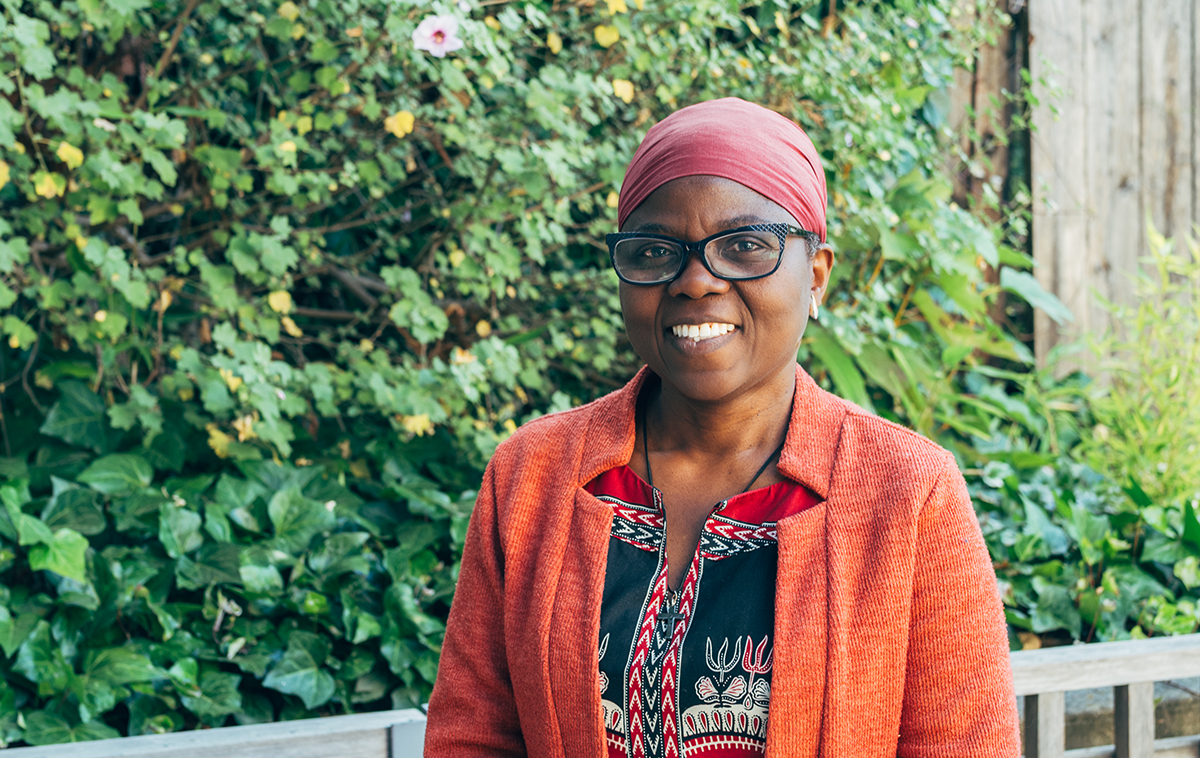
One of those who took the stage with him was Léocadie Lushombo, who for the past five years has been a professor of theological ethics at the Jesuit School of Theology of Santa Clara University. Since an early age, Lushombo has been a member of the Teresian Association, a Christian group devoted to protecting the most vulnerable. She spent 12 years conducting hands-on work for NGOs in Central Africa and Latin America, and has spent the past 12 years as a moral theologian, focusing on the poorest and most vulnerable.
Along the way, she earned degrees that would form the intersectional nature of her work, including master’s degrees in development, economics, peace and justice, as well as a theology degree, and a Ph.D. And she did all this while living on almost every continent and learning to speak seven languages.
The Unveiling in Rome
The others who joined Pope Leo in Rome were three influential cardinals, a co-founder of the AI company Anthropic, and Anna Rowlands, one of the only lay theologians invited as an expert consultant to the recent Synod on Synodality.
During the press conference at 11:30 a.m. in Rome, Lushombo shared her analysis of several “cautions” offered by Pope Leo in his encyclical. They included:
- Maintaining intellectual agency and not “offloading” personal responsibility for finding truth onto machines. “If we afford our judgment onto machine then we will no longer strive to know the whole, and will consign ourself to mere recognition of partial aspect,” she said.
- Maintaining “internal freedom” when digital products aim to exploit vulnerabilities or capture ever more of a person’s attention. Pope Leo argues that internal freedom requires adopting “attitude such as silence, deep study, reading and careful analysis,” she said.
- A warning against “data colonialism.” She quoted Pope Leo in saying “even today, colonialism assumes new forms. It no longer dominate only bodies but appropriate data, transforming personal lives into exploitable information.” She added that “the speed of AI extinguishes the desire to ask questions” and that Pope Leo warns that “knowing” is more than accumulating data, but includes the ability to engage in four basic human cognitive activities identified by the Canadian Jesuit philosopher Bernard Lonergan, S.J.: experiencing, understanding, judging, and deciding.
Drawing upon her international perspective, Lushombo shared numerous examples of global indigenous and communal philosophies that emphasize interconnectedness, including the African Ubuntu concept of "I am because I belong;” the Korean concept of “Jeong” or “we” over individual success; and the values in Indonesia, Malaysia, or the Philippines, that communities share burdens and provide mutual support.
“AI can lead people to treat learning as an artificial isolated transactional process, rather than a communal dialogical one,” she said. “So there is therefore a danger that those cultures that understand learning as a matter of relationship, community and dialogue will be eroded.”
She ended by focusing on Pope Leo’s cautions against the exploitation of the poor and of vulnerable workers, including children and adolescents working in dangerous conditions to unearth minerals used in technology, and the worsening impact of AI on those seeking jobs, especially in developing countries. "The ethical obligation to shatter these oppressive chains and defend the rights of vulnerable workers rests with us all," she said, and is "fundamental to the common good."
A Lifetime Dedicated to Hearing the Cries of the Unheard
To her colleagues and those who know her best, it is unsurprising that Pope Leo would choose Lushombo to help frame a historic teaching document focused on human dignity and the need to curtail technology’s worst impacts on the vulnerable and the earth.
The encyclical includes “all the ways AI is going to be impacting humanity—from the use of AI in warfare, to the widening of the wealth-poor gap, polarization, and the widespread disenfranchisement of large groups of people,” said Elyse Raby, assistant professor of religious studies at Santa Clara. “Much of this is central to Dr. Lushombo’s scholarship, especially as it pertains to women in Africa.”
“It’s a huge honor” for Lushombo, said Julie Hanlon Rubio, the Shea-Huesman Professor of Christian Social Ethics at JST-SCU, who was on the team that hired Lushombo and was immensely impressed with her.
“My sense is that her importance will continue to grow, because of her background, her training, her talent, and because of her language and cultural fluency,” added Rubio. “That mix of abilities is just very rare and very valuable, and it makes her an extremely important commentator on anything the Vatican is putting out.”
A Global, Multicultural Perspective
Born in the Democratic Republic of the Congo (DRC), Lushombo’s scholarship centers on the ethical and theological dimensions of Christian life, especially in global and African contexts. She joined the Teresian Association, a group devoted to putting “faith into practice and to contribute to human flourishing and social transformation by means of education and culture,” starting when she was 20 years old.
Early on as a Teresian, Lushombo worked at non-governmental organizations (NGOs) in the Democratic Republic of the Congo, the Great Lakes Region of Central Africa, and in Latin America—where she dedicated herself to the mission of the group and serving vulnerable populations. That work entailed serving as a researcher and consultant-trainer on justice, peace, and gender issues.
In addition to developing operational, strategic, and diagnostic plans for numerous NGOs, she worked on projects for primary and secondary education accessibility in the DRC capital, Kinshasa; social housing advocacy in Lima, Peru, and Marrakech, Morocco; evaluating the harms of mineral resource extraction in the DRC; empowering local justice and peace commissions in DRC; and creating effective analysis tools to increase women’s political rights and participation in the DRC. She also worked on “linking and learning” programs that connected local community advocates in DRC and Lima, Peru.
Her interest in theology began when her Teresian community in the Congo was visited by Mary Frolich, RSCJ, who was teaching theology at the Catholic Theological Union in Chicago. Lushombo and Frolich became fast friends and enjoyed being together and practicing their respective languages, French and English. Eventually, Frolich encouraged Lushombo to pursue a degree in theology and to join her at the Catholic Theological Union in Chicago. What started as a gentle nudge from a friend led Lushombo to a thriving career as a Catholic moral theologian.
Of course, Lushombo’s work as a theologian has been heavily shaped by her background in the non-profit sector. In the classroom, she brings in real-life speakers with multicultural and intercultural perspectives, and raises issues of theological importance, including clinical pastoral care related to end of life, and the plight of farmworkers, refugees, and immigrants.
A Voice in the Vatican
This past spring, she was appointed by Pope Leo XIV to be a member of the Dicastery for Promoting Integral Human Development, which was formed “to express the Church’s solicitude in the fields of justice, peace, the safeguarding of all of Creation, as well as in those that concern health and works of charity.”
Before that, in spring 2024, she was appointed by the Vatican Secretariat of the Synod of Bishops to be a member of a key study group tasked with addressing topics raised by the Synod on Synodality: hearing the cry of the poor and the earth. In March, the group issued a report, “To hear the cry of the poor and the earth.”
Part of what likely drew Pope Leo to call upon Lushombo, her peers say, is the vast scope, depth, and quantity of her writings. Her work explores topics including globalization, ecological sustainability and conservation, rape as a weapon of war, and other critical issues affecting women, and theological foundations for political participation.
“She has expertise in a wide range of ethical issues, including economics, social ethics, environmental ethics, peacebuilding, gender,” said Rubio. “It’s really amazing, that kind of range. So when she is looking at something new, like AI—which very few ethicists are experts on today—she will bring all of that expertise as well as her experience as an African theologian, somebody educated in the U.S, Africa, and Spain, and speaks an amazing number of languages—she will bring all of that to what Pope Leo has written.”
“She has long taken an interest in respect-for-life issues,” added Eduardo Fernandez, S.J., professor of pastoral theology and ministry at JST-SCU. “She is living the call of Vatican II to open the Church’s windows and listen, to be involved in the modern world and be part of the solution.”
A Much-Needed Moral Voice
As AI claims much of the world’s imagination, finances, environmental resources, and economic value, there has been a glaring vacuum in moral leadership about its impact on those whose lives will be drastically altered by AI—and whose voices and fears are not being taken into consideration.
Many people are hoping Pope Leo XIV and his first encyclical will provide that moral leadership, with assistance from theologians like Lushombo.
“At a time when new questions are emerging about human dignity and the condition of the most vulnerable in our society, Professor Lushombo brings her theological scholarship to advance the Church’s mission of promoting the flourishing of all human beings in the name of the Gospel,” said Agbonkhianmeghe Orobator, S.J., dean of JST-SCU. “Her commitment and creativity as a teacher and scholar with a global reach have brought her to this moment. She is an important voice for the Church and the world.”

Located in Berkeley, California, the Jesuit School of Theology is an international center for the study of theology, faithful to the intellectual tradition of the Society of Jesus. JST provides students the opportunity to faithfully and critically engage the 2,000 year tradition of Christianity through approaches grounded in the 21st century, the Church’s global context, and our Jesuit identity.