What history can teach us about the future of the global economy
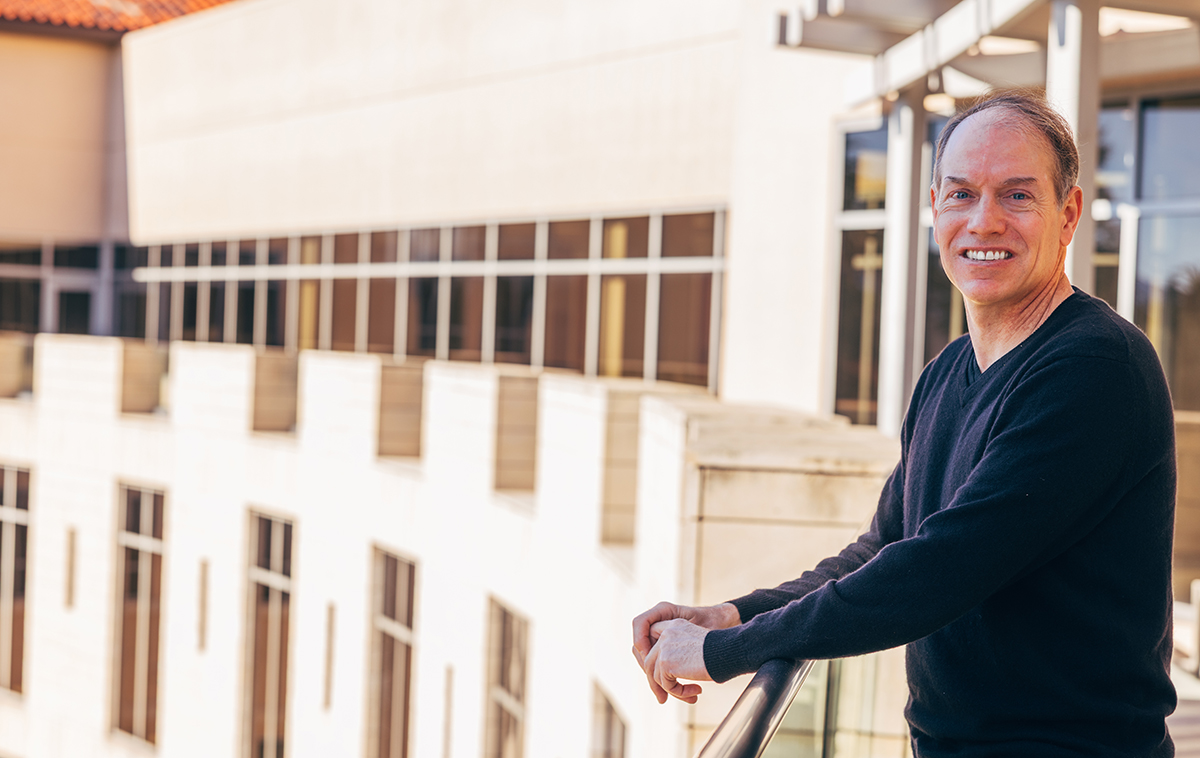
Kris Mitchener is the Robert and Susan Finocchio Professor of Economics at Santa Clara University. His published articles and books have advanced understanding of things like how costly trade wars harm all participants; why some countries that borrow to expand their economies thrive and others fail; and how financial crises impact the availability of affordable loans and monetary policy. As an economist, he is fascinated with how pivotal moments in history, such as the Meiji Restoration in Japan, the U.S. Civil War, and the Great Depression, shape our institutions and economy.
This interview series invites Santa Clara faculty members to reflect on the questions, motivations, and impact that guide their work as educators and researchers.
What questions or challenges are at the heart of your current work?
My current research explores three central issues that are important to our economy: trade policy, the stability of our financial system, and the sustainability of public finance.
In trade policy, I’ve recently been thinking about the effects of large changes in tariffs, such as the new tariff regimes from the Trump Administration in April 2025. What are the effects of trade wars on combatants or participants in them?
Looking at the largest trade war in history, the infamous 1930 Smoot-Hawley Tariff Act, it started with the narrow aim of helping distressed farmers, but then mushroomed into a wholesale rewriting of the U.S. tariff code. It caused many countries to design retaliatory tariffs that hit U.S. products particularly hard, like automobiles. Were there winners? The short answer is no. Trade flows fell for all the combatants, both the U.S. and its trade partners.
In March 2025, I wrote an op-ed to that effect and spent a lot of time doing press interviews and talking to policymakers around the globe. I hope it helped convince many countries that retaliating wasn’t necessarily productive. Thus far, we’ve actually seen limited retaliation, and where we have, it de-escalated in most cases.
Now, I’m working on how tariffs affect prices. Because the new tariff regime is not yet fully known, our best answers still reside in the past, so we return to the last time we had permanent large increases in tariffs, the 1930s, and find that after the first few months, the entire price increase due to tariffs was borne by domestic firms and households. Foreign producers did not absorb the hit.
A second research area examines factors affecting the stability of our financial system.
Cataclysmic events like the financial crisis of 2007-2008, or even more locally, the banking distress emanating from Silicon Valley Bank in 2023, have always fascinated me. Financial crises shape the world in so many ways, primarily because when lending collapses and financial firms begin to de-leverage, it leads to effects on Main Street: falling investment and consumer spending, falling incomes, falling production, and rising unemployment. Much of my published research explores how risk piles up before the crisis, how crises propagate through the financial system, and how governments respond to these risks ex ante and ex post—for example, through lender of last resort operations, through financial regulation and supervision.
Lastly, my work examines the sustainability of public finance. In particular, how countries pay their debts and how borrowing can become “unsustainable.”
Sovereign defaults are politically and economically costly, but the part of me that lived through the global financial crisis and Covid-19 pandemic also recognized that not all debt is bad. So my co-authors and I wrote a book entitled, In Defense of Public Debt. It sounds rah-rah, but it’s actually a balanced examination of both the dark side—the messy defaults and recessions that follow—and the bright side of sovereign borrowing—how public debt has been used as both a pillar for growth and for insulating economies from shocks, be they global pandemics, wars, or financial crises.
Why is this issue important for the world to address it this time?
We’re facing a world where an increasingly large share of our government spending is just going to pay interest on the debt, which means all the things we might like to spend money on—schools and education and support for people or our environment or whatever the agendas are for the 21st century—that’s going to get crowded out by paying interest on the debt. And that’s sad to leave that legacy for our children.
Why have you chosen to dedicate your career to this research?
I’m fascinated as a social scientist by the complexity of humans and the decisions we make. We’re such interesting creatures. Our brains are so sophisticated, and yet we know so little. Economists like to think about how constraints and incentives shape choices—whether at the individual level or on bigger, countrywide levels, international levels, macro levels.
I also appreciate how we have arrived at the state of the world we live in, which draws me to history, especially episodes characterized by dramatic shocks—ones that seem to leave a lasting imprint on our institutions, on our markets, and on people’s lives.
I love the sleuthing aspect of my job. Part of me feels like a detective when I enter the archives to unearth new data or uncover a new puzzle about the way our economy works.
How have your students impacted your research?
I love a good question in class, and you never know when those are going to come. That’s the joy of being in the classroom.
I’m probably most indebted to the many students who’ve helped me as research assistants while at SCU. I’m absolutely delighted when students express an interest in faculty research and want to get engaged in what we do outside the classroom.
I encourage students to seek that out at SCU. Often, these opportunities lead to an honors thesis; they can take some data that we’ve been working with and learn the scholarly process of crafting an argument and empirically analyzing it. It’s the whole pursuit of knowledge that I think drives many of us in the academy, and I want to pass on that excitement on to my students.
What is a book in your field that you think everyone should read?
Many of our students have probably gained an interest in economics because of reading Steven Levitt’s “Freakonomics,” which is kind of a classic that draws students into the discipline. I don’t think you could go wrong with Brad DeLong’s “Slouching Towards Utopia.” It’s a fascinating look at 20th century economic history from a brilliant thinker with a unique perspective on framing the world. Finally, a finance professor and colleague at Yale, Will Goetzmann, has a book called “Money Changes Everything,” which is a deep dive into the origins of modern finance. It features vignettes as well as important insights using anthropology, history, and, of course, finance to paint this picture of how modern finance came about. It spans social sciences, but also is fun to read if you’re not an academic.

Combining our core values rooted in the Jesuit tradition with the dynamic ethos of Silicon Valley, we educate ethical business leaders who will work to make our businesses, our community, and our world a better place.